Where does Murphy’s law come from?
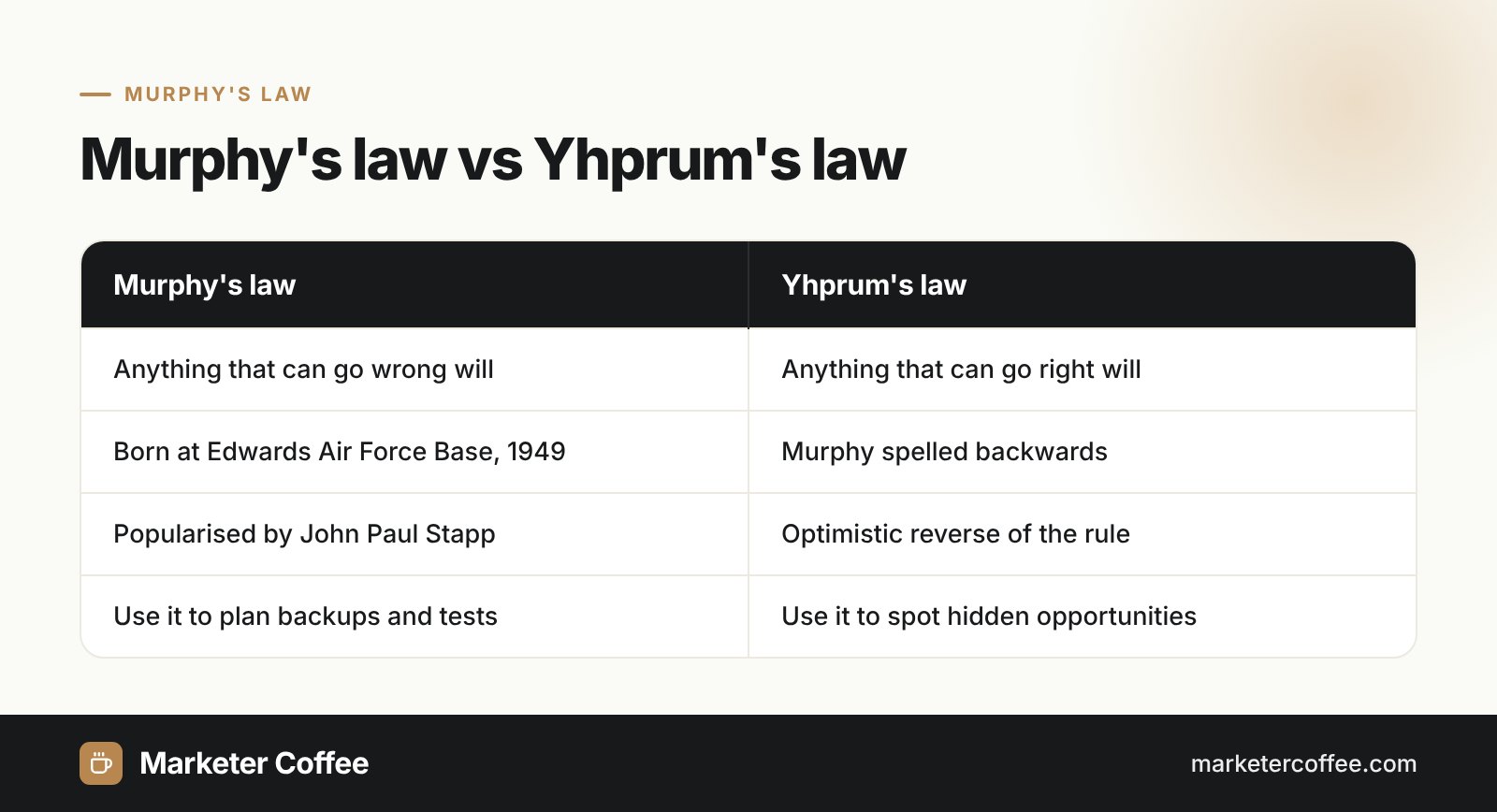
Murphy’s law comes from the US Air Force project MX981 at Edwards Air Force Base in 1949, which tested how much deceleration the human body can survive on a rocket sled. Murphy’s team supplied strain gauges for the test, and in one run all 4 sensors showed zero because they had been wired backwards. Murphy blamed the technician, saying in effect that if there is any way to do it wrong, he will.
The project commander, Lt. Col. John Paul Stapp, later told the press that the crew worked by the rule that anything that can go wrong will. Stapp did not invent the phrase, but he made it famous. Arthur Bloch’s 1977 book “Murphy’s Law, and Other Reasons Why Things Go Wrong” then brought it to a mass audience.
Murphy’s law and related laws
Murphy’s law has several cousins with slightly different meanings:
| Law | Meaning |
|---|---|
| Murphy’s law | Anything that can go wrong will go wrong. |
| Sod’s law (UK) | Things go wrong at the worst possible moment. |
| Finagle’s law | Anything that can go wrong will, and at the worst time. |
| Yhprum’s law | The optimistic reverse: anything that can go right will go right. |
Scientists explain the effect with confirmation bias: we remember the one time the toast landed butter side down and forget the times it did not. Physicist Robert Matthews still won a 1996 Ig Nobel Prize for showing why falling toast often lands butter side down.
Murphy’s law in marketing and SEO
For marketers, Murphy’s law is a practical rule for planning launches, migrations and campaigns. In my SEO projects, the riskiest moments are site migrations and international rollouts, where one wrong redirect rule can remove a whole language version from Google. Typical “Murphy” failures I check for:
- Robots.txt or noindex left over from the staging site.
- Temporary 302 redirects used where permanent ones were needed.
- IP-based redirects that hide country versions from Googlebot, which Google warns mostly crawls from US addresses.
- Broken tracking that makes every KPI look like a crash.
The same logic applies to product work: release an MVP, expect things to break, and plan the fix before launch day, not ASAP after it. My SEO strategy process includes a pre-launch checklist for exactly this reason.
Frequently asked questions about Murphy's law
What does Murphy's law say?
Murphy's law says that anything that can go wrong will go wrong. It is used as a reminder to plan for failures instead of assuming everything will work.
Who was Murphy in Murphy's law?
Murphy was Captain Edward A. Murphy Jr., a US Air Force engineer. He worked on rocket sled deceleration tests at Edwards Air Force Base in 1949, where the saying was born.
What is the opposite of Murphy's law?
The opposite is Yhprum's law, which is Murphy spelled backwards. It says that anything that can go right will go right.
Related terms
- The Real-Life Murphy and How 'Murphy's Law' Came to Be · Military.com
- Murphy's law · Wikipedia
- How Google crawls locale-adaptive pages · Google Search Central