How does a 302 redirect work?
A 302 redirect works by answering a request with status 302 and a Location header that points to the new URL. The browser then requests that new address on its own, so the user rarely notices the hop. According to MDN Web Docs, a browser that gets a 302 after a POST request may repeat it as GET, which is why developers use 307 when the method has to stay the same.
How does Google treat a 302 redirect?
Google follows a 302 but does not use it as a signal that the target URL should become canonical. Google Search Central explains that with temporary redirects the source page usually stays in search results, while the target can still be indexed if other canonical signals point to it. A 301 or 308 works the opposite way: the new URL replaces the old one in results.
Link equity is not the issue it used to be. In July 2016 Gary Illyes of Google stated that 30x redirects no longer lose PageRank, as reported by Search Engine Land. The real risk of a wrong 302 is that Google keeps showing the old URL and splits signals between two addresses, which wastes crawl budget.
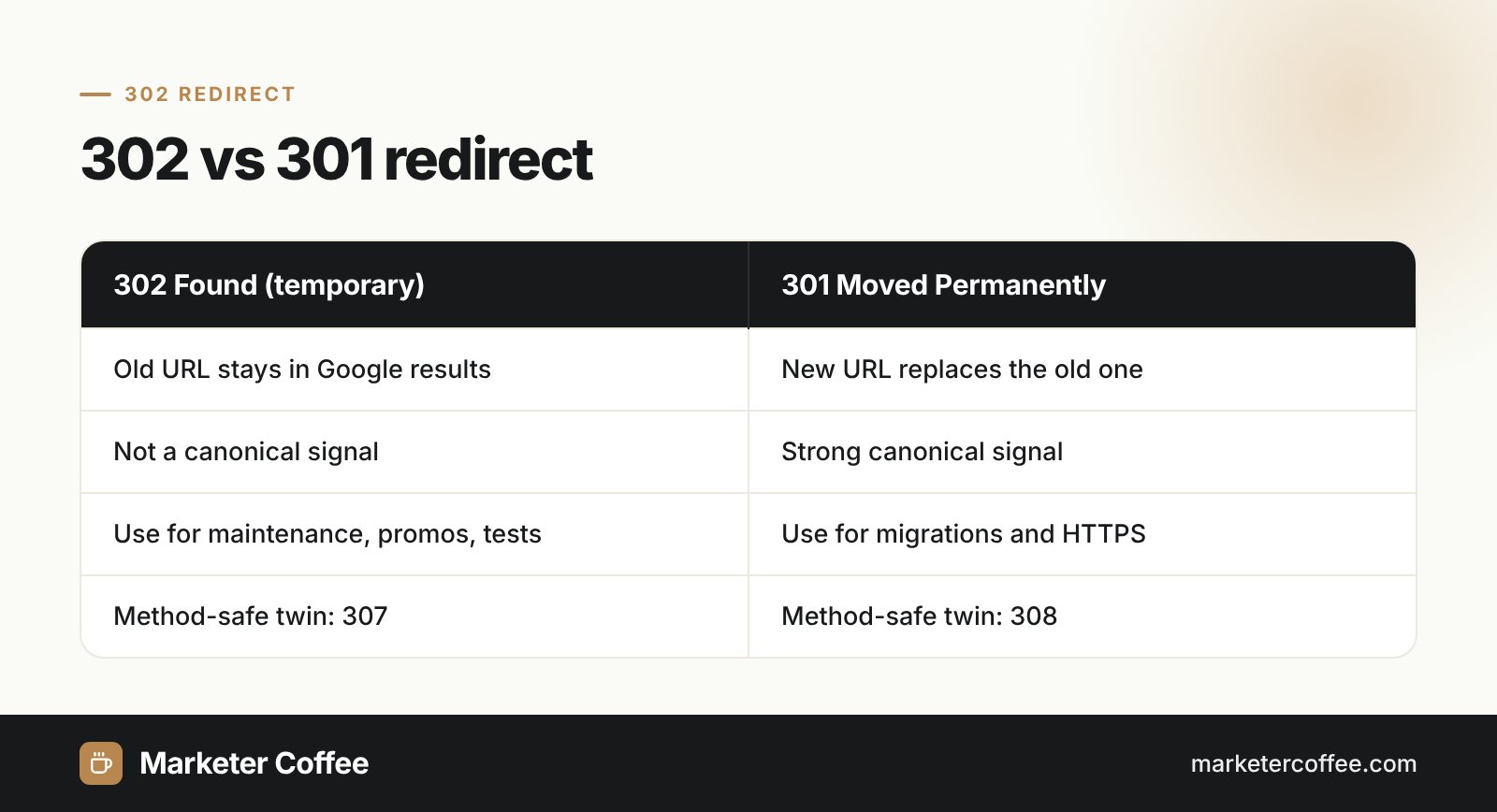
302 vs 301 redirect
The difference between 302 and 301 is the intent you communicate: temporary versus permanent. Choose the code by asking whether the old URL will come back.
| 302 Found | 301 Moved Permanently | |
|---|---|---|
| Meaning | temporary move | permanent move |
| URL shown in Google | usually the source URL | the target URL |
| Canonical signal | no | yes |
| Typical use | maintenance, short promotions, tests | domain migration, new URL structure, HTTPS |
| Method-safe twin | 307 Temporary Redirect | 308 Permanent Redirect |
When should you use a 302 redirect?
Use a 302 redirect only when the original URL will return within a defined time. Typical cases:
- Maintenance: a product or service is temporarily unavailable and you send visitors to an explanation page.
- Seasonal campaigns: a category page points to a limited promotion for a few weeks.
- A/B tests: a share of traffic goes to a test variant to measure conversion.
- Out-of-stock products: a product page points to a replacement until stock returns.
Google also lists a meta refresh with a delay above 0 seconds as a temporary redirect, but server-side redirects have the best chance of being read correctly.
How to set up a 302 redirect
A 302 redirect is set up on the server or in the application, before any page content is sent. The most common methods:
- Apache: a line in .htaccess such as “Redirect 302 /old-page /new-page”.
- Nginx: a rule “return 302 /new-page;” inside the location block.
- PHP: a header call with the Location header and the 302 code.
- WordPress and Shopify: redirect plugins or built-in URL redirect settings, where you pick the code from a list.
After deployment, check the response code with the browser developer tools or the URL Inspection tool in Google Search Console, because many plugins silently fall back to 302.
Common 302 mistakes in SEO
The most common 302 mistake is using it for a permanent change because a CMS or plugin sets it by default. In e-commerce SEO audits I regularly see:
- Migrations: HTTP to HTTPS or domain moves done with 302 instead of 301.
- Language redirects: automatic 302 jumps by IP that hide language versions from crawlers and conflict with hreflang.
- Chains: several hops in a row that slow down crawling.
- Forgotten temporary redirects: campaigns that ended months ago but still redirect.
Frequently asked questions about 302 redirect
What does a 302 redirect mean?
A 302 redirect means the requested page has moved to another URL temporarily. The server returns status 302 Found with the new address in the Location header, and the browser loads it automatically.
Is a 302 redirect bad for SEO?
No, a 302 is not bad when the move is truly temporary. It becomes a problem when used for a permanent change, because Google keeps the old URL in results and does not treat the target as canonical.
What is the difference between 302 and 307?
Both codes mean a temporary redirect and Google treats them the same way. The difference is technical: after a 307 the browser must keep the original HTTP method, while after a 302 a POST may be changed to GET.
How long can a 302 redirect stay in place?
A 302 should stay only as long as the temporary situation lasts. If the old URL will not return, replace the 302 with a 301 so Google moves its signals to the new address.
Related terms
- Redirects and Google Search · Google Search Central
- 302 Found · MDN Web Docs (Mozilla)
- RFC 9110: HTTP Semantics, 302 Found · IETF / RFC Editor
- Google: There is no PageRank dilution when using 301, 302, or 30x redirects anymore · Search Engine Land