What is a top-level domain?
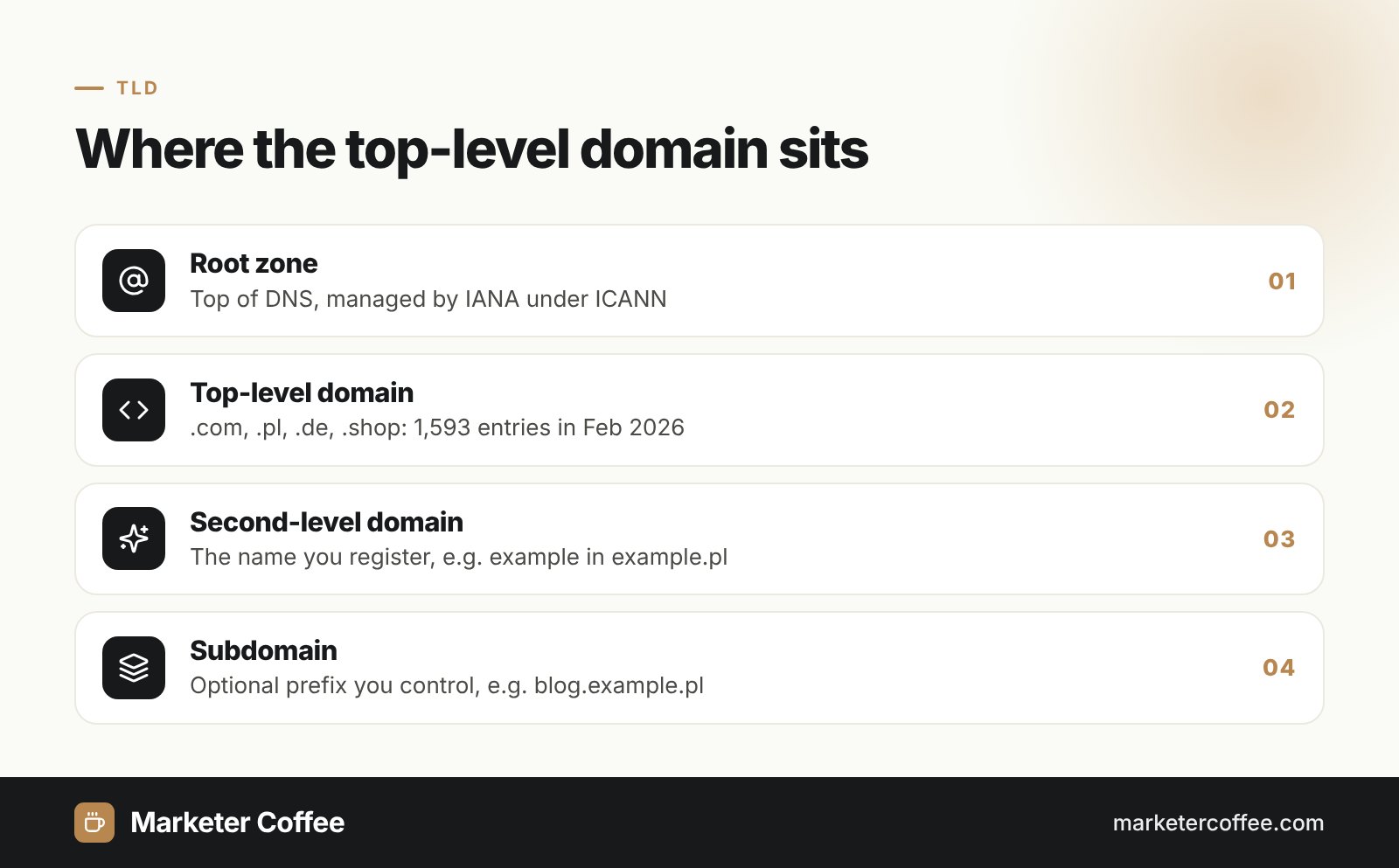
A top-level domain is the last segment of a domain name, after the final dot, such as .com in example.com or .pl in example.pl. It sits directly below the DNS root, the top of the hierarchy that turns names into IP addresses. IANA, a function operated under ICANN, maintains the official Root Zone Database that lists every TLD and the organisation that manages it.
How does the domain name hierarchy work?
The domain hierarchy works from right to left: root, top-level domain, second-level domain, then subdomains. In blog.example.co.uk, “uk” is the TLD, “co” a second-level zone run by the registry, “example” the registered name and “blog” a subdomain. Each level delegates authority to the next, so the .pl registry decides the rules for every name ending in .pl.
How many top-level domains are there?
As of February 2026 the IANA Root Zone Database lists 1,593 TLD entries, including 156 retired or unassigned strings and 11 test domains. Most came from ICANN’s 2012 New gTLD Program, which delegated more than a thousand new extensions. The next round opened on 30 April 2026 and closed on 12 August 2026 with 1,663 applications, so the list will grow again.
Types of top-level domains
Top-level domains fall into four practical groups, from the oldest generic extensions to brand-owned strings.
Generic TLDs (gTLDs)
Generic TLDs are extensions not tied to a country, such as .com, .org, .net and newer ones like .shop or .app.
Country-code TLDs (ccTLDs)
Country-code TLDs are two-letter extensions assigned to countries and territories, such as .pl, .de or .cz. Poland’s .pl is run by NASK and had 2,559,869 active names at the end of 2025, according to NASK’s annual report.
Brand and community TLDs
Brand TLDs are extensions owned by one company for its own use, such as .google, while community TLDs serve a defined group or city.
Special-use and test TLDs
Special-use TLDs are reserved strings like .test or .arpa that never serve public websites.
TLDs in SEO and international SEO
For SEO, the TLD matters mainly as a geotargeting signal: Google treats a ccTLD as a strong sign that a site targets that country. Google Search Central lists three valid structures for multi-country sites, and the choice affects how authority, backlinks and crawl budget are shared.
| Structure | Example | Main advantage | Main drawback |
|---|---|---|---|
| ccTLD | example.de | Clearest country signal | Each domain builds authority alone |
| Subdomain on gTLD | de.example.com | Easy to host separately | Weaker country signal in the URL |
| Subdirectory on gTLD | example.com/de/ | One domain shares all authority | One server location for all markets |
Google also treats some ccTLDs, for example .io, .me and .tv, as generic, so they carry no country signal. Whatever structure you choose, connect language versions with hreflang. In my international SEO projects, Polish e-commerce brands entering Germany or Czechia usually win faster with subfolders on one strong domain, while local ccTLDs pay off when trust in local brands decides conversion (see my guide to SEO in Germany).
How to choose a TLD for your website
Choose a TLD by matching it to your target market, brand plan and budget, not to any assumed ranking bonus.
- Pick the local ccTLD when you serve one country only, such as .pl for Poland.
- Pick .com or another gTLD when you plan to expand into several markets.
- Avoid cheap novelty extensions that users associate with spam.
- Check registry rules, since some ccTLDs require a local address or company.
Frequently asked questions about TLD
What is the difference between a TLD and a domain name?
A TLD is only the final extension, such as .com. The domain name is the full registered address, such as example.com, made of a second-level name plus the TLD.
Does the TLD affect SEO?
Yes, for geotargeting: Google treats country-code TLDs as a strong signal that a site targets one country. Generic TLDs like .com carry no country signal and do not rank better by themselves.
How many TLDs exist?
The IANA Root Zone Database listed 1,593 TLD entries in February 2026, including retired and test strings. ICANN's 2026 round received 1,663 new applications.
Is .io a country-code domain?
Technically yes, .io is the ccTLD of the British Indian Ocean Territory. Google treats it as a generic TLD, so it gives no country targeting.
Related terms
- Root Zone Database · IANA
- List of Internet top-level domains · Wikipedia
- New gTLD Program (2026) · ICANNWiki
- Raport roczny 2025: rynek nazw domeny .pl · NASK
- Managing multi-regional and multilingual sites · Google Search Central