



What is a subscription model?
A subscription model is a business model in which customers pay a recurring fee, usually monthly or yearly, for ongoing access to a product or service. Instead of selling once, the company sells continued value: software (SaaS), streaming, news, delivery perks, boxes of physical goods or professional services on retainer. Revenue becomes predictable, and the main goal shifts from closing sales to keeping customers.
How does the subscription model work?
The subscription model works on three levers: acquiring subscribers, keeping them and increasing what each one pays. Companies track these levers with recurring revenue metrics such as MRR, ARR and ARPU, plus churn, the share of customers who cancel in a period. When churn is lower than new sign-ups and upgrades, recurring revenue compounds month after month.
Key facts about the subscription economy
The subscription economy keeps growing faster than traditional revenue models, according to Zuora’s 2025 Subscription Economy Index, which tracks more than 600 subscription companies.
| Finding (Zuora SEI 2025) | Value |
|---|---|
| Revenue growth of index companies in 2024 | 16.5% |
| Growth advantage over the S&P 500 (two years) | 11% faster |
| US consumers who took a new subscription in 2024 | 68% |
| Cancellations linked to price increases | 47% |
Types of subscription models
Subscription businesses differ mainly in what the recurring fee buys.
Access subscriptions
Access models charge for unlimited or tiered use of a digital service, as Netflix, Spotify and SaaS tools such as Asana do.
Replenishment and curation boxes
Replenishment models deliver physical products on a schedule, for example razors, coffee or pet food.
Membership perks
Membership models sell benefits on top of regular purchases, such as free delivery in Amazon Prime or Allegro Smart.
Hybrid and usage-based models
Hybrid models combine a base subscription with usage fees or one-off add-ons. Zuora reports that companies using four or more revenue models grew average revenue per account 4.5% faster than single-model companies.
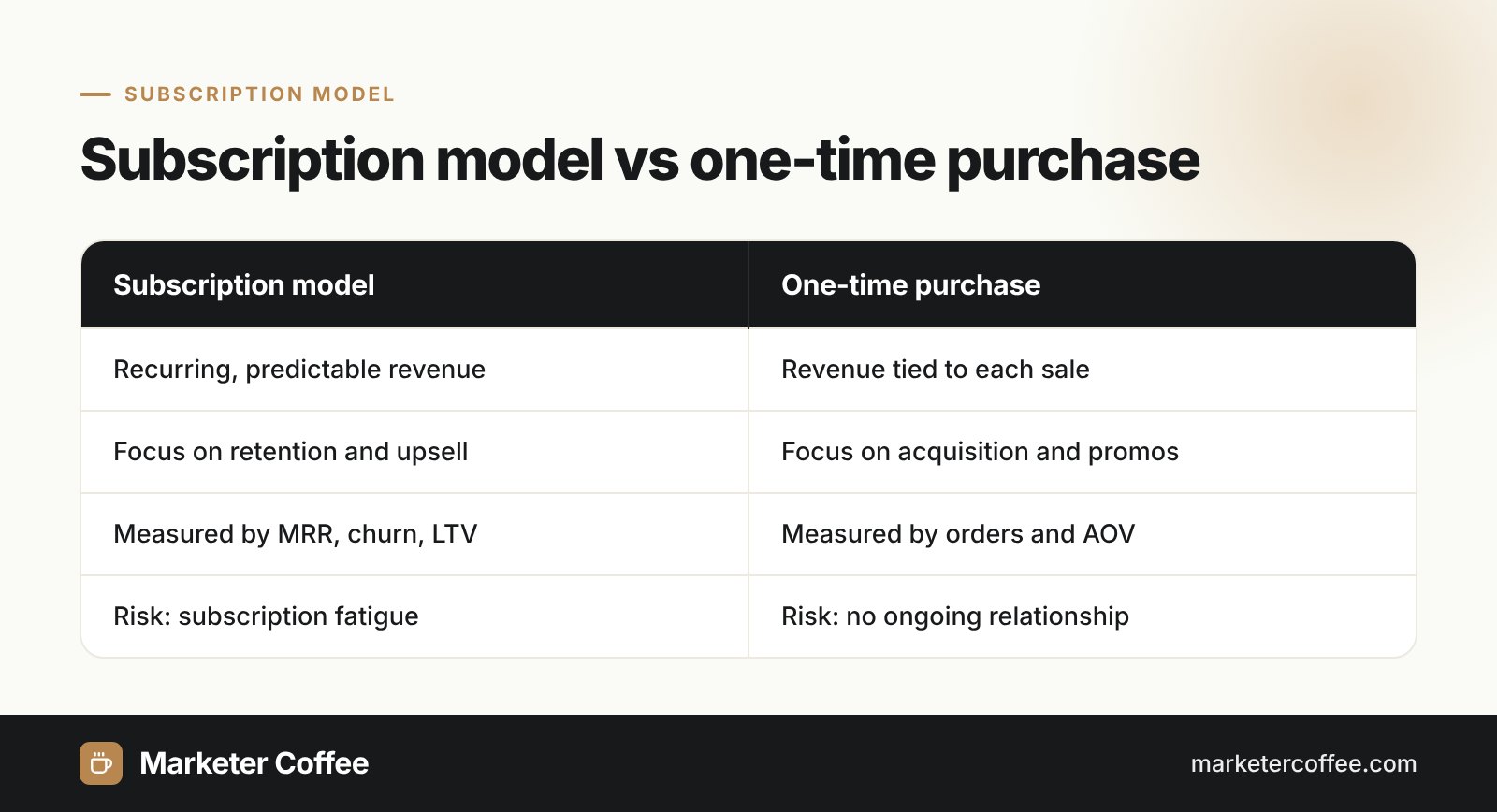
Subscription model vs one-time purchase
The two models differ most in cash flow timing and what marketing has to optimise.
| Aspect | Subscription model | One-time purchase |
|---|---|---|
| Revenue | Recurring and predictable | Lumpy, tied to campaigns |
| Key metric | Churn, MRR, lifetime value | Order volume, average order value |
| Marketing focus | Onboarding, retention, upsell | Acquisition and repeat promotions |
| Customer risk | Subscription fatigue, cancellations | No ongoing relationship |
The subscription model in SaaS marketing and SEO
For subscription companies, SEO is a compounding acquisition channel that matches compounding revenue. Content that ranks keeps bringing trial sign-ups without paying for each click, which lowers acquisition cost and improves payback. In SaaS SEO projects I focus on comparison pages, use-case pages and integrations, because these queries carry purchase intent and are often cited in AI answers when buyers ask ChatGPT for tool recommendations. Retention content, such as help centres and tutorials, also reduces churn.
Frequently asked questions about Subscription model
What are examples of the subscription model?
Netflix, Spotify, Microsoft 365, Amazon Prime and SaaS tools like Asana all use subscriptions. Physical examples include coffee or razor delivery boxes.
What are the advantages of a subscription model?
The main advantages are predictable recurring revenue, higher customer lifetime value and closer customer relationships. The trade-off is constant pressure to reduce churn.
Why do customers cancel subscriptions?
Price is the leading reason: Zuora's 2025 research links 47% of cancellations to price increases. Low perceived value and unused services are other common causes.
Which metrics measure a subscription business?
The core metrics are MRR, ARR, ARPU, churn rate and customer lifetime value. Together they show growth, retention and revenue per customer.
Related terms
- Zuora's 2025 Subscription Economy Index reveals growth resilience · Subscription Insider
- The 2025 Subscription Economy Index · Zuora
- 70% Polaków wydaje na subskrypcje do 100 zł · ITwiz
