



What is MRR?
MRR is the normalised monthly value of all active subscriptions. It turns a mix of plans, prices and billing periods into one number that founders, investors and marketers can compare month to month. MRR is the heartbeat of every subscription model, from software to streaming and boxes delivered monthly.
How to calculate MRR
MRR is calculated as the number of paying customers multiplied by the average monthly revenue per customer. The average per customer is the ARPU metric. An equivalent method adds up the monthly value of every plan:
| Plan | Customers | Price per month | MRR |
|---|---|---|---|
| Basic | 100 | $10 | $1,000 |
| Pro | 50 | $20 | $1,000 |
| Business | 30 | $30 | $900 |
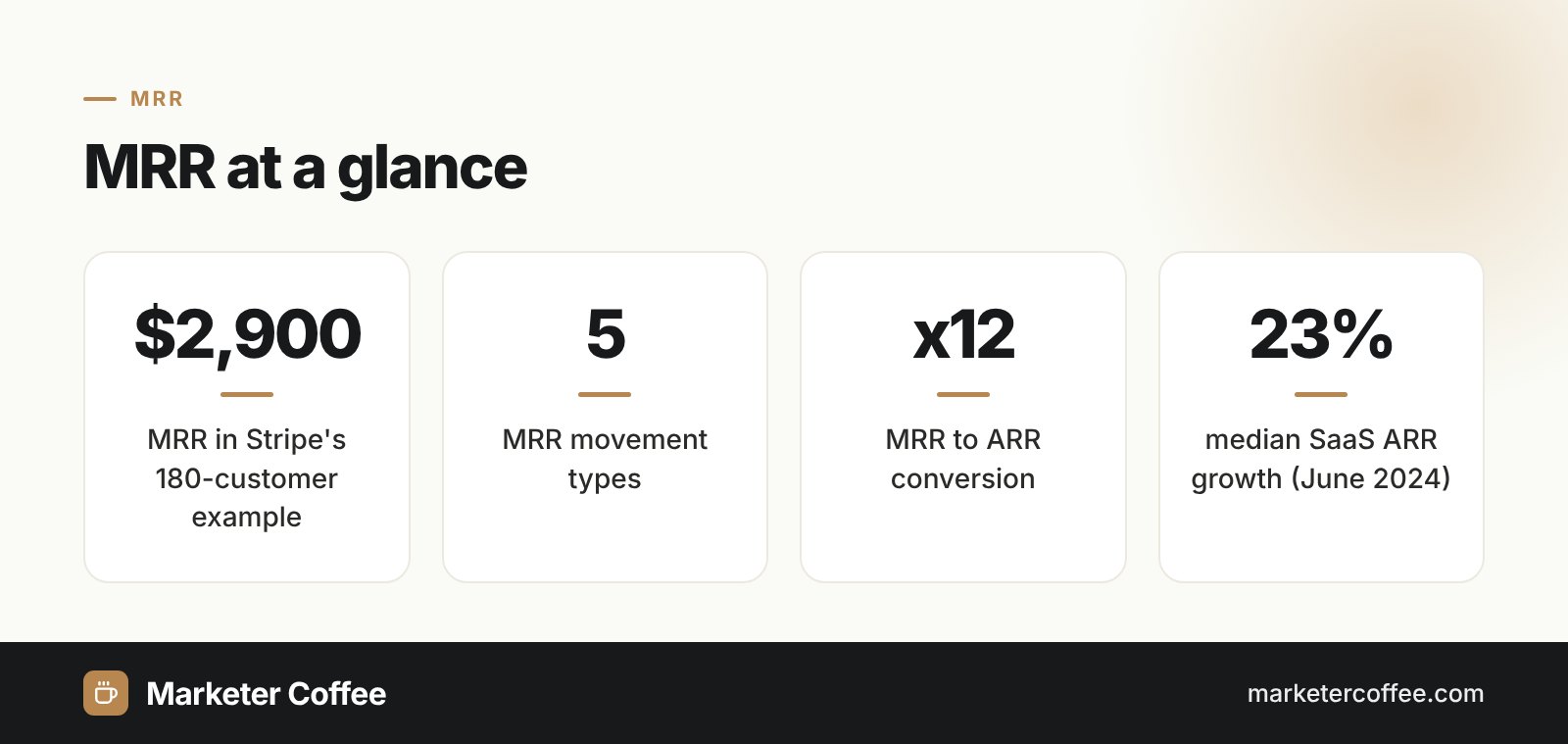
| Total | 180 | $2,900 |
What counts and what does not:
- Recurring subscription fees count.
- Discounts reduce MRR, according to ChartMogul’s calculation rules.
- One-time items such as setup fees, hardware or consulting do not count.
- Annual and quarterly plans are spread across months using the billing interval.
Types of MRR
MRR is split into 5 movement types that explain why the total changed, as Stripe describes them.
New MRR
New MRR is revenue from customers who subscribed for the first time this month.
Expansion MRR
Expansion MRR comes from existing customers who upgrade, add seats or buy add-ons.
Contraction MRR
Contraction MRR is revenue lost when customers downgrade or remove features.
Churned MRR
Churned MRR is revenue lost from customers who cancel.
Reactivation MRR
Reactivation MRR is revenue from former customers who come back.
Net new MRR = new MRR + expansion MRR + reactivation MRR minus contraction MRR minus churned MRR.
MRR vs ARR
MRR and ARR measure the same recurring revenue over different time frames.
| MRR | ARR | |
|---|---|---|
| Period | one month | one year |
| Best for | monthly plans, short-term analysis, early-stage startups | annual or multi-year contracts, planning, investor reporting |
| Typical relation | base value | MRR multiplied by 12 |
Growth expectations have cooled. ChartMogul data from June 2024 shows a median ARR growth rate of 23% for SaaS companies, unchanged since the end of 2023.
MRR in marketing and SEO
MRR is the KPI that connects marketing activity with company value. In SaaS SEO I report organic sign-ups and the new MRR they bring, not only traffic. A blog post that ranks for a high-intent query and brings 20 trials a month matters more than a viral article with 50,000 visits and no paying users.
Three practical links between MRR and search:
- Attribute new MRR to organic, paid and AI referral channels in your analytics and billing data.
- Prioritise pages for features that drive expansion MRR, such as integrations and higher plans.
- Track churn reasons and create help content that answers them, which also earns visibility in AI answers.
Frequently asked questions about MRR
What does MRR stand for?
MRR stands for monthly recurring revenue. It is the predictable subscription income a company earns each month from active customers, without one-time fees.
How do you calculate MRR?
Multiply the number of paying customers by the average monthly revenue per customer, or add up the monthly value of every active subscription. Annual plans are spread over 12 months, and one-time fees are excluded.
What is the difference between MRR and ARR?
MRR measures recurring revenue for one month, while ARR measures it for one year. ARR is typically MRR multiplied by 12 and is used more often for annual contracts and investor reporting.
What is net new MRR?
Net new MRR is the change in MRR during a month. It equals new MRR plus expansion and reactivation MRR, minus contraction and churned MRR.
Related terms
- What is monthly recurring revenue (MRR)? How to calculate, increase and use MRR · Stripe
- Chart: Monthly Recurring Revenue (MRR) · ChartMogul Help Center
- SaaS growth remains slow throughout H1 2024 · ChartMogul
