



What is a KPI?
A KPI is a metric that the business has chosen as decisive for reaching a goal. TechTarget defines KPIs as quantifiable measures that stakeholders use to track factors crucial to the organisation’s objectives, in areas from finance and sales to marketing and IT. Revenue, conversion rate or customer retention become KPIs only when someone owns them and compares them with a target.
KPI vs metric
The difference between a KPI and a metric is the link to a goal. Every KPI is a metric, but most metrics are not KPIs.
| Metric | KPI | |
|---|---|---|
| Purpose | describes an activity or process | shows progress toward a goal |
| Example | website sessions, items sold | organic leads per month vs target |
| Number tracked | dozens or hundreds | a few per team |
| Owner | often none | a named person or team |
Where do KPIs come from? The balanced scorecard
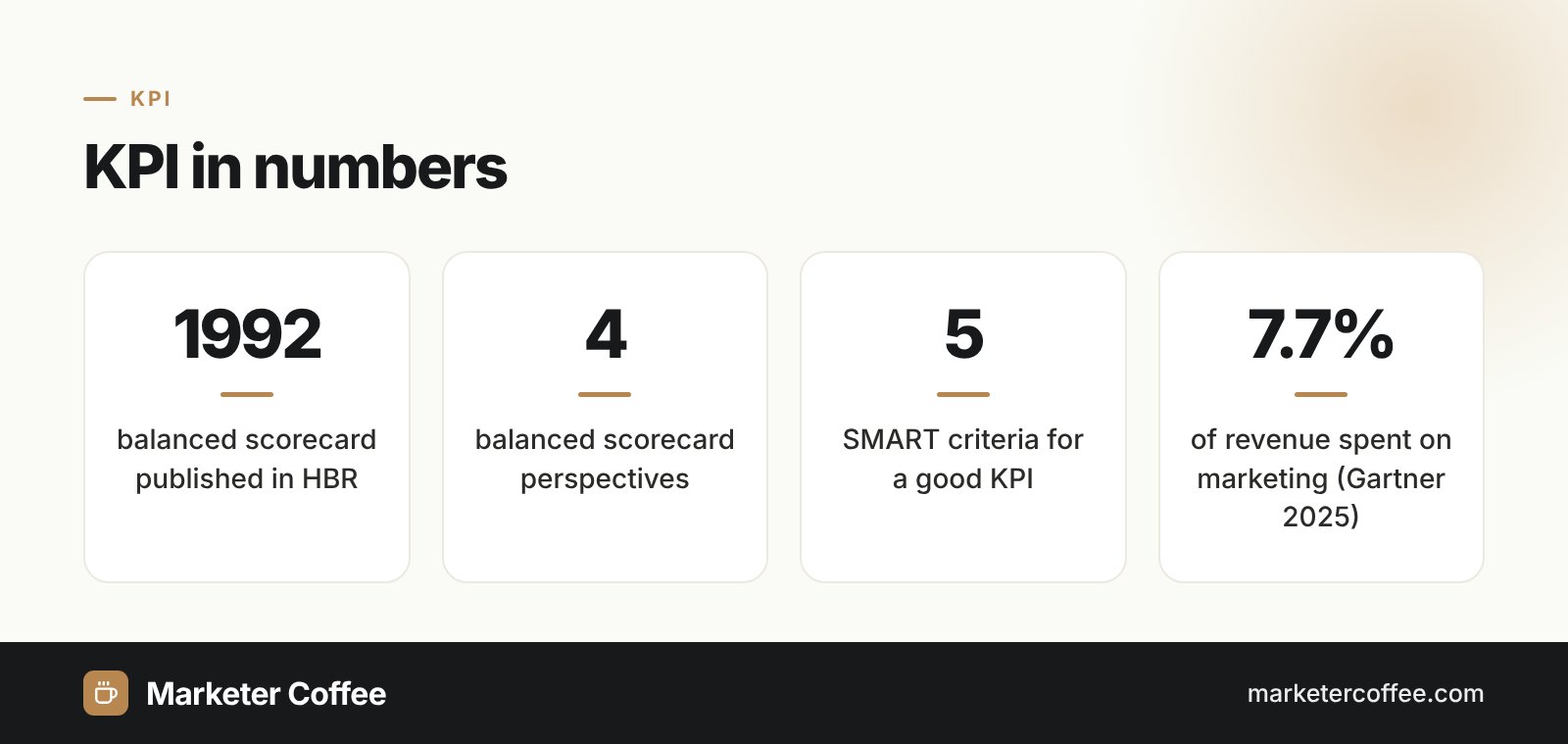
Modern KPI thinking comes largely from the balanced scorecard by Robert S. Kaplan and David P. Norton, published in Harvard Business Review in January 1992. They argued that financial results alone are not enough and proposed 4 perspectives:
- Financial: cash flow, sales growth, operating income.
- Customer: how customers see the company, such as quality and service.
- Internal business: the processes that matter most to customers.
- Innovation and learning: the ability to launch products and improve.
Types of KPIs
KPIs are usually grouped by timing and by level, and a good dashboard balances both.
Leading and lagging KPIs
Lagging KPIs report results that already happened, such as quarterly revenue. Leading KPIs predict future results, such as new sales bookings or demo requests, so you can react earlier.
Strategic and operational KPIs
Strategic KPIs track long-term company goals at the top level. Operational KPIs cover narrower, short-term processes, such as weekly ticket response time.
How to set a good KPI (SMART)
A good KPI follows the 5 SMART criteria:
- Specific: it names exactly what is measured.
- Measurable: it has a clear formula and data source.
- Achievable: the target is realistic.
- Relevant: it supports a business objective.
- Time-bound: it has a deadline.
KPI examples in marketing and SEO
Marketing KPIs matter more each year because budgets are under pressure. Gartner’s 2025 CMO Spend Survey of 402 marketing leaders found budgets flat at 7.7% of company revenue, and 59% of CMOs said they lack the budget to execute their strategy. Clear KPIs are how marketing proves its value. Typical examples:
- Organic leads or sales from SEO, tracked as key events in Google Analytics 4.
- Organic CTR for priority pages in Search Console.
- Cost per lead in paid campaigns.
- Share of brand mentions in AI answers for a fixed prompt list.
- MRR growth for SaaS companies.
In Google Analytics 4, actions you mark as important are now called key events. Google renamed them from conversions so that the term conversion means the same in Analytics and Google Ads. In my SEO measurement setups I tie each KPI to one key event, so reports and targets use identical numbers.
Frequently asked questions about KPI
What does KPI stand for?
KPI stands for key performance indicator. It is a measurable value that shows progress toward a specific business goal, such as monthly revenue or lead volume.
What is the difference between a KPI and a metric?
A KPI is a metric linked to a goal, a target and an owner. Metrics describe activities in general, while KPIs are the few numbers that decide whether a strategy is working.
How many KPIs should a team have?
A team should usually track 3 to 5 KPIs. More than that dilutes focus, while the remaining numbers can stay as supporting metrics on a dashboard.
What are good KPIs for SEO?
Good SEO KPIs measure business results: organic leads, organic revenue and conversion rate from organic traffic. Supporting metrics include impressions, CTR, rankings and, increasingly, brand mentions in AI answers.
Related terms
- What are key performance indicators (KPIs)? · TechTarget
- Kaplan and Norton: The balanced scorecard, measures that drive performance (summary) · Management And Accounting Web
- Gartner 2025 CMO Spend Survey reveals marketing budgets have flatlined at 7.7% of overall company revenue · Gartner
- [GA4] Key events and conversions · Google Analytics Help
