What is conversion rate optimization?
Conversion rate optimization is the practice of getting more value from the traffic you already have by removing friction and strengthening motivation. A conversion is any action you define as valuable: an order, a demo request, a newsletter sign-up or a free trial. The conversion rate is conversions divided by sessions or users, multiplied by 100. CRO raises that rate through research and testing, not guesswork, and it is usually tracked as a core KPI next to traffic and revenue.
How does the CRO process work?
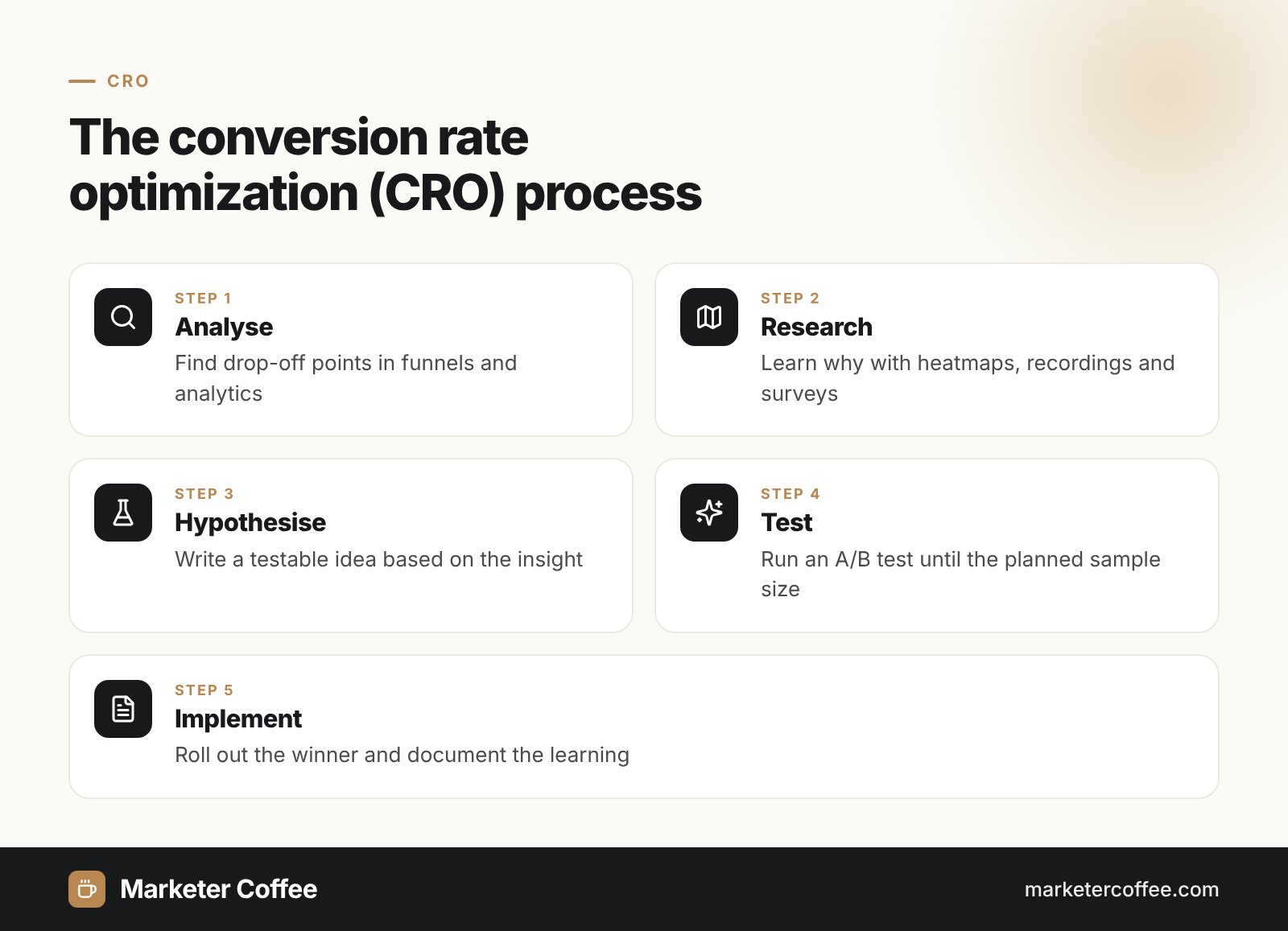
The CRO process works as a repeating loop of research, hypothesis, test and implementation:
- Analyse quantitative data: funnels, drop-off points and device or channel differences in analytics.
- Collect qualitative data: session recordings, a heatmap, on-site surveys and user tests.
- Write a hypothesis: “Changing X for audience Y will raise metric Z, because of insight W.”
- Prioritise ideas by expected impact, confidence and effort.
- Run an A/B or multivariate test until it reaches the planned sample size.
- Implement the winner, document the learning and start the next cycle.
Key elements of CRO
CRO covers 3 areas: the data you collect, the changes you test and the tools you use.
Research methods
Research methods show where users drop off and why. Analytics answers “where”, while recordings, heatmaps and surveys answer “why”. Baymard’s checkout research is a good example: 40% of abandoning shoppers blame extra costs such as shipping and fees, and 18% leave because the shop forces them to create an account.
What CRO teams test
CRO teams test elements that change motivation, clarity or friction: headlines and value propositions, calls to action, form length, pricing presentation, trust signals, checkout steps and page speed.
CRO tools
CRO tools handle analytics, behaviour tracking and experimentation. Google Optimize, once the default free A/B testing tool, was shut down on 30 September 2023, so teams moved to platforms such as VWO, Optimizely, AB Tasty or tests built into analytics and feature-flag tools.
CRO benchmarks
| Metric | Value | Source |
|---|---|---|
| Median landing page conversion rate | 6.6% | Unbounce, 41,000+ pages (2024) |
| Average cart abandonment | 70.22% | Baymard Institute, 50 studies |
| Abandonment due to extra costs | 40% | Baymard Institute |
| Abandonment due to complex checkout | 17% | Baymard Institute |
Benchmarks vary widely by industry, traffic source and offer, so compare a page mainly with its own history.
CRO and SEO
CRO and SEO work best together because SEO brings the visitors and CRO turns them into customers. Doubling the conversion rate has the same revenue effect as doubling organic traffic, and it is often cheaper. The overlap has a name, search experience optimization (SXO): matching the page to the search intent, answering the question above the fold and making the next step obvious. In AI search the link is even tighter. Visitors who arrive from an AI answer have usually done their research already, so the landing page must confirm what the assistant said and make buying easy. I measure organic conversions per landing page as part of measuring SEO results, and paid traffic from Google Ads follows the same logic.
CRO vs SEO vs paid acquisition
| Approach | Goal | Main lever |
|---|---|---|
| SEO | More qualified organic visitors | Content, technical health, links |
| Paid acquisition | More visitors on demand | Budget, targeting, bids |
| CRO | More conversions from the same visitors | Research, UX changes, testing |
Frequently asked questions about CRO
What does CRO stand for in marketing?
CRO stands for conversion rate optimization. It is the process of increasing the share of visitors who complete a desired action, such as buying or filling in a form.
How do you calculate conversion rate?
Divide the number of conversions by the number of sessions or users and multiply by 100. For example, 30 orders from 1,000 sessions gives a 3% conversion rate.
What is a good conversion rate?
It depends on the industry, offer and traffic source. Unbounce's 2024 benchmark found a median landing page conversion rate of 6.6%, but your own trend over time matters more than an average.
What replaced Google Optimize for A/B testing?
Google Optimize was shut down on 30 September 2023 without a direct successor. Teams now use third-party tools such as VWO, Optimizely or AB Tasty connected to Google Analytics 4.
Related terms
- Conversion Benchmark Report · Unbounce
- Cart Abandonment Rate Statistics · Baymard Institute
- [Sunset September 2023] Google Optimize · Google