



What are the characteristics of FMCG?
FMCG products share low prices, frequent purchases and fast consumption. Seen from the shopper’s side, the decision takes seconds and involves little research. Seen from the producer’s side, profit comes from selling huge volumes with thin margins through the widest possible distribution.
- Price: low unit price, often an impulse purchase.
- Frequency: bought weekly or even daily.
- Shelf life: short, especially for dairy, bread and fresh products.
- Distribution: extensive, from hypermarkets to convenience stores and online grocery.
- Turnover: high inventory rotation and constant restocking.
Examples of FMCG categories
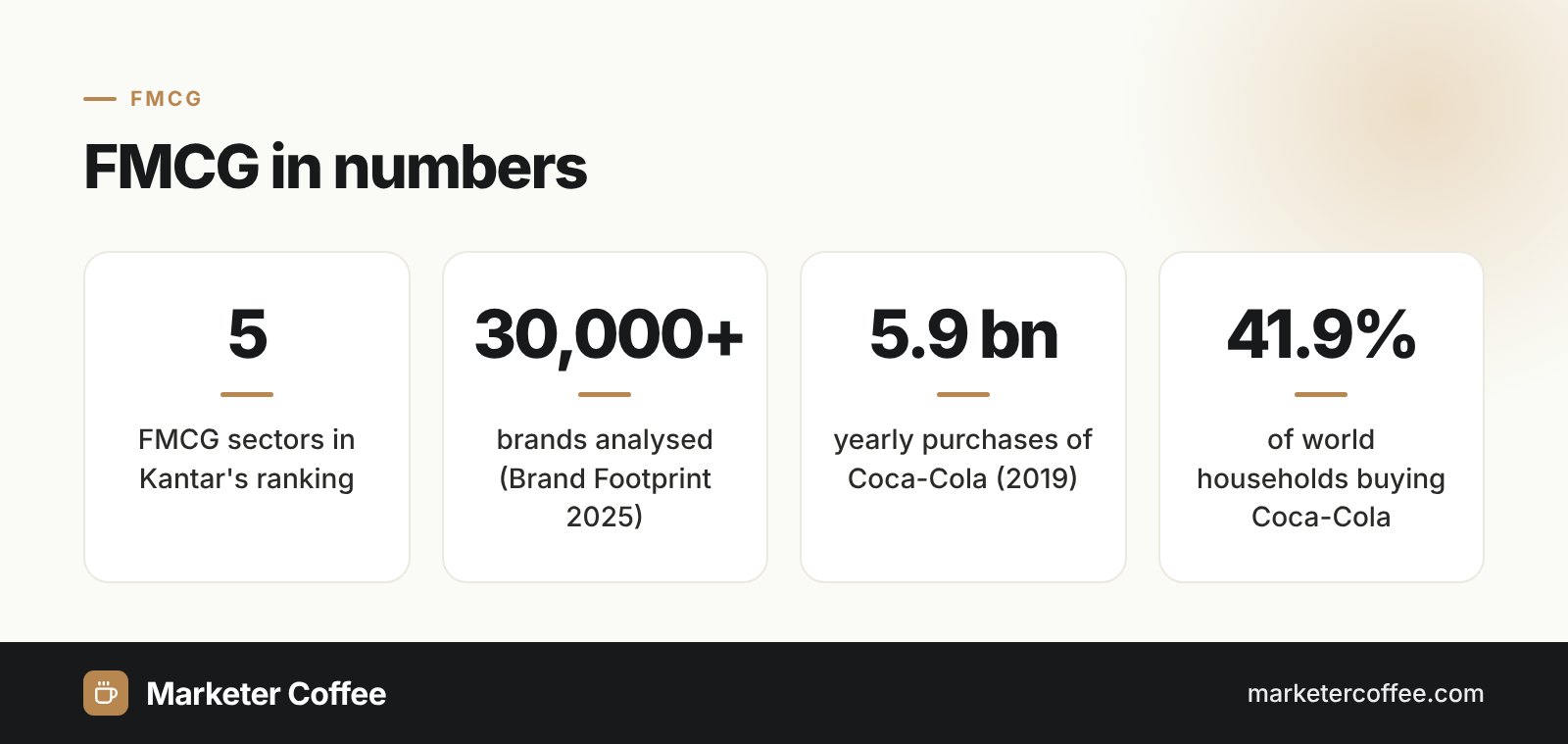
Kantar’s Brand Footprint ranking groups FMCG into five sectors, which cover almost every product in a typical shopping basket.
| Sector | Examples |
|---|---|
| Beverages | Soft drinks, water, coffee, juices |
| Food | Snacks, sauces, ready meals, sweets |
| Dairy | Milk, yoghurts, cheese |
| Health and beauty | Toothpaste, shampoo, deodorants, OTC drugs |
| Homecare | Detergents, dishwashing liquids, cleaners |
Largest FMCG brands and companies
The FMCG market is dominated by global groups such as The Coca-Cola Company, Colgate-Palmolive, Unilever, Nestle, PepsiCo and Procter and Gamble. Kantar measures brand strength with Consumer Reach Points (CRP), a combination of population, household penetration and purchase frequency. The 2025 edition analyses more than 30,000 brands in 56 countries.
In the 2019 global ranking the top five were Coca-Cola, Colgate, Maggi, Lifebuoy and Lay’s. Coca-Cola reached 41.9% of households worldwide, which bought it on average 12.3 times a year. Local champions matter too: in Poland the 2024 ranking was led by dairy brands Mlekovita, Piatnica and Mlekpol, ahead of global names.
FMCG vs CPG and durable goods
FMCG is a subset of consumer packaged goods (CPG), although the two terms are often used interchangeably. CPG also covers slower-selling packaged items such as clothing or some beauty products. Durable goods (fridges, cars, furniture) sit at the opposite end.
| Aspect | FMCG | Durable goods |
|---|---|---|
| Purchase frequency | Daily or weekly | Every few years |
| Price | Low | High |
| Decision time | Seconds, often impulse | Weeks of research |
| Margin | Low, volume driven | Higher per unit |
FMCG marketing, SEO and AI search
FMCG marketing focuses on reach, mental availability and presence at the point of sale, because shoppers rarely compare options in depth. Traditionally this meant TV, outdoor and in-store promotion. Today TikTok, influencers and buzz marketing do much of that job, and a viral video can empty shelves in days.
Search still matters for FMCG brands, just differently than for B2B. In my e-commerce SEO projects I see three areas where FMCG brands win or lose visibility:
- Retailer search: product titles and images on grocery platforms and marketplaces drive most online sales.
- Recipe and usage content: queries like “what to cook with” or “how to remove a stain” reach buyers before they choose a brand.
- AI answers: assistants such as ChatGPT recommend products by name, so consistent product data across retailers and the brand site matters.
Track brand KPIs such as penetration and purchase frequency alongside organic visibility, since sales growth in FMCG comes mainly from reaching more households.
Frequently asked questions about FMCG
What does FMCG stand for?
FMCG stands for fast-moving consumer goods. These are low-priced products bought often and used up quickly, such as food, drinks and toiletries.
What is the difference between FMCG and CPG?
FMCG is a subset of CPG (consumer packaged goods). CPG also includes slower-selling packaged products such as clothing, while FMCG covers only fast-selling everyday items.
What are examples of FMCG companies?
Typical FMCG companies are The Coca-Cola Company, Unilever, Nestle, PepsiCo, Colgate-Palmolive and Procter and Gamble. Strong local players exist in every country, such as Mlekovita in Poland.
What is the most chosen FMCG brand in the world?
Coca-Cola is the most chosen FMCG brand in Kantar's global Brand Footprint ranking. In the 2019 edition it was bought about 5.9 billion times in a year.
Related terms
- Fast-moving consumer goods · Wikipedia
- Brand Footprint report, the new FMCG ranking, is out · Kantar
- Brand Footprint 2025: What is Brand Footprint · Kantar Worldpanel
- 10 Most Popular Food Brands In Poland · ESM Magazine (Kantar Brand Footprint data)
