



What is a minimum viable product?
A minimum viable product is an experiment disguised as a product: it has just enough features for early users to get real value and give real feedback. “Minimum” means you cut everything that does not test the core assumption. “Viable” means the product still solves the problem well enough that people use it, pay for it or sign up for it. The goal is learning, not a smaller launch.
Where does the MVP concept come from?
The MVP concept comes from product development and the Lean Startup movement.
| Year | Milestone |
|---|---|
| 2001 | Frank Robinson, co-founder of SyncDev, coins “minimum viable product” as the product with the best return relative to risk |
| 2011 | Eric Ries publishes The Lean Startup (Crown Business) and links the MVP to validated learning |
In the Lean Startup model, the MVP feeds the Build, Measure, Learn loop: build the smallest thing that tests a hypothesis, measure how customers respond and decide whether to persevere or pivot.
Types of MVP
MVPs come in several types that differ in how much you actually build.
Landing page MVP
A landing page MVP describes the product and measures sign-ups or pre-orders before anything exists. It tests demand and messaging, and it doubles as an early SEO and paid search test.
Explainer video MVP
An explainer video MVP shows how the product would work. Dropbox is the classic case: according to Productboard, Drew Houston’s three-minute demo video brought about 75,000 people to the beta waitlist overnight.
Concierge and Wizard of Oz MVP
These MVPs deliver the service manually behind a simple interface. The customer sees a product, while the team does the work by hand to learn what really matters before automating it.
Single-feature MVP
A single-feature MVP ships one working function that solves the core problem, typical for SaaS products that later grow into platforms.
How to build an MVP
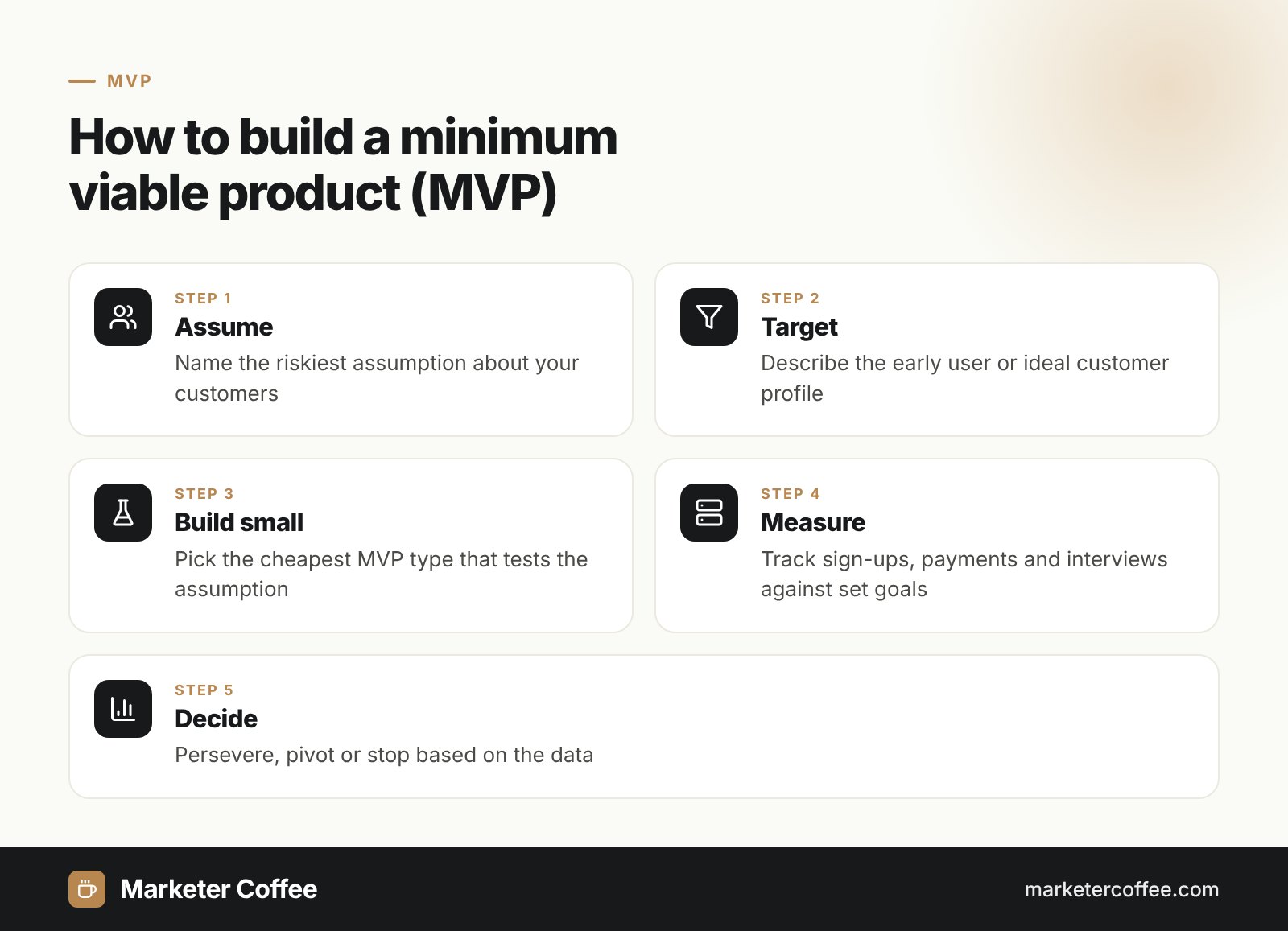
Building an MVP follows a short sequence from assumption to decision:
- Define the riskiest assumption, usually “people want this enough to pay”.
- Describe the target user, ideally as an ideal customer profile (ICP).
- Choose the cheapest MVP type that can test that assumption.
- Set success metrics before launch, such as sign-up rate or paid conversion.
- Launch to a small audience, collect data and interviews, then persevere, pivot or stop.
MVP in marketing and SEO
An MVP is also a marketing test of message, channel and audience. A landing page with a clear value proposition shows which words resonate, and search data shows whether anyone is already looking for the solution. Before writing code, I check search demand for the problem in each target market: if nobody searches for it, the product will need paid or outbound channels, which changes the business case. For SaaS founders this is the first step of a B2B SaaS SEO strategy, and my SaaS SEO consultancy often starts at the MVP stage with keyword and competitor mapping. Once the MVP gains traction, metrics such as MRR and ARR show whether growth is real.
MVP vs prototype vs MLP
| Concept | Purpose | Who uses it |
|---|---|---|
| Prototype | Test design and feasibility | Internal team, test users |
| MVP | Test demand and the business assumption | Real early customers |
| Minimum lovable product (MLP) | Win users with a polished core experience | Early adopters in crowded markets |
Frequently asked questions about MVP
Who invented the term minimum viable product?
Frank Robinson, co-founder of SyncDev, introduced the term in 2001. Eric Ries popularised it in The Lean Startup, published in 2011.
What is an example of an MVP?
Dropbox is the best-known example. Drew Houston published a short video showing how the product would work, and about 75,000 people joined the beta waitlist overnight, proving demand before the full product was built.
What is the difference between an MVP and a prototype?
A prototype tests whether something can be built and how it should look, usually with internal testers. An MVP goes to real customers to test whether they want the product enough to use or pay for it.
Related terms
- Minimum Viable Product (MVP) · Productboard
- The Lean Startup · Wikipedia
