



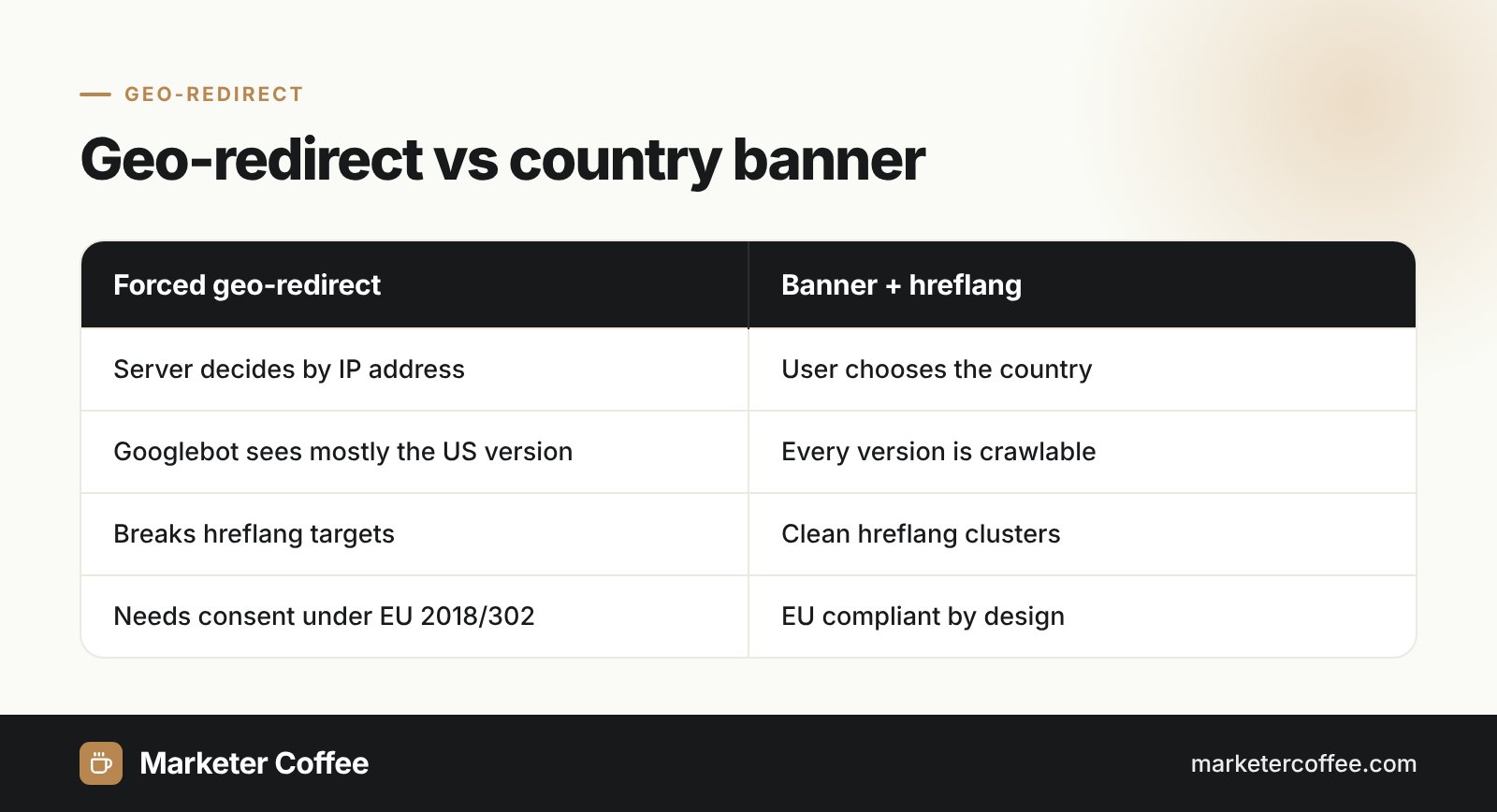
How does a geo-redirect work?
A geo-redirect works by looking up the visitor’s IP address in a geolocation database and returning a redirect to the matching market URL. A user in Prague who opens example.com receives a 302 to example.com/cz/, while a user in Berlin lands on example.com/de/. Some setups also read the browser’s Accept-Language header, which is a language signal rather than a location signal.
A typical server response looks like this:
- Request: GET / from a Czech IP address
- Response: HTTP/1.1 302 Found, Location: https://example.com/cz/, Vary: Accept-Language
The logic often lives in the CDN (Cloudflare, Akamai, Fastly) because the edge server already knows the visitor’s country.
Why geo-redirects are risky for SEO
Geo-redirects are risky because Googlebot sees only the version served to its own IP address. Google’s documentation on locale-adaptive pages says the crawler’s default IPs appear to be in the US and that it sends requests without an Accept-Language header. John Mueller summed it up in Google’s Ask Googlebot series in October 2022: Googlebot usually crawls and indexes a site from a single location, so only one location-based version gets indexed. The 3 main consequences are below.
Hidden market versions
If every US request is forced to /en-us/, Googlebot may never reach /de/ or /pl/, so those pages drop out of the index or never enter it.
Broken hreflang clusters
A hreflang annotation that points to a URL which redirects elsewhere is invalid, because the target is not a canonical, indexable page.
Wrong canonicals
Temporary 302 and 307 redirects are not a canonical signal for Google, but a redirected homepage confuses which URL represents the brand. Google’s guidance on x-default exists exactly for auto-redirecting and selector homepages.
What Google recommends instead
Google recommends separate URLs per locale, explicit hreflang annotations and visible links between versions. Its multi-regional guide says not to use IP analysis to adapt content and not to redirect based on a guess about the user’s language. In practice this gives 4 safe patterns:
- Serve every URL with 200 to every visitor and crawler, whatever the IP.
- Show a dismissible banner (“Looks like you are in Germany, go to the German shop?”) instead of redirecting.
- Redirect only the root URL with a 302 and mark it as x-default, never deep pages.
- Remember the user’s manual choice in a cookie and respect it on the next visit.
Geo-redirects and EU law
In the European Union, geo-redirects are also a legal issue under the Geo-blocking Regulation (EU) 2018/302, applicable since 3 December 2018. Article 3 forbids redirecting a customer to a country version tailored to their nationality or residence without their explicit consent, and even after consent the originally requested version must stay easily accessible. For e-commerce shops selling across the EU this means a banner or a country selector, not a forced redirect.
Geo-redirect vs geotargeting
A geo-redirect decides for the user, while geotargeting tells search engines which market a URL serves and lets Google send the right users there:
| Aspect | Geo-redirect | Geotargeting (hreflang, ccTLD) |
|---|---|---|
| Who decides | Server, by IP | Search engine and user |
| Crawlability | Often one version only | All versions |
| EU compliance | Needs explicit consent | No issue |
| Best for | Root URL with x-default | Every market page |
In my projects for Polish brands entering Germany, the Czech Republic and Romania, removing forced IP redirects is often the quickest win: the German and Czech versions start appearing in their local Google within weeks, because Googlebot can finally crawl them. The same applies to AI search, since AI Overviews and Bing Copilot can only cite pages their crawlers can reach.
Planning a multi-country rollout? See my international SEO consultancy or the guide to SEO in Germany.
Frequently asked questions about Geo-redirect
Are geo-redirects bad for SEO?
Forced geo-redirects are bad for SEO when they stop Googlebot from reaching other market versions. Googlebot mostly crawls from US IPs, so it may only index the version served to the US.
Should a geo-redirect be 301 or 302?
Use a 302 or 307 when you redirect by location, because the target depends on the visitor and is not a permanent move. A 301 tells Google that the redirect target should become canonical.
Are IP-based redirects legal in the EU?
IP-based redirects to another country version need the customer's explicit consent under Regulation (EU) 2018/302. The originally requested version must also remain easily accessible.
What is the best alternative to a geo-redirect?
The best alternative is a country suggestion banner combined with hreflang and visible language links. Users keep control and Googlebot can crawl every version.
Related terms
- Managing multi-regional and multilingual sites · Google Search Central
- How Google crawls locale-adaptive pages · Google Search Central
- Tell Google about localized versions of your page · Google Search Central
- Redirects and Google Search · Google Search Central
- Regulation (EU) 2018/302 on unjustified geo-blocking · EUR-Lex
- Google On The Main Thing To Know About Geo IP Redirects · Search Engine Journal
