



How does international SEO work?
International SEO works by giving every market its own crawlable URL and telling search engines which audience each URL serves. Google Search Central recommends separate URLs per language version instead of switching content with cookies or browser settings, because Googlebot usually crawls from the United States and does not send an Accept-Language header. Google detects the language of a page from its visible content, not from the lang attribute or the URL, so each page has to be fully written in one language, including navigation.
Two situations need different treatment:
- Multilingual sites: content in several languages, for example a Swiss site in German, French and Italian (see multilingual SEO).
- Multi-regional sites: content for several countries, for example separate shops for Germany and Austria with different prices and delivery terms.
International SEO URL structures
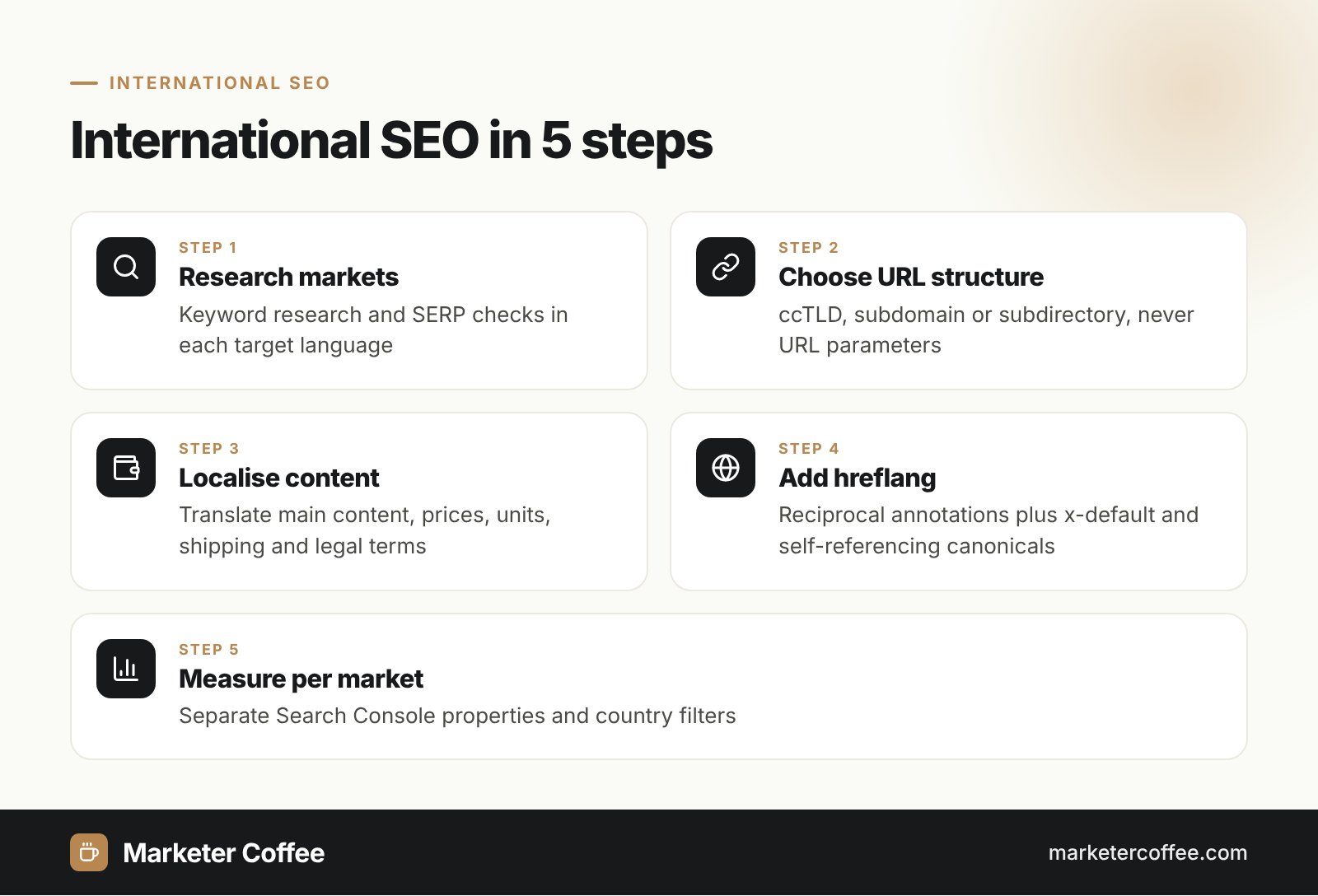
The URL structure is the first decision in every international SEO project, because it decides how markets are separated and how strong the country signal is. Google lists 4 options:
| Structure | Example | Pros | Cons |
|---|---|---|---|
| ccTLD | example.de | Strongest country signal, server location irrelevant | Costly, one country per domain, local registration rules |
| Subdomain on a gTLD | de.example.com | Easy setup, separate hosting possible | Users cannot tell if “de” means language or country |
| Subdirectory on a gTLD | example.com/de/ | Easy setup, one host, shared authority | Harder to separate markets on one server |
| URL parameters | example.com?loc=de | None | Not recommended by Google |
Google treats vanity ccTLDs such as .tv and .me as generic domains. It also ignores geo meta tags such as geo.position, so they add no targeting value.
Key elements of international SEO
A working setup has 4 technical and content layers that must agree with each other: hreflang, canonicals, localised content and local signals.
Hreflang and x-default
Hreflang maps every language or country version to the others, for example hreflang=”de-AT” href=”https://example.com/de-at/”. Every version must list itself and all alternates, and links must be reciprocal, or Google ignores them. Add an x-default URL for users who match no version.
Canonical tags
Each language version carries a self-referencing canonical tag. Pointing the German page’s canonical at the English page tells Google to drop the German URL, which breaks the hreflang set.
Localised content
Google treats translated pages as duplicates only when the main content stays untranslated. Translating just the menu and footer is not enough. Real localisation also covers currency, units, shipping, legal terms and local search phrases.
Local signals
Google names local addresses and phone numbers, local currency, links from local sites and Business Profile data as additional geotargeting signals. Server IP location helps, but a CDN often hides it.
International SEO beyond Google
International SEO also means optimising for the search engines each market actually uses. Bing reads a content-language meta tag, a content-language HTTP header, ccTLDs and reverse IP lookup, in that order of priority, rather than relying on hreflang. In the Czech Republic, Statcounter data for September 2026 shows Google at 78.71% and the local engine Seznam at 15.05%, so a Czech expansion without Seznam visibility leaves about 15% of searches untouched. In my projects for Polish brands entering Germany and Romania, keyword research per market matters more than translation: German buyers often search with different product names than a literal translation of the Polish term suggests.
How to measure international SEO in Search Console
Measure each market with a separate Search Console property per subdirectory, subdomain or ccTLD, plus country filters in the Performance report. Google deprecated the International Targeting report and its country-targeting setting in 2022, and its help page states that hreflang remains supported. Track per market: impressions, clicks, average position for local keywords, and the share of traffic landing on the wrong language version.
Planning an expansion to Germany or the Czech Republic? See my international SEO consultancy or the guide to SEO in Germany.
Frequently asked questions about International SEO
What is the best URL structure for international SEO?
Subdirectories on one generic domain (example.com/de/) are the easiest to maintain and keep authority in one place. A ccTLD gives the strongest country signal but costs more and needs links built separately for each domain.
Is translated content duplicate content?
Translated pages are not duplicates for Google when the main content is translated. Google treats them as duplicates only when the main content stays in the original language and only the template is translated.
Can I still set a target country in Google Search Console?
No. Google deprecated the International Targeting report and country-targeting setting in 2022. Use ccTLDs, hreflang and local signals instead.
Should I redirect users by IP address?
Google advises against automatic redirects based on IP or language, because Googlebot crawls mostly from the US and may never see other versions. Show a language suggestion banner and let users choose.
Related terms
- Managing multi-regional and multilingual sites · Google Search Central
- Tell Google about localized versions of your page · Google Search Central
- The International Targeting report is deprecated · Google Search Console Help
- How To Tell Bing Your Website's Country and Language · Bing Webmaster Blog
- Survey of 8,709 consumers in 29 countries finds that 76% prefer purchasing products with information in their own language · CSA Research
- Search engine market share Czech Republic · Statcounter Global Stats
