



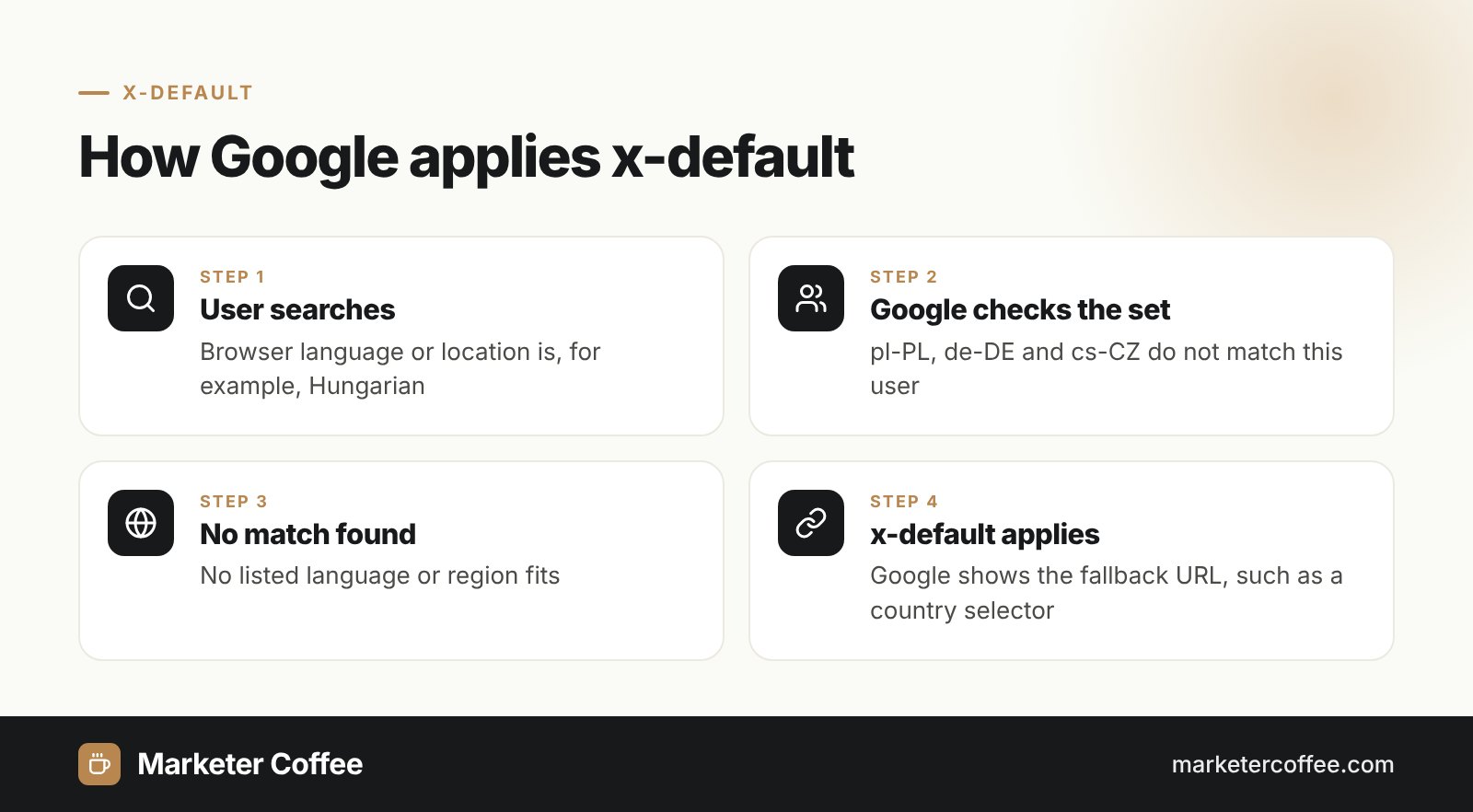
How does x-default work?
x-default works as the catch-all entry in a hreflang set: Google uses it for any language or region you have not listed. If your shop has pl-PL, de-DE and cs-CZ versions, a searcher in Hungary or a French speaker in Belgium matches none of them, and Google can show the x-default URL instead of guessing. Google Search Central notes that the language of the x-default page itself does not matter, which is why the value carries no language code.
x-default does not raise rankings. It only decides which of your existing URLs appears for unmatched users, as part of the wider hreflang mechanism.
x-default syntax: HTML, HTTP header and sitemap
You add x-default with the same method you use for the rest of your hreflang set. Google accepts 3 methods, and x-default is valid in all of them:
- HTML head: <link rel=”alternate” hreflang=”x-default” href=”https://example.com/” />
- HTTP header: Link: <https://example.com/>; rel=”alternate”; hreflang=”x-default”
- XML sitemap: <xhtml:link rel=”alternate” hreflang=”x-default” href=”https://example.com/” /> inside every url entry of the set
The x-default line must appear on every version in the set, next to the self-reference and all other alternates. When the sets differ between pages, or a page does not link back, Google may ignore the annotations.
When to use x-default
Use x-default when you have a page that serves no single language or market. The 2013 Google announcement and the current documentation name these cases:
Language or country selector
A page such as example.com/choose-country/ where users pick their market is the textbook x-default target.
Auto-redirecting homepage
A root URL that sends visitors to /pl/ or /de/ based on their settings should be marked as x-default, so Google understands it is a router, not a duplicate.
Global English version
Many sites point x-default to their general English page because it serves the widest audience. This works when the English page is written for an international reader, not only for the UK or US.
| Setup | Good x-default target |
|---|---|
| Country selector at the root | example.com/ |
| Subdirectories, English as global language | example.com/en/ |
| ccTLDs plus a .com hub | example.com |
x-default in international SEO practice
x-default matters most for sites that cover a few markets but receive traffic from many. A Polish shop with Polish, German and Czech versions still gets visitors from Slovakia, Austria and Hungary. Without x-default, Google picks whichever version it finds most relevant, often the Polish homepage, which a Slovak user cannot read. Google also warns that Googlebot usually crawls from US IP addresses without an Accept-Language header, so it mostly sees whatever your root URL returns to an unmatched visitor. A clear x-default makes that behavior intentional.
Common x-default errors
- Pointing x-default to a URL that redirects, returns 404 or has noindex.
- Using x-default as a language code, for example hreflang=”x-default-en”.
- Adding x-default on the homepage only and forgetting category and product pages.
- Declaring 2 different x-default URLs within one set.
- Setting a canonical tag on the x-default page that points to another language version.
Combine x-default with links to every version in the visible language switcher, and avoid forced geo-redirects, which Google advises against. On large sites, declaring hreflang in the XML sitemap makes x-default easier to keep consistent.
Need help with hreflang and x-default across several markets? See my international SEO consultancy or order a technical SEO review.
Frequently asked questions about x-default
Is x-default required in hreflang?
No, x-default is optional. Google recommends it when you have a fallback page such as a language selector or a global version for users you do not target directly.
Can x-default point to the English version?
Yes. Many sites use their general English page as x-default because it serves the widest international audience. The same URL then appears twice in the set, once as en and once as x-default.
When did Google introduce x-default?
Google announced the x-default hreflang value in April 2013 on the Webmaster Central Blog. Hreflang itself had launched in December 2011.
Does Bing support x-default?
Bing's webmaster blog does not name x-default among its signals. It lists the content-language meta tag, the lang attribute, HTTP headers, ccTLDs and server IP as its language and country signals, so add a content-language tag as well.
Related terms
- Tell Google about localized versions of your page · Google Search Central
- Introducing "x-default hreflang" for international landing pages · Google Webmaster Central Blog
- How Google crawls locale-adaptive pages · Google Search Central
- Managing multi-regional and multilingual sites · Google Search Central
