How does multilingual SEO work?
Multilingual SEO works by giving every language its own crawlable URL, fully translated content and hreflang annotations that connect the versions. Google detects the language of a page from its visible content, not from code. Google Search Central states that it ignores the lang attribute and the URL when it determines language, so a German page with English navigation and an English product description looks mixed and ranks poorly in both markets.
Google also advises against switching content with cookies or browser settings. Googlebot usually crawls from US IP addresses and sends no Accept-Language header, so versions that appear only after automatic detection often stay invisible to the crawler.
Multilingual SEO vs multi-regional SEO
Multilingual SEO targets languages, while multi-regional SEO targets countries. Google defines a multilingual site as one with content in several languages and a multi-regional site as one aimed at users in several countries. Many sites are both, for example a shop with de-DE, de-AT and pl-PL versions.
| Aspect | Multilingual SEO | Multi-regional SEO |
|---|---|---|
| Target | Language (de, pl, cs) | Country (DE, AT, CH) |
| Hreflang value | hreflang=”de” | hreflang=”de-AT” |
| Main work | Translation and keyword research per language | Prices, currency, shipping, local signals |
| Typical example | SaaS docs in 6 languages | Shop with Austrian and Swiss prices |
Key elements of multilingual SEO
A working multilingual setup rests on four elements: URL structure, hreflang, translated content and local keyword research. Each is described below.
URL structure
Google lists four options: a country code domain (example.de), a subdomain (de.example.com), a subdirectory (example.com/de/) and URL parameters (example.com?lang=de). Google does not recommend parameters. A ccTLD sends the strongest country signal but costs more to run; a subdirectory is the easiest to maintain and inherits the authority of the main domain.
Hreflang and x-default
Hreflang tells Google which URL serves which language. A minimal set in the head of the Polish page looks like this:
- <link rel=”alternate” hreflang=”pl” href=”https://example.com/pl/” />
- <link rel=”alternate” hreflang=”de” href=”https://example.com/de/” />
- <link rel=”alternate” hreflang=”x-default” href=”https://example.com/” />
The x-default value names the fallback page for users whose language you do not serve.
Translated content, not translated boilerplate
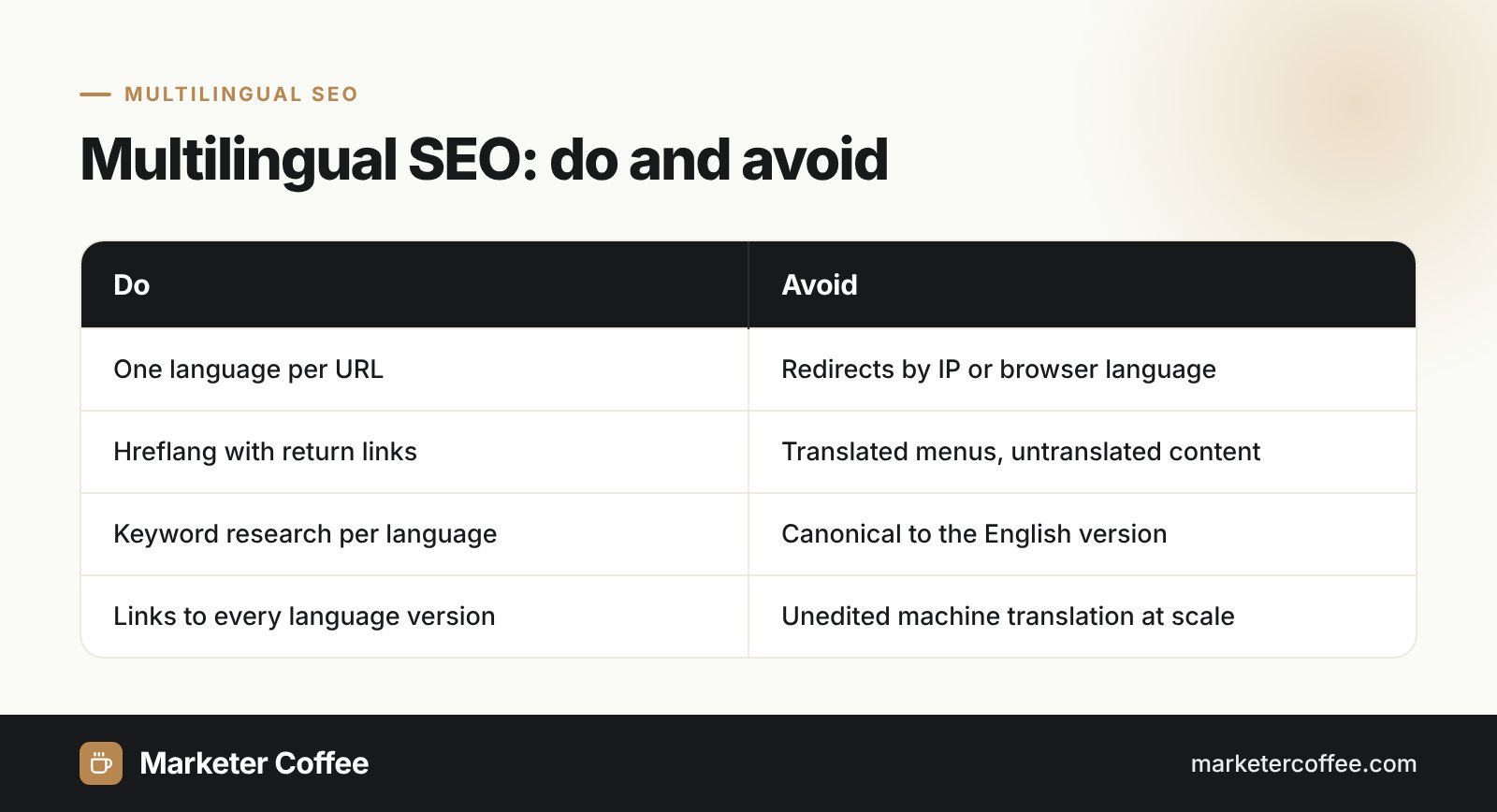
Each page should use one language for both the main content and the navigation. Google calls out sites that translate only menus and footers while the main text stays in one language. Google’s spam policies also list scaled translation without added value as scaled content abuse, so raw machine translation of thousands of pages is a risk.
Keyword research per language
Keywords do not translate one to one. A Polish user types “lodówka do zabudowy”, a German “Einbaukühlschrank” and a Czech “vestavná lednice”, and each phrase has its own volume and competition. Research every language from scratch and adapt the search intent to each market.
Multilingual SEO for Bing and AI search
Bing uses the content-language meta tag as its strongest language and country signal, followed by HTTP headers, the ccTLD and server IP, according to the Bing Webmaster Blog. Adding a content-language tag costs nothing and covers markets where Bing matters. AI assistants such as ChatGPT and Gemini answer in the user’s language and pull from pages in that language, so a missing language version means your brand is absent from those answers too.
Common multilingual SEO mistakes
- Automatic redirects by IP or browser language that hide versions from Googlebot.
- Canonical tags on all language versions pointing to the English page.
- Missing return links in hreflang sets.
- Machine-translated content published without editing.
- Language versions blocked or forgotten in the XML sitemap.
Search Console no longer helps with country targeting: Google removed the International Targeting report on 22 September 2022, and hreflang is now the main signal you control.
Planning a multilingual site? See my international SEO consultancy and the guide to SEO in Germany.
Frequently asked questions about Multilingual SEO
What is the difference between multilingual and international SEO?
Multilingual SEO focuses on serving content in several languages. International SEO is broader and also covers country targeting, local domains, currencies and market signals.
Is machine translation bad for multilingual SEO?
Machine translation is not banned, but Google treats mass-produced translated pages without added value as scaled content abuse. Edit and localize machine output before you publish it.
Which URL structure is best for a multilingual site?
A subdirectory such as example.com/de/ is the best choice for most sites because it is cheap to run and shares the domain's authority. A ccTLD fits companies that need a strong country signal and can maintain separate domains.
Does Google use the lang attribute to detect language?
No. Google detects language from the visible content of the page and ignores the lang attribute and the URL for that purpose.
Related terms
- Managing multi-regional and multilingual sites · Google Search Central
- Tell Google about localized versions of your page · Google Search Central
- Spam policies for Google web search (scaled content abuse) · Google Search Central
- Usage statistics of content languages for websites · W3Techs
- How To Tell Bing Your Website's Country and Language · Bing Webmaster Blog
- Google Search Console to remove International Targeting report · Search Engine Land