How does content localization work?
Content localization works by rewriting every element of a page for one locale, not only the words. The W3C defines localization (shortened to l10n, because 10 letters sit between the l and the n) as adapting a product or document to the language, cultural and other requirements of a target market. Its sibling, internationalization (i18n), is the engineering work that makes localization possible: Unicode support, flexible layouts, separate URL paths per market.
What does localization change?
Localization changes the text, the formats and the commercial details of the offer. The W3C lists these areas, and in SEO projects I add keywords and trust signals.
Language and keywords
Each market searches with its own vocabulary. Germans type “Handyhülle”, not a literal translation of “phone case”, so localized pages need fresh keyword research per market, not translated keyword lists.
Formats and units
Formats cover currency, decimal separators, date and time, addresses, phone numbers and measurement units. A Polish page shows 1 299,00 zł, a US page $1,299.00.
Culture, law and trust
This layer covers images, colours, idioms, payment methods, delivery terms, legal notices and local reviews. CSA Research found that 73% of consumers want product reviews in their own language.
Localization vs translation vs transcreation
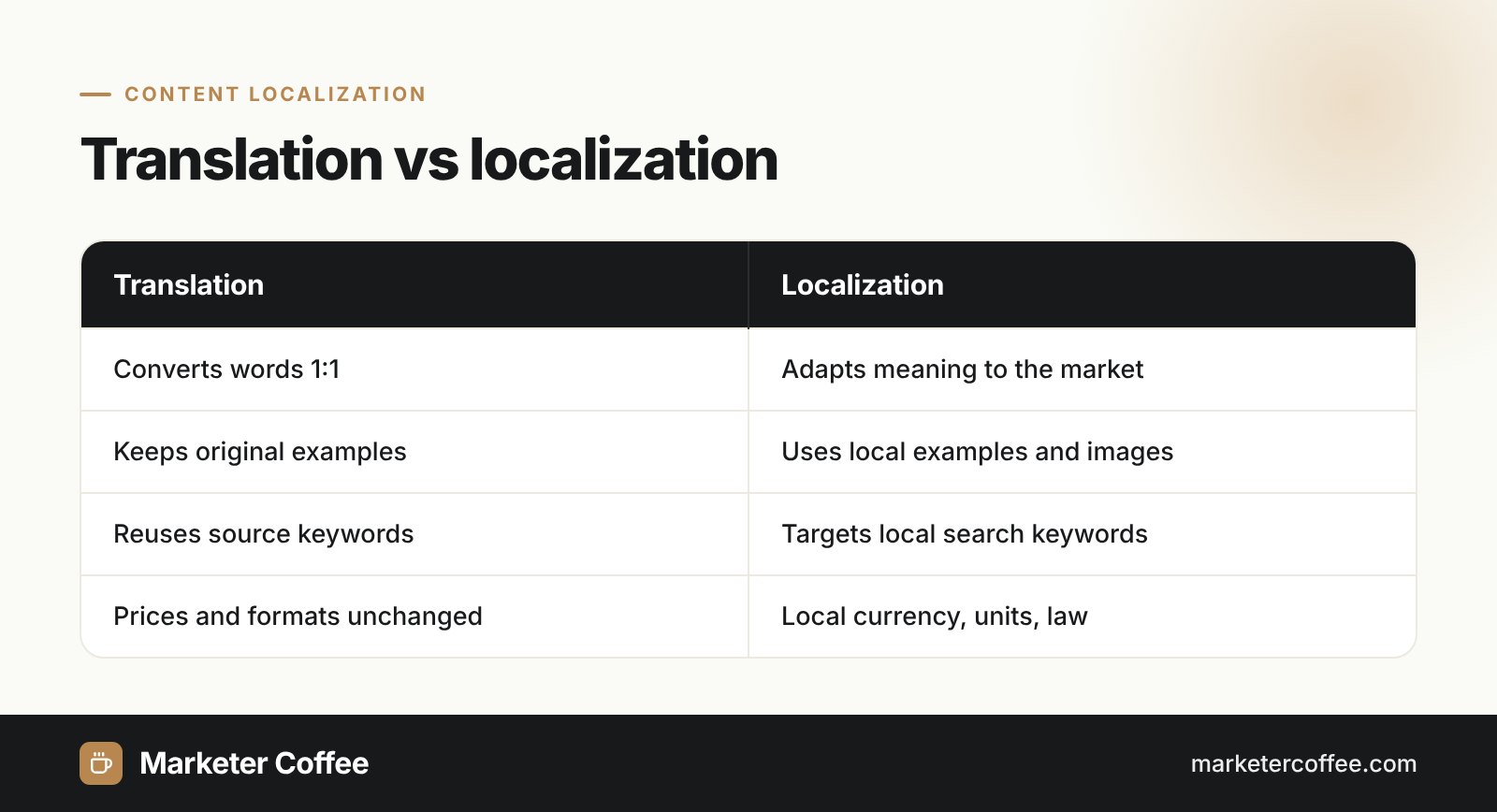
Translation, localization and transcreation are 3 levels of adaptation, from converting words to recreating the message.
| Level | What changes | Typical content |
|---|---|---|
| Translation | Words, meaning stays 1:1 | Manuals, legal documents |
| Localization | Words, formats, examples, keywords, prices | Product pages, category pages, help centres |
| Transcreation | The whole creative idea | Slogans, ads, campaign landing pages |
Content localization in international SEO
Localized content is the part of international SEO that actually earns rankings, while hreflang and URL structure only route users to the right version. Google Search Central gives clear rules for multilingual sites:
- Keep one language per page, for the main content and the navigation.
- Avoid side-by-side translations on a single URL.
- Give each locale its own URL and connect the versions with hreflang.
- Link visibly to other language versions instead of redirecting users by IP or browser language.
Google detects the language from visible content, not from the lang attribute or the URL. Translating only the template while the main text stays in one language creates near-duplicates, the same issue described under duplicate content. Machine translation is not banned, but Google’s spam policies list automated translation that adds little value to users as a form of scaled content abuse.
Localization matters for AI search too. ChatGPT, Gemini and Google AI Mode answer in the user’s language and cite sources written in that language, so a German query rarely surfaces an English page. In expansions into Germany I see this market as the strictest: CSA Research reports that 57% of German respondents buy only on local-language websites, the highest share of all countries surveyed.
How to measure content localization
Localization is measured per market, not for the whole site. Filter the Search Console performance report by country, compare clicks and average position for each language folder, and track conversion rate per locale in your analytics. A localized version that gets impressions but few clicks usually needs better titles in the local language, while a version with no impressions usually targets the wrong keywords.
Planning content for several markets? See my international SEO consultancy and the guide to SEO in Germany.
Frequently asked questions about Content localization
What is the difference between translation and localization?
Translation converts words from one language to another, while localization adapts the whole content to a market: currency, formats, examples, keywords, legal terms and images. A translated page can still feel foreign, a localized one reads as written locally.
Why is it called l10n?
l10n is a numeronym for localization: the 10 stands for the number of letters between the first letter l and the last letter n. Internationalization is shortened to i18n in the same way.
Is machine-translated content bad for SEO?
Machine translation is not penalised by itself. Google's spam policies target automated translation that produces many pages with little value for users, so have native speakers review and adapt machine drafts.
Does content localization need hreflang?
Yes, localized versions should live on separate URLs connected with hreflang. Hreflang tells Google which version to show in which market, while localization makes each version worth ranking.
Related terms
- Localization vs. Internationalization · W3C Internationalization
- Consumers Prefer their Own Language · CSA Research
- Managing multi-regional and multilingual sites · Google Search Central
- Spam policies for Google web search · Google Search Central
- How Google crawls locale-adaptive pages · Google Search Central