



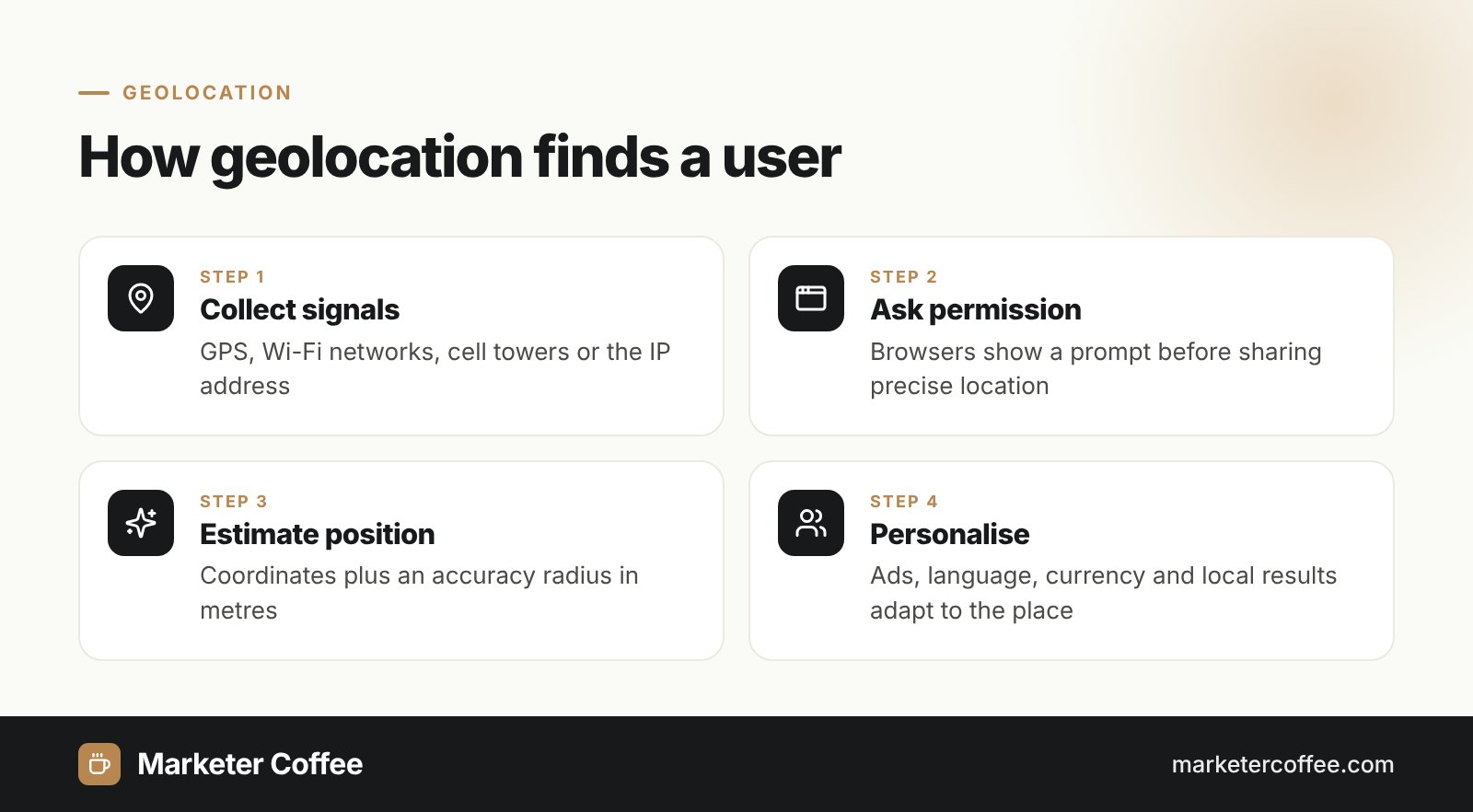
How does geolocation work?
Geolocation works by combining one or more location signals into an estimated position with an accuracy radius. The device or server picks the best available signal and reports coordinates, or for IP data, a country, region and city. The four main methods differ a lot in precision:
| Method | How it locates | Typical precision |
|---|---|---|
| GPS (satellite) | Signals from navigation satellites | A few metres outdoors |
| Wi-Fi positioning | Known locations of nearby Wi-Fi networks | Street level in cities |
| Cell towers | Distance to mobile base stations | Hundreds of metres to kilometres |
| IP geolocation | Databases mapping IP ranges to places | Country about 99.8%, US city about 66% within 50 km (MaxMind) |
MaxMind adds that IP data is never precise enough to identify a household or street address, and VPNs often show the server’s location instead of the user’s.
Browser geolocation: the W3C Geolocation API
Websites access precise location through the Geolocation API standardised by the W3C. A script calls navigator.geolocation.getCurrentPosition() for a single reading or watchPosition() to follow movement. According to MDN, the API:
- Requires explicit user permission through a browser prompt.
- Works only in secure contexts (HTTPS).
- Returns latitude, longitude and an accuracy value, defined in the W3C spec as a 95% confidence radius in metres.
The W3C published the API as a Recommendation on 1 September 2022 and moved it back to Candidate Recommendation in March 2026 to continue its development. Location data is also personal data under Article 4(1) of the GDPR, so collecting it needs a legal basis and clear consent.
Geolocation in marketing and advertising
Geolocation lets marketers show different offers, ads and content depending on where the user is. Typical uses include:
- Location targeting in Google Ads by country, region, city, postal code or radius (minimum 1 km).
- Store finders and local landing pages.
- Currency, shipping and language defaults in e-commerce.
- Geofencing push notifications in mobile apps and IoT devices.
Google Ads offers two options: “Presence” reaches only people physically in an area, while “Presence or interest” also includes people searching for it. Google says Travel, Real Estate and Education advertisers saw 5% more Search conversions after switching to the broader option (internal data, May to June 2022). I set this per market when building Google Ads campaigns.
Geolocation and SEO
Geolocation affects SEO because Google personalises results by the searcher’s location and crawls mostly from US IP addresses. Two consequences matter for international sites:
Avoid automatic IP redirects
Google’s documentation on locale-adaptive pages warns that Googlebot’s default IPs appear to be in the USA and its requests carry no Accept-Language header. A site that redirects visitors by IP can hide its Polish or German pages from Google. Use separate URLs with hreflang and show a suggestion banner instead of a forced redirect.
Check rankings from the right location
Rankings in Warsaw differ from rankings in Wrocław, and both differ from Berlin. Track positions with a rank tracker set to each target city, and check which domain structure fits your markets. I describe the full setup in my international SEO projects.
AI assistants also use location: ask ChatGPT for “the best SEO agency near me” and the answer depends on where it thinks you are.
Frequently asked questions about Geolocation
How accurate is IP geolocation?
IP geolocation is accurate at country level in about 99.8% of cases, according to MaxMind. City-level accuracy is much lower, around 66% within 50 km for the US, and it never pinpoints a specific address.
Is geolocation data personal data?
Yes, location data is listed as a personal identifier in Article 4(1) of the GDPR. Websites need user consent or another legal basis to collect precise location.
Does Google use geolocation in search results?
Google personalises results based on the searcher's location, especially for local queries. That is why the same keyword can rank differently in two cities.
Should I redirect users by IP address?
Avoid forced IP redirects, because Googlebot crawls mainly from US addresses and may never see your other language versions. Use separate URLs with hreflang and an optional language banner.
Related terms
- Geolocation API · MDN Web Docs
- Geolocation (W3C specification) · W3C
- Geolocation accuracy · MaxMind
- Art. 4 GDPR: Definitions · gdpr-info.eu (Regulation (EU) 2016/679)
- Target ads to geographic locations · Google Ads Help
- How Google crawls locale-adaptive pages · Google Search Central
