



What is a scam?
A scam is a deliberate deception designed to trick a person or company into handing over money, personal data or access. The word is informal English for fraud and usually describes schemes run online, by phone or by text message. Unlike a bug or a mistake, a scam always has an intent to deceive and a victim who acts voluntarily because they trust a false story.
How does a scam work?
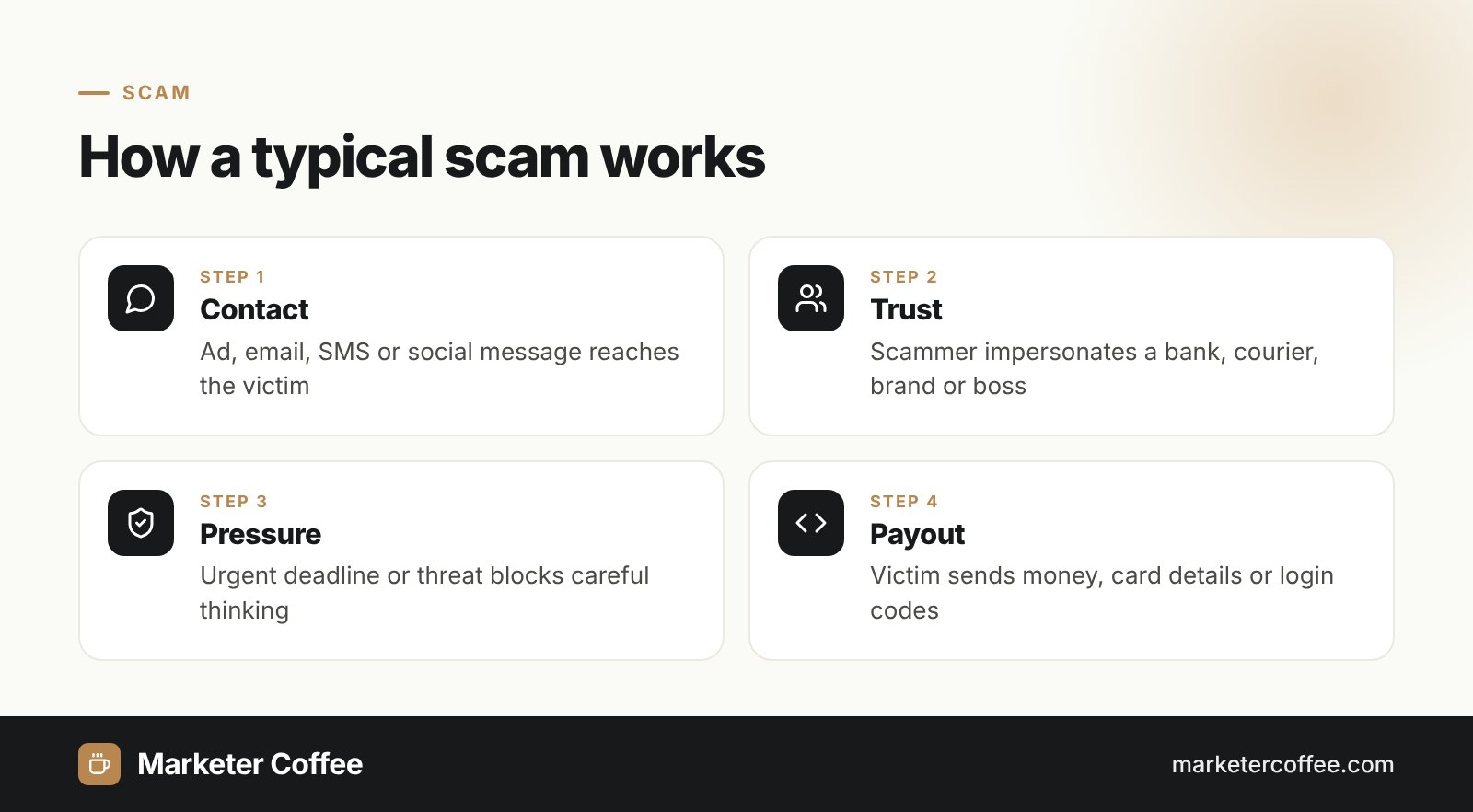
Most scams follow the same four-stage pattern: contact, trust, pressure and payout. The scammer reaches the victim through an ad, email, SMS or a message on Messenger, impersonates a trusted brand or person, creates urgency (“your account will be blocked today”) and then asks for a transfer, card details or login codes. Generative AI makes each stage cheaper, from fluent phishing emails to deepfake videos of celebrities and chatbots that keep victims talking.
How big is the scam problem?
Scams are one of the fastest-growing forms of crime in both the US and Poland.
| Source | Figure |
|---|---|
| US FTC, 2025 data | $15.9 billion in reported fraud losses from 3 million reports |
| US FTC, 2025 data | $7.9 billion lost to investment scams, the costliest type |
| Google Ads Safety Report 2025 | 602 million scam ads removed, 4 million scam-linked accounts suspended |
| CERT Polska, 2025 report | 97% of handled incidents were computer fraud |
The FTC’s March 2026 figures show losses grew from over $12 billion in 2024 to $15.9 billion in 2025, while imposter scams remained the most reported category with over 1 million reports.
Common types of scams
Scams take many forms, but five types appear in most reports from the FTC and CERT Polska.
- Phishing: fake login pages for banks, couriers or marketplaces.
- Investment scams: fake trading platforms promoted with deepfake ads.
- Imposter scams: messages from a fake boss, relative, bank or government office.
- Fake shops: stores that take payment and never ship.
- Advertiser scams: fake agencies or “SEO experts” promising guaranteed results.
Scams in digital marketing and SEO
Marketers face scams both as targets and as brands that scammers impersonate. Typical examples are fake Google Ads “account suspension” emails, fake domain renewal invoices and offers of thousands of cheap backlinks, which belong to black hat SEO and can trigger penalties. Brands also lose customers when scammers clone their site or run ads with their logo. In my audits I check for cloned domains and brand-name ads, because they erode trust and can feed misleading data into AI answers about the brand.
How to protect your business from scams
Protecting a business from scams relies on verification habits more than on tools.
- Verify every payment request through a second, known channel.
- Enable two-factor authentication on Google Ads, Meta and hosting accounts.
- Monitor new domains and ads that use your brand name.
- Protect forms with reCAPTCHA to block automated abuse.
- Report fraudulent ads to Google and Meta, and phishing sites to national CERT teams.
Frequently asked questions about Scam
What is the difference between a scam and fraud?
A scam is an informal word for fraud that relies on tricking the victim into acting voluntarily. Fraud is the broader legal term that also covers deception without direct victim contact, such as accounting fraud.
How much money do people lose to scams?
US consumers reported $15.9 billion in fraud losses in 2025, according to the FTC. Investment scams caused the largest share, $7.9 billion.
How do I recognise a scam?
Watch for urgency, requests for payment or codes, and senders who impersonate trusted brands. Verify through an official channel before you act.
How many scam ads does Google remove?
Google removed 602 million scam-related ads and suspended 4 million scam-linked advertiser accounts in 2025, according to its Ads Safety Report.
Related terms
- FTC testifies before Joint Economic Committee on agency's efforts to combat fraud · US Federal Trade Commission
- Polacy zgłaszają coraz więcej oszustw: raport CERT Polska za 2025 · GSMONLINE.PL
- Raport roczny CERT Polska 2025 · CERT Polska (NASK)
- Gemini blocked more than 99% of bad ads before they ran in 2025 · Search Engine Land
