



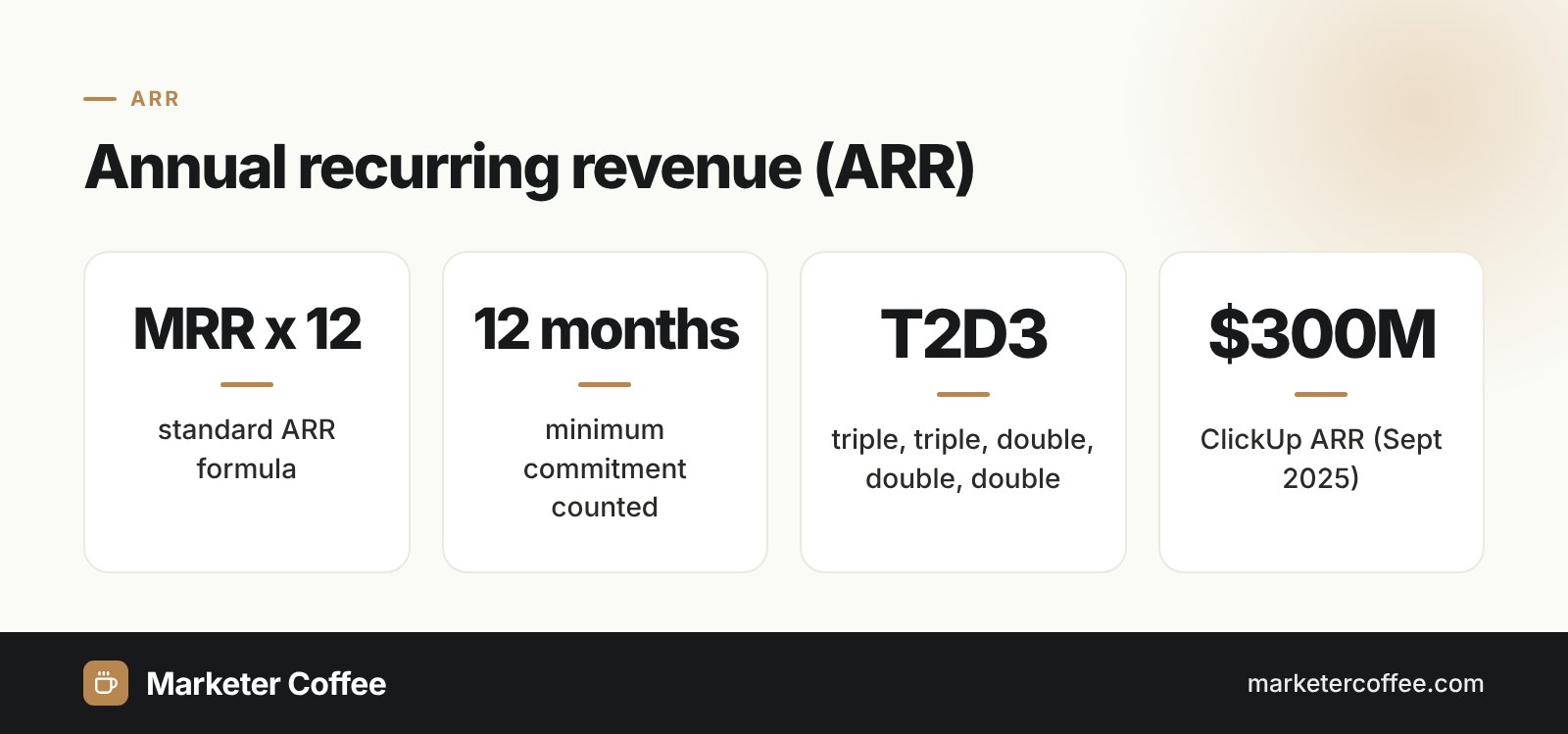
What is annual recurring revenue?
Annual recurring revenue is a forward-looking snapshot of how much subscription revenue a company will collect over 12 months if nothing changes. It applies to businesses built on the subscription model, mainly SaaS. Stripe’s guide stresses two boundaries: ARR counts only revenue with a commitment of at least 12 months, and it excludes non-recurring items such as one-time setup fees. ARR is not an accounting figure under IFRS or US GAAP, so each company defines it slightly differently and investors read the definition in the footnotes.
How to calculate ARR?
ARR is calculated by annualising recurring subscription revenue, most often as monthly recurring revenue multiplied by 12. Stripe gives two formulas:
- ARR = number of annual subscriptions x annual subscription price
- ARR = MRR x 12, for monthly plans
A company with 500 customers on a $100 monthly plan has MRR of $50,000 and ARR of $600,000. Polish SaaS company Brand24 reported MRR of about $726,000 at the end of Q4 2024, which corresponds to an ARR of roughly $8.7 million.
Components of ARR change
ARR changes come from 4 movements that SaaS teams track every month:
- New ARR: subscriptions from new customers.
- Expansion ARR: upgrades, extra seats and add-ons.
- Contraction ARR: downgrades and lost seats.
- Churned ARR: cancelled subscriptions.
Net new ARR equals new plus expansion minus contraction and churn.
ARR growth benchmarks
The best-known ARR growth benchmark is T2D3: triple, triple, double, double, double. Neeraj Agrawal of Battery Ventures described the path, modelled on public SaaS companies such as Salesforce, Workday and Zendesk, with $100 million ARR as the milestone founders aim for. Point Nine notes that starting from about $1 to 2 million ARR, this pace leads to around $100 million in 6 to 7 years. A second benchmark, the Rule of 40, adds the growth rate and profit margin and expects the sum to reach 40%.
ARR in marketing and SEO
ARR matters to marketers because it is the number that SaaS boards use to judge whether marketing spend pays back. A channel that brings many trial sign-ups but few annual contracts adds little ARR. In SaaS SEO projects I map organic landing pages to pipeline and closed ARR, not just to sign-ups, so that the team sees which keyword clusters bring paying customers. ARR also connects to ARPU: content that attracts larger companies raises average revenue per account and expansion ARR. I explain how to build that reporting in my B2B SaaS SEO guide, and the SaaS SEO consultancy page shows how I work with subscription companies.
ARR vs MRR
| Aspect | ARR | MRR |
|---|---|---|
| Time frame | 12 months | 1 month |
| Typical use | Annual and multi-year contracts, B2B | Monthly plans, B2C and SMB |
| Audience | Board, investors, valuation | Operations, monthly forecasting |
| Sensitivity | Smooths short-term changes | Shows churn and upgrades fast |
What ARR does not show
ARR does not show cash, profit or the cost of acquiring customers. Stripe lists its blind spots: discounts, extra fees and customer acquisition costs stay outside the metric, so it should always be read next to churn rate, gross margin and CAC payback.
Frequently asked questions about ARR
How do you calculate ARR?
Multiply monthly recurring revenue by 12, or multiply the number of annual subscriptions by their annual price. Exclude one-time fees and other non-recurring revenue.
What is the difference between ARR and revenue?
ARR is a run-rate snapshot of active subscriptions, while revenue is income recognised in the accounts for a period. ARR ignores one-off sales, services and timing of payments.
What is a good ARR growth rate?
A widely cited benchmark is T2D3: tripling ARR for two years and doubling it for three. Point Nine notes that this pace takes a company from about $1 to 2 million to around $100 million ARR in 6 to 7 years.
Is ARR the same as MRR times 12?
For companies with monthly plans, yes, ARR is usually MRR multiplied by 12. Companies with annual contracts often calculate ARR directly from contract values.
Related terms
- ARR: A key metric for business performance · Stripe
- A mantra for SaaS success: triple, triple, double, double, double · Battery Ventures
- 6 SaaS metric frameworks and benchmarks to know before fundraising · Point Nine
- ClickUp accelerating to $300 Million Annual Recurring Revenue, 400% Growth in AI Sales · Business Wire via MEA Tech Watch
- BRAND24 S.A. raport bieżący 1/2025: dane operacyjne za IV kwartał 2024 · Brand24 S.A.
