



How does a redirect chain form?
A redirect chain forms when a redirect points to a URL that itself redirects, instead of pointing to the final page. Each step is an HTTP response from the 3xx class defined in RFC 9110, the IETF standard for HTTP semantics, with a Location header that names the next URL. Browsers and Googlebot request each URL in turn until they get a normal 200 response.
Chains rarely come from one decision. They build up over years through:
- Protocol changes: http to https.
- Host changes: non-www to www or the reverse.
- Formatting rules: trailing slash or lowercase normalisation.
- Site migrations: new URL structures, CMS changes or domain moves.
- Content updates: merged articles and discontinued products redirected again after an earlier redirect.
A typical example: http://example.com/shoes redirects to https://example.com/shoes, which redirects to https://www.example.com/shoes, which redirects to https://www.example.com/shoes/. That is 3 hops for one link.
Redirect chain vs redirect loop
A redirect loop is a chain that never ends because it returns to an earlier URL. MDN Web Docs notes that browsers detect such loops and show an error, for example Firefox’s message that the server is redirecting in a way that will never terminate. A chain eventually reaches a page, a loop never does.
| Feature | Redirect chain | Redirect loop |
|---|---|---|
| Final page | Reached after several hops | Never reached |
| User impact | Slower load | Error page |
| Google impact | Delay, lost crawl requests, error if too long | Redirect error, URL not indexed |
How does Google treat redirect chains?
Google follows a chain up to a limit and indexes only the final target. Google Search Central states that its crawlers follow up to 10 redirect hops by default and ignore any content returned by the redirecting URLs. The Page indexing report in Search Console lists four redirect errors: a chain that was too long, a redirect loop, a redirect URL that exceeded the maximum URL length, and a bad or empty URL in the chain.
Chains also mix signals. A permanent 301 redirect or 308 redirect tells Google the target should be canonical, while a temporary 302 redirect keeps the source URL as a candidate. A chain that combines both sends a weaker, mixed signal than one direct permanent redirect. On large sites every extra hop is another request taken from the crawl budget.
How to find and fix redirect chains
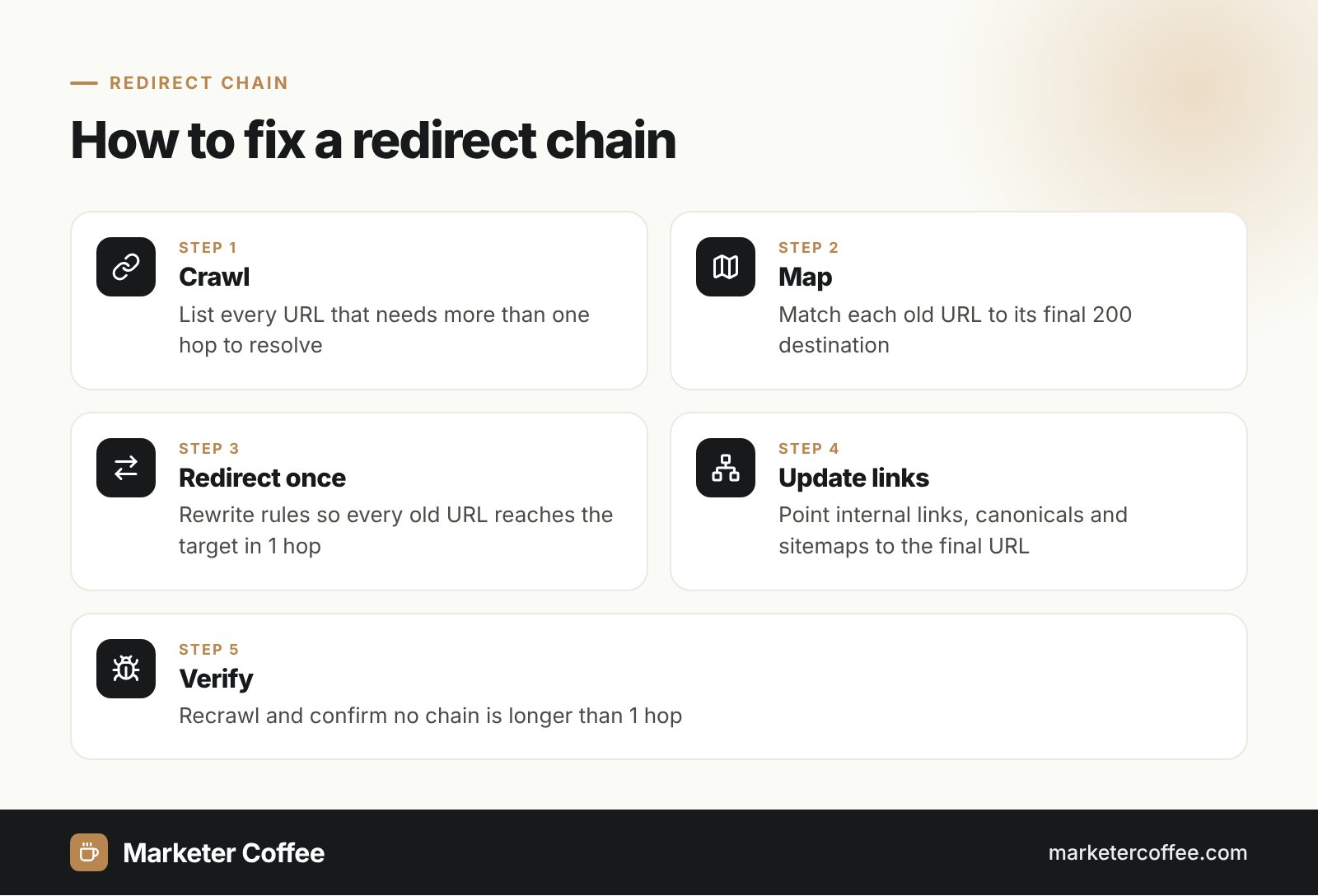
Fixing a chain means pointing every old URL and every internal link straight at the final destination. I use this process in technical audits:
- Crawl the site with a tool that reports redirect chains, such as Screaming Frog or Sitebulb.
- Export old URLs from backlinks and Search Console to catch external links that start chains.
- Update redirect rules so each old URL goes to the final URL in one hop.
- Update internal links, canonical tags, hreflang and XML sitemaps to the final URL.
- Recrawl and check that every redirect resolves in a single step.
Server examples as plain text. Nginx, one hop from any http or non-www request: return 301 https://www.example.com$request_uri; placed in the http and non-www server blocks. Apache, one rule instead of two: Redirect 301 /old-page https://www.example.com/new-page/ with the final URL, slash included. Google recommends keeping redirects for at least 1 year after a site move and, for users, ideally indefinitely.
Redirect chains are one of the first items I check in a technical SEO audit, especially before an international domain move, where http, host and language-folder redirects stack quickly. More on that in my technical SEO services.
Frequently asked questions about Redirect chain
How many redirects does Google follow?
Google's crawlers follow up to 10 redirect hops by default. Google still recommends redirecting directly to the final URL and keeping chains below 3 to 5 hops.
Are redirect chains bad for SEO?
Redirect chains slow down pages, use extra crawl requests and can end in a redirect error if they get too long. One direct permanent redirect is the cleanest signal for Google.
What is the difference between a redirect chain and a redirect loop?
A redirect chain reaches a final page after several hops. A redirect loop sends the request back to an earlier URL and never reaches a page, so browsers show an error.
How do I fix a redirect chain?
Change the redirect rules so each old URL points to the final destination in one hop. Then update internal links, canonicals and sitemaps to the final URL.
Related terms
- Site moves with URL changes · Google Search Central
- How HTTP status codes, and network and DNS errors affect Google Search · Google Search Central
- Redirects and Google Search · Google Search Central
- Page indexing report · Google Search Console Help
- RFC 9110: HTTP Semantics · IETF
- Redirections in HTTP · MDN Web Docs
