



How does a 307 redirect work?
A 307 redirect works by returning status 307 with a Location header that points to the temporary URL. The browser then sends the same request to that URL automatically. If the original request was a POST with form data, the second request is also a POST with the same data. The client keeps using the original URL for future requests, because the move is only temporary.
A typical server response looks like this:
- Status line: HTTP/1.1 307 Temporary Redirect
- Header: Location: https://example.com/summer-sale
According to http.dev, a 307 response is not cacheable by default, so browsers check the original URL again on the next visit.
307 redirect in RFC 9110
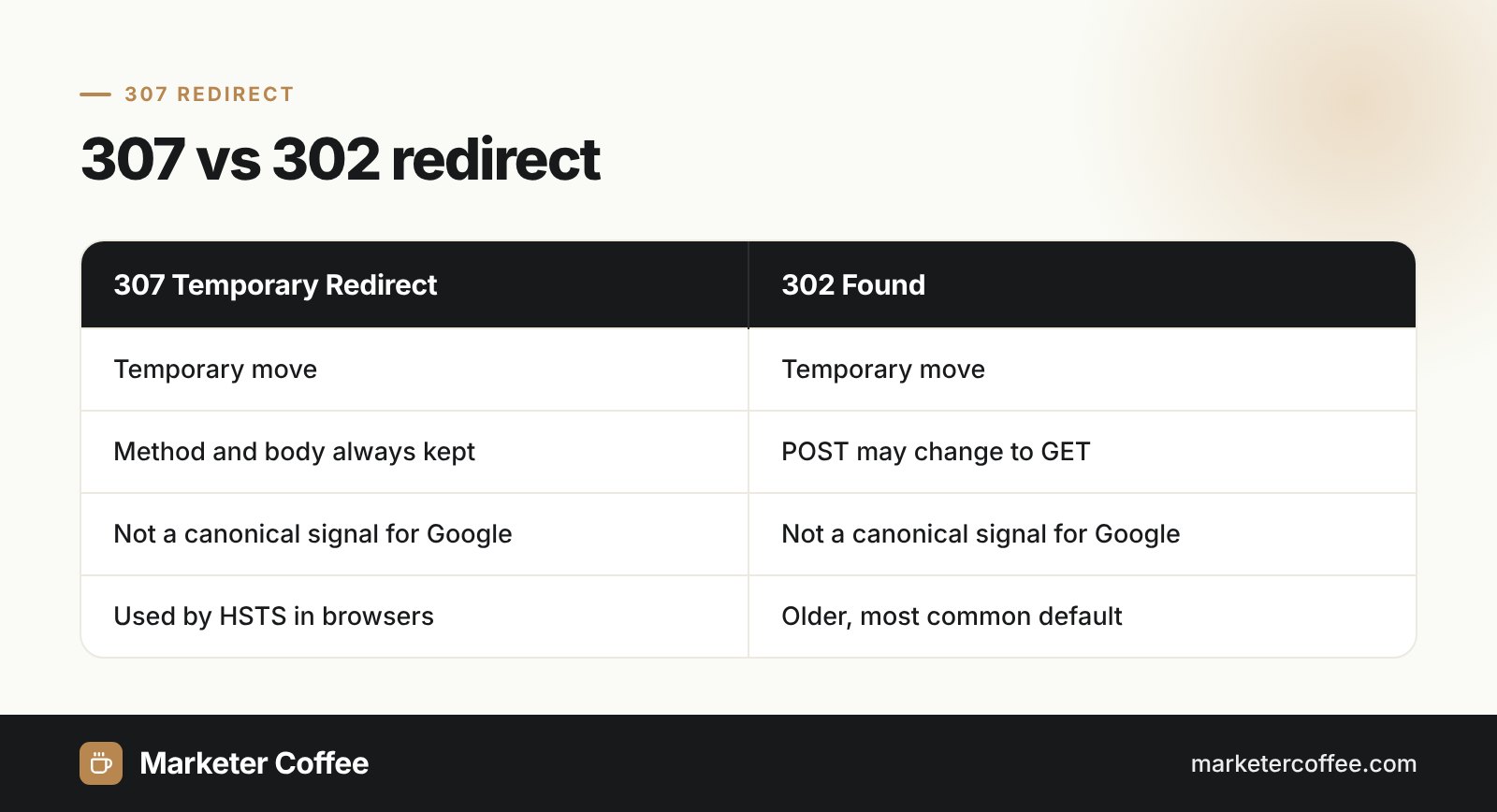
RFC 9110 defines 307 as a temporary redirect in which the user agent must not change the request method (section 15.4.8). This rule is the whole reason the code exists. Its older sibling, the 302 redirect, also means “temporarily moved”, but early browsers turned POST requests into GET after a 302, and the specification still tolerates that behaviour for historical reasons. MDN Web Docs notes that for plain GET requests, 302 and 307 behave the same way.
How does Google treat a 307 redirect?
Google treats a 307 as a temporary redirect that is not a canonical signal for the target URL. Google Search Central lists 302, 303 and 307 together in the temporary group: Googlebot follows the redirect, but the indexing system does not use it to pick the target as canonical. The original URL normally stays in search results, while the target can still get indexed if other signals (internal links, canonical tags, sitemaps) point to it.
In my technical SEO audits, the most common problem is a permanent move implemented as a 307 by a framework default. Rankings then sit on the old URL for weeks, because Google is waiting for the page to come back.
The HSTS 307 “internal redirect”
A 307 that you see in Chrome DevTools or a crawler is often not sent by your server at all, but generated by the browser because of HSTS. HTTP Strict Transport Security (RFC 6797) tells browsers to use only HTTPS on a domain. Once the policy is stored, the browser rewrites any http:// link to https:// internally and labels it “307 Internal Redirect”. Screaming Frog explains that the real server response behind it is usually a 301 from HTTP to HTTPS, which you should keep in place for first-time visitors and for Googlebot.
When to use a 307 redirect
A 307 redirect fits short, reversible moves where the original URL should keep its rankings. Typical cases:
- Maintenance windows, when a page sends users to a status page for a few hours.
- A/B tests that send part of the traffic to a variant URL.
- Form or API endpoints that move temporarily and must keep POST data.
- Geo or language routing on a homepage, where the root URL should stay indexable.
Use a 301 redirect or a 308 redirect when the move is permanent, and avoid long redirect chains that mix temporary and permanent codes.
How to set up a 307 redirect: server examples
A 307 is set up with one line in the server or application config. Common examples:
- Apache (.htaccess): Redirect 307 /old-page https://example.com/new-page
- Nginx: location = /old-page { return 307 https://example.com/new-page; }
- PHP: header(“Location: https://example.com/new-page”, true, 307);
- Next.js: redirects with permanent: false return 307 by default.
307 vs 302 vs 308
| Code | Type | Method kept? | Google canonical signal |
|---|---|---|---|
| 302 Found | Temporary | Not guaranteed | No (weak) |
| 307 Temporary Redirect | Temporary | Yes | No (weak) |
| 308 Permanent Redirect | Permanent | Yes | Yes (strong) |
| 301 Moved Permanently | Permanent | Not guaranteed | Yes (strong) |
Not sure which codes your site returns? A SEO audit maps every redirect and its status code.
Frequently asked questions about 307 redirect
What is the difference between a 302 and a 307 redirect?
Both are temporary redirects, but a 307 guarantees that the browser repeats the request with the same method and body. A 302 historically allowed browsers to change POST into GET. For GET requests and for SEO, they behave the same.
Is a 307 redirect bad for SEO?
A 307 is not bad for SEO when the move is really temporary, because Google keeps the original URL in search. It becomes a problem when it is used for a permanent move, since Google then does not treat the target as canonical.
Why do I see a 307 Internal Redirect in Chrome?
Chrome shows a 307 Internal Redirect when HSTS forces an HTTP request to HTTPS inside the browser. Your server did not send it; the real server redirect is usually a 301.
Does a 307 redirect pass link equity?
Google follows 307 redirects, but it does not use them as a signal that the target should be canonical, so ranking signals mostly stay with the original URL. Use a 301 or 308 to move signals to a new URL.
Related terms
- RFC 9110: HTTP Semantics · IETF
- Redirects and Google Search · Google Search Central
- 307 Temporary Redirect · MDN Web Docs
- An SEO's guide to crawling HSTS and 307 redirects · Screaming Frog
- 307 Temporary Redirect · http.dev
- redirects (next.config.js) · Next.js / Vercel
