



What is ARPU?
ARPU is a unit-economics metric that shows how much revenue one average user generates in a given period, usually a month, quarter or year. It turns a large revenue figure into a number that is easy to compare across time, markets and customer segments. Investors watch ARPU closely because growth can come from more users or from more revenue per user, and the two have very different costs.
How to calculate ARPU
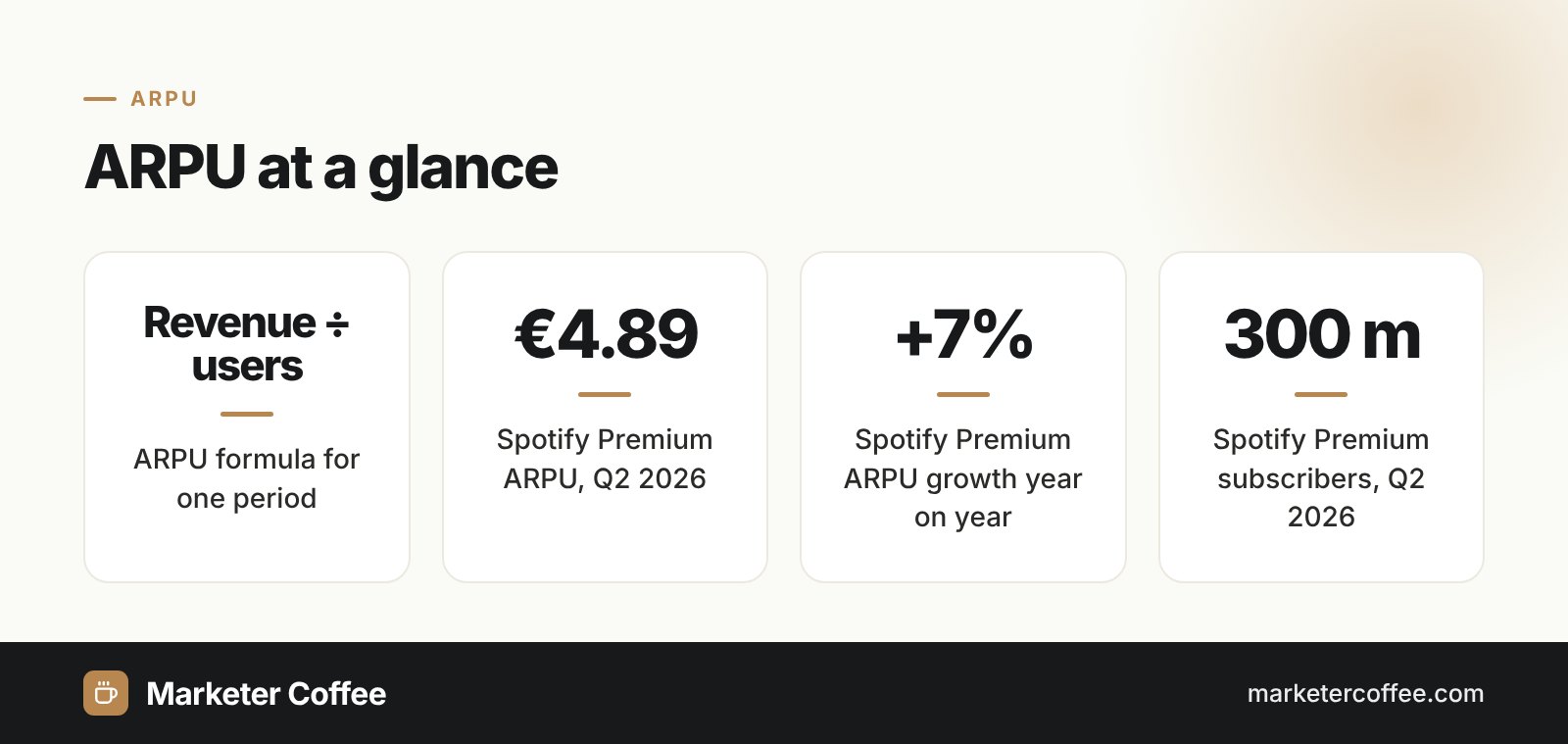
ARPU is calculated with one formula: revenue for the period divided by the average number of users in the same period.
ARPU = total revenue ÷ average number of users
Use the average of the opening and closing user counts, because the number of users changes during the period. Example: a SaaS product earns $50,000 in a month, starts with 900 customers and ends with 1,100. The average is 1,000 customers, so monthly ARPU is $50.
ARPU and related metrics
ARPU has several variants that change the denominator or the time frame. Choose the one that matches your business model.
| Metric | What it divides | Typical use |
|---|---|---|
| ARPU | Revenue by all users | Telecoms, streaming, social media |
| ARPPU | Revenue by paying users only | Freemium apps, mobile games |
| ARPDAU | Daily revenue by daily active users | Mobile games |
| ARPA | Revenue by accounts | B2B SaaS with team plans |
ARPPU is always higher than ARPU in a freemium model, because free users are excluded. In SaaS, monthly ARPU multiplied by paying customers gives MRR, and MRR times 12 gives ARR.
ARPU examples
Public companies report ARPU in their quarterly results, which makes it a useful benchmark for pricing and growth.
| Company | Metric | Value |
|---|---|---|
| Spotify, Q2 2026 | Premium ARPU | €4.89 (up 7% year on year) |
| Spotify, Q2 2026 | Premium subscribers | 300 million |
Spotify said the increase came mainly from price rises, partly offset by product and market mix. This shows the two classic levers: price and mix.
ARPU in marketing and SEO
ARPU matters to marketers because it sets how much you can afford to pay to acquire a customer. Combined with retention, it gives customer lifetime value, which caps a sensible cost per acquisition in paid search and the budget for content. In my SaaS SEO work I compare ARPU by acquisition channel: users from comparison and “alternative to” keywords often choose higher plans than users from broad informational content. For a subscription model, ARPU by country also shows which markets justify localised content, which links to international SEO planning.
- Raise prices or introduce a higher tier.
- Promote annual plans and add-ons at the right moment.
- Target keywords that attract larger customers.
- Reduce discounting in acquisition campaigns.
Limits of ARPU
ARPU is an average, so it hides the spread between small and large customers. A rising ARPU can mean healthy upsells or simply the loss of many small users. Read it together with user growth, churn, margin and KPIs such as conversion rate, and segment it by plan, country and channel before you act.
Frequently asked questions about ARPU
What is ARPU?
ARPU stands for average revenue per user. It is total revenue in a period divided by the average number of users in that period.
How do you calculate ARPU?
Divide total revenue for the period by the average number of users, using the average of the opening and closing counts. For example, $50,000 of monthly revenue and 1,000 average users give an ARPU of $50.
What is the difference between ARPU and ARPPU?
ARPU divides revenue by all users, while ARPPU divides it only by paying users. In freemium products ARPPU is always higher than ARPU.
What is a good ARPU?
A good ARPU depends on the industry, price point and cost of acquiring a customer. Compare it with your customer acquisition cost and with public competitors in the same model.
Related terms
- Average revenue per user · Wikipedia
- Spotify Technology S.A. Q2 2026 shareholder update (Form 6-K) · U.S. SEC / Spotify
- Orange podał swoje wyniki za zeszły rok, podwyżki działają · GSMonline.pl
