



How does a CDN work?
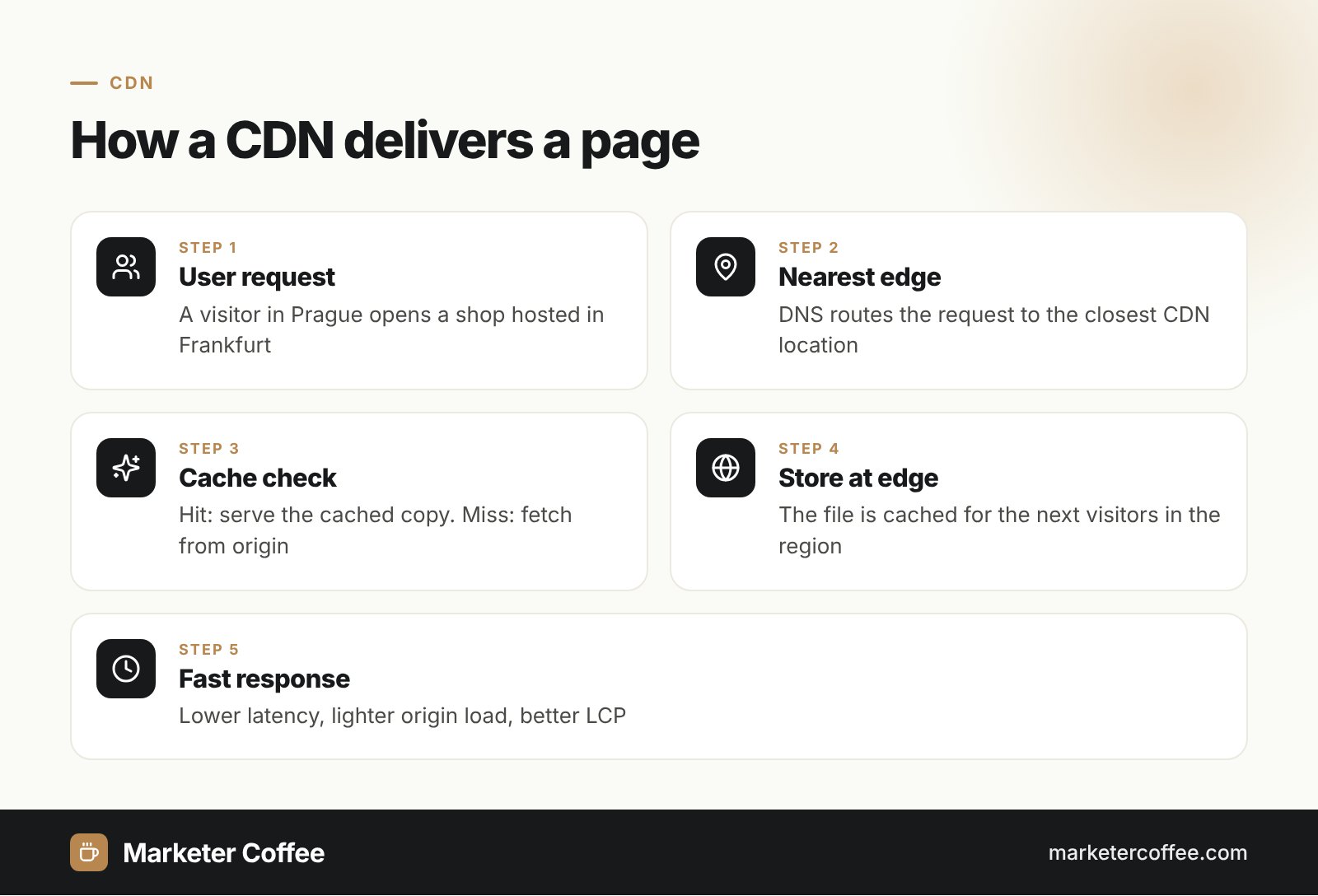
A CDN works by serving each request from the edge server nearest to the user instead of from the distant origin server. The process takes 4 steps:
- A user in Prague requests a page from a shop hosted in Frankfurt.
- DNS routes the request to the nearest CDN location, for example Prague.
- The edge server returns the cached copy (a cache hit) or fetches the file from the origin, stores it and returns it (a cache miss).
- Later visitors in that region get the cached copy without contacting the origin.
Cloudflare places servers at internet exchange points, where providers swap traffic, which shortens the route and lowers costs. Google’s web.dev guide names a cache hit ratio of 90% as a good goal for most sites.
History and main CDN providers
The commercial CDN market began with Akamai, founded on 20 August 1998 by MIT professor Tom Leighton and Danny Lewin, after Tim Berners-Lee challenged MIT colleagues in 1995 to find a better way to deliver web content. Akamai launched commercial service in April 1999. Today the market is dominated by reverse proxy and CDN services measured by W3Techs:
| Provider | Share of all websites (W3Techs, Oct 2026) |
|---|---|
| Cloudflare | 27.4% |
| Amazon CloudFront | 1.7% |
| Fastly | 0.9% |
| Akamai | 0.6% |
Cloudflare lists data centres in Frankfurt, Berlin, Munich, Prague, Warsaw and Wrocław, among more than 300 cities, and says 95% of internet users are within 50 ms of its network.
Benefits of a CDN
A CDN delivers 4 main benefits: speed, lower hosting costs, availability and security.
Speed
Shorter distance and cached files cut Time to First Byte, which web.dev calls particularly effective for improving Largest Contentful Paint, one of the Core Web Vitals.
Lower bandwidth costs
The edge answers most requests, so the origin server sends less data and the hosting bill drops.
Availability
Load balancing and failover move traffic to another location when one data center goes down.
Security
Most CDNs absorb DDoS attacks, manage TLS certificates and filter malicious bots before they reach the origin.
CDN and SEO
A CDN helps SEO through faster pages and a higher crawl capacity, but a wrong configuration can block Googlebot. In December 2024 Google explained on its Search Central blog that it raises the crawl rate when it detects a CDN, because the infrastructure can take more requests. That matters for crawl budget on large stores. The same post lists the risks:
- Bot challenges: “Are you human?” pages hide the real content from Googlebot; Google asks for a 503 status in such cases.
- Firewall rules: a WAF can block Google’s IP addresses without anyone noticing.
- Error pages with status 200: Google may treat them as duplicates and drop them from the index.
- Cold cache: launching a million new URLs at once sends every first request to the origin.
Check how Googlebot sees CDN-served pages with the URL Inspection tool in Search Console.
CDN in international SEO
A CDN is the standard way to serve one site fast in many countries without hosting it in each one. Google calls server location only a weak geotargeting hint, precisely because CDNs blur it, so a .com shop hosted in Poland and served through a CDN can rank in Germany as long as hreflang, the URL structure and local content point there. The risk lies in CDN features that redirect by IP or vary content by country: Googlebot mostly crawls from the US, so automatic geo-redirects at the edge can hide your German or Czech version from Google. When I set up expansions into Germany or the Czech Republic, I check every edge rule for this before launch.
Expanding to new markets? My technical SEO services cover CDN and crawl configuration, and my international SEO consultancy handles the market setup.
Frequently asked questions about CDN
Is a CDN the same as web hosting?
No, a CDN does not replace hosting. The website stays on its origin server, and the CDN caches copies of its files on servers close to users.
Does a CDN improve SEO?
A CDN improves page speed and Core Web Vitals, and Google raises the crawl rate when it detects one. Poorly configured bot protection can block Googlebot, so test pages with the URL Inspection tool.
Which CDN is the most popular?
Cloudflare is the most widely used service by far: W3Techs measured it on 27.4% of all websites in October 2026. Amazon CloudFront, Fastly and Akamai follow far behind.
Does a CDN affect geotargeting?
A CDN makes server location meaningless as a country signal, which Google already treats as weak. Geotargeting relies on hreflang, URL structure and local content instead.
Related terms
- What is a content delivery network (CDN)? · Cloudflare
- Cloudflare global network · Cloudflare
- Usage statistics of reverse proxy services for websites · W3Techs
- Akamai company history · Akamai
- Content delivery networks (CDNs) · web.dev (Google)
- Google explains how CDNs impact crawling and SEO · Search Engine Journal
