What do Core Web Vitals measure?
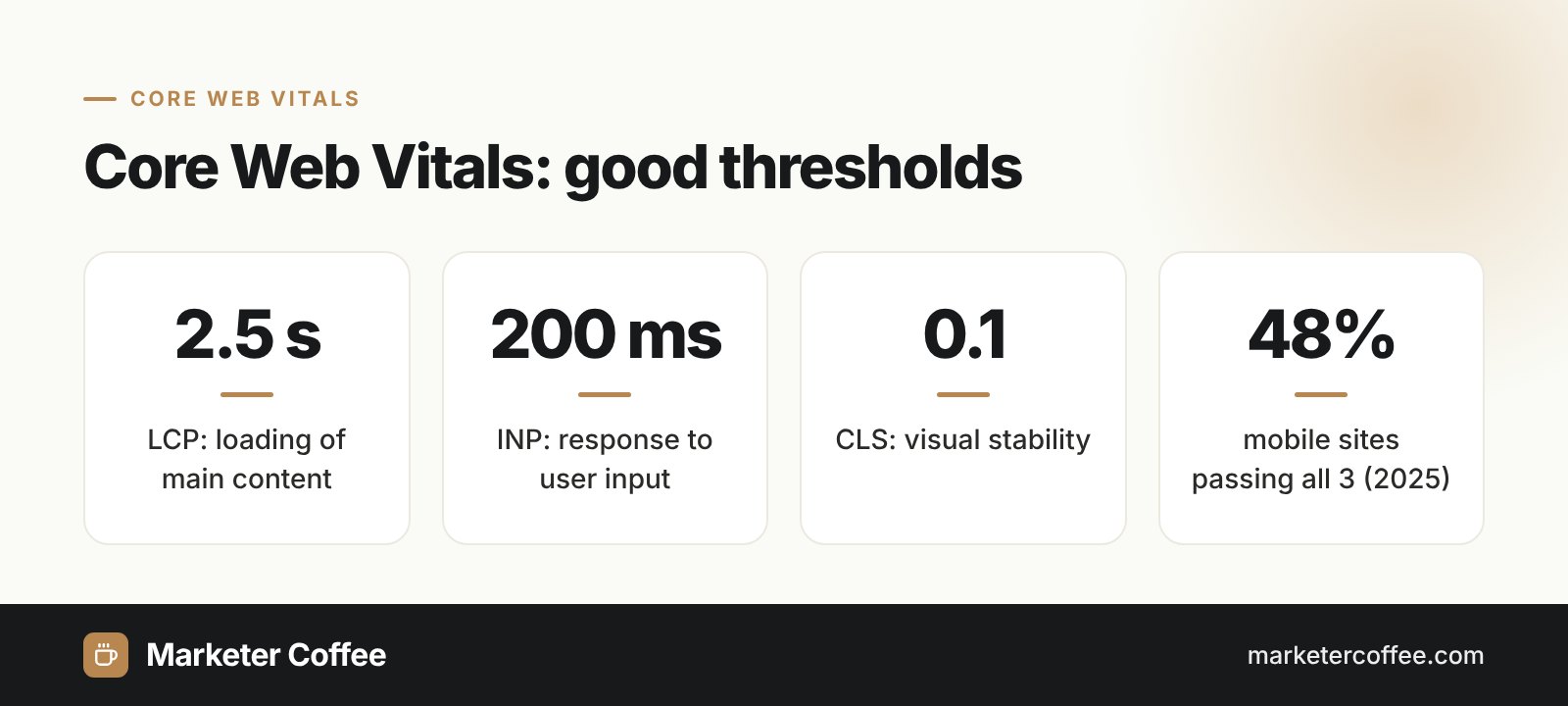
Core Web Vitals measure how fast the main content loads, how quickly the page reacts to input and how much the layout jumps while loading. Each metric has 3 bands defined by Google’s Chrome team on web.dev:
| Metric | Measures | Good | Needs improvement | Poor |
|---|---|---|---|---|
| LCP (Largest Contentful Paint) | Loading | 2.5 s or less | 2.5 to 4 s | Over 4 s |
| INP (Interaction to Next Paint) | Responsiveness | 200 ms or less | 200 to 500 ms | Over 500 ms |
| CLS (Cumulative Layout Shift) | Visual stability | 0.1 or less | 0.1 to 0.25 | Over 0.25 |
A page passes only when the 75th percentile of real page loads meets the good threshold for all 3 metrics, measured separately for mobile and desktop.
History of Core Web Vitals
Core Web Vitals have changed once since launch: INP replaced First Input Delay (FID) on 12 March 2024.
- May 2020: Google announces Web Vitals and the first 3 Core Web Vitals (LCP, FID, CLS).
- June to August 2021: The page experience update rolls out in Google Search, originally scheduled for May.
- May 2022: Chrome introduces INP as an experimental metric.
- 12 March 2024: INP becomes a Core Web Vital, and FID is deprecated and removed from Search Console.
Core Web Vitals metrics explained
The 3 metrics are LCP for loading, INP for interactivity and CLS for stability, and each has its own typical causes.
Largest Contentful Paint (LCP)
LCP records when the largest visible image or text block finishes rendering. It is the metric most sites fail: the Web Almanac 2025 reports good LCP on 62% of mobile sites. Slow servers, heavy hero images and render-blocking CSS are the usual causes.
Interaction to Next Paint (INP)
INP measures the delay between a click, tap or key press and the next visual update, across the whole visit. Heavy JavaScript, third-party tags and large DOM trees push it up. 77% of mobile sites have good INP, against 97% on desktop.
Cumulative Layout Shift (CLS)
CLS adds up unexpected layout shifts, for example a cookie banner or ad slot pushing text down. Reserving space for images, ads and embeds fixes most issues. 81% of mobile sites have good CLS.
How to measure Core Web Vitals
Core Web Vitals are measured with field data from real Chrome users, supported by lab tools for debugging:
- Search Console Core Web Vitals report: groups of URLs by status, separately for mobile and desktop.
- PageSpeed Insights: field data from the Chrome User Experience Report (CrUX) plus a Lighthouse lab test.
- Chrome DevTools: all 3 metrics while you test interactions.
- Lighthouse: LCP and CLS in the lab, with Total Blocking Time as a proxy for INP.
- web-vitals JavaScript library: real-user data sent to your own analytics.
Core Web Vitals and SEO
Core Web Vitals are part of the page experience signals that Google says align with what its core ranking systems reward, not a standalone ranking boost. Google Search Central recommends good Core Web Vitals, but relevance still comes first: a fast page with weak content does not outrank a slower, much better answer. In my audits the business case is usually conversion, not rankings, because slow product pages lose buyers on mobile. Read more in my guide to mobile SEO.
On international sites, measure Core Web Vitals per market, because CrUX data reflects real users and their networks and devices. A shop hosted in Poland can pass in Warsaw and fail for users in Romania if the HTML is not served from a CDN close to them. Language versions also differ in templates, fonts and third-party scripts, such as a local payment widget or chat tool, so I check each language folder separately in Search Console. Server-side rendering and fewer render-blocking resources usually help LCP across all markets at once, which also makes crawling cheaper for Googlebot. Faster pages also improve conversion rate optimisation results.
Need a performance and technical review? See my technical SEO services.
Frequently asked questions about Core Web Vitals
What are the 3 Core Web Vitals?
The 3 Core Web Vitals are Largest Contentful Paint (LCP), Interaction to Next Paint (INP) and Cumulative Layout Shift (CLS). Good values are 2.5 seconds or less, 200 milliseconds or less and 0.1 or less.
Are Core Web Vitals a ranking factor?
Core Web Vitals are part of the page experience signals that Google says its core ranking systems seek to reward. Relevance and content quality still matter more, so they act mostly as a tiebreaker between similar pages.
When did INP replace FID?
INP replaced First Input Delay as a Core Web Vital on 12 March 2024. FID was removed from Search Console the same day.
Why do lab and field Core Web Vitals scores differ?
Lab tools like Lighthouse test one page load on a simulated device, while field data from CrUX reflects many visits by real Chrome users. Google uses field data for its assessment.
Related terms
- Web Vitals · web.dev (Google Chrome team)
- Defining the Core Web Vitals metrics thresholds · web.dev
- Understanding Core Web Vitals and Google search results · Google Search Central
- Interaction to Next Paint becomes a Core Web Vital on March 12 · web.dev
- Web Almanac 2025: Performance · HTTP Archive
- Google Page Experience Algorithm Update Launching In Mid-June · Search Engine Journal