
The best newsletter platforms in 2026 are beehiiv if you want to grow and earn from a newsletter as a business, Kit if you sell products to your audience, Substack if you are a writer who wants paying readers without any setup, and Ghost if you want to own the whole site. I am Adrian Dąbrowiecki, I run Marketer Coffee, an SEO agency for SaaS and ecommerce brands, and I look at newsletters mostly from the angle of owned traffic: the audience you keep when Google or a social feed changes its mind. Below are eight newsletter builders with prices checked today, what each one is good at, where each one gets expensive, and how to choose.
Two things moved this year. On 1 October 2026 beehiiv renamed and repriced its plans, and existing customers move to the new prices at their first renewal after 1 November. Mailchimp, meanwhile, cut its free plan again in January, to 250 contacts and 500 emails a month. If you picked a platform two years ago on the basis of its free tier or its price, it is worth checking again.
What Is a Newsletter Platform?
A newsletter platform is software that lets you collect subscribers, write and send regular emails to them, and usually publish the same posts on a web archive, with optional tools to charge for access.
The line between a newsletter platform and a general email marketing service has become blurry. The difference is mostly about who the product is built for. Newsletter-first tools such as beehiiv, Substack, Ghost and Buttondown assume the email itself is the product: they give you a hosted publication, a recommendation network, paid subscriptions and, in beehiiv’s case, an ad marketplace. Email marketing services such as Mailchimp, MailerLite and Brevo assume the email supports something else, like a store or a sales process, so they put more weight on automation, segmentation and integrations. If you are deciding between the two families, my guide to the best email marketing services covers the second one in more depth.
There is a third thing to look at that rarely shows up in comparisons: whether your archive helps you in search. A newsletter whose posts live on your own domain, with clean URLs and proper metadata, can earn organic traffic for years. One that lives only in inboxes, or on someone else’s domain, cannot.
How I Chose These Tools
I compared the platforms on four things: how easy it is to start, how they help you grow a list, how you can earn money from it, and what the bill looks like once the list reaches ten thousand people rather than one hundred.
Every price below was checked on the vendor’s own pricing page on 14 October 2026. Where a pricing page did not show numbers to me, I say so and give a third-party figure marked “about”. Ratings come from G2, and some of the smaller tools have very few reviews there, which I mention. None of the links in this article are affiliate links.
The category is growing fast. beehiiv’s State of Newsletters 2026 report says the platform sent more than 28 billion emails in 2025, and that paid subscription revenue on beehiiv grew from $8 million in 2024 to $19 million in 2025. Those are a vendor’s own numbers about its own platform, but they show where creators are putting their effort.
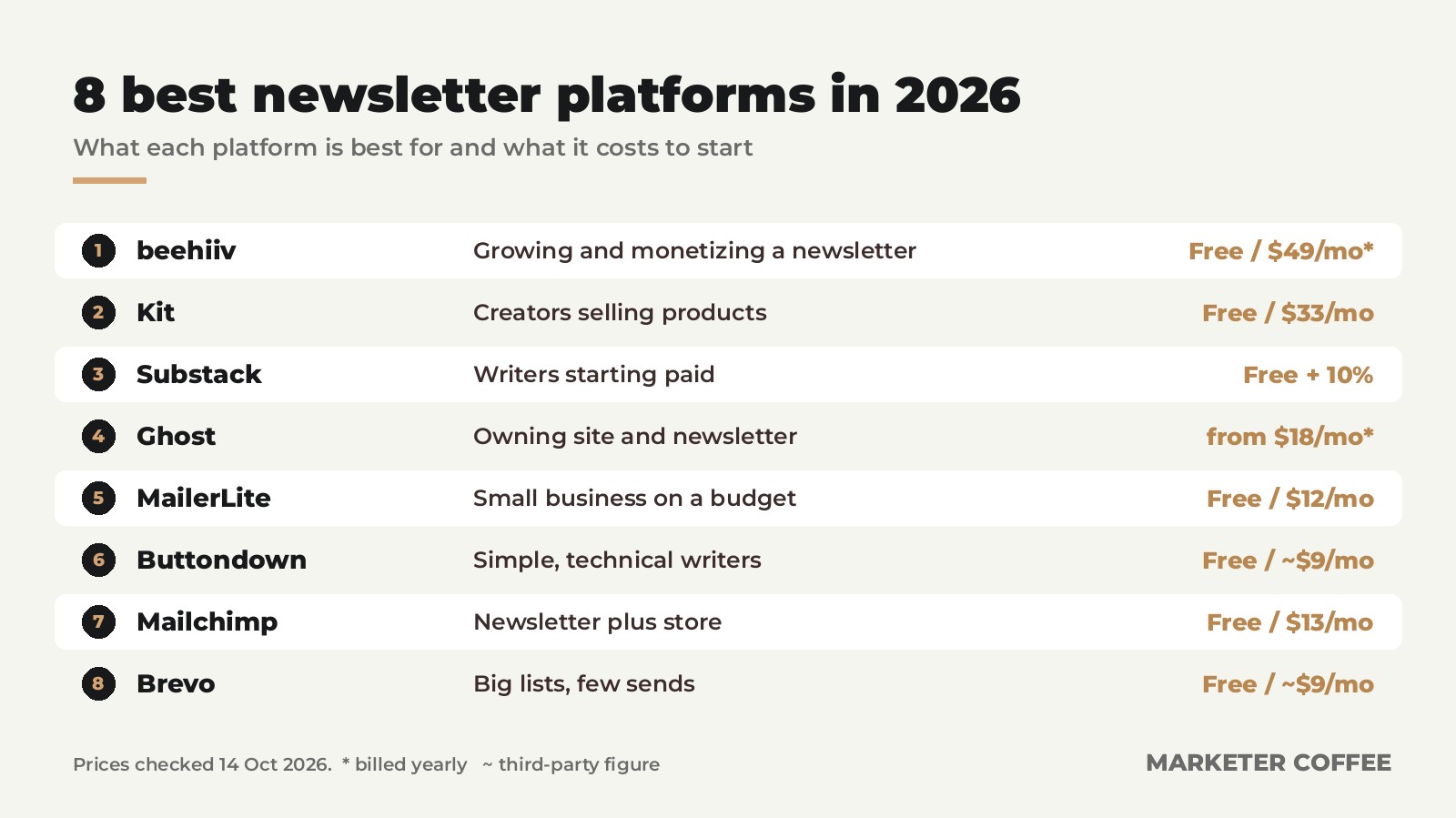
8 Best Newsletter Platforms in 2026
The platforms are ranked by how well they serve someone whose newsletter is a real part of their business, with growth and monetization weighted above price.
| Tool | Best for | Starting price | Free option |
|---|---|---|---|
| beehiiv | Growing and monetizing a newsletter | $49/mo, billed yearly (Lite) | Up to 2,500 subscribers |
| Kit | Creators who sell products | $33/mo (Creator) | Up to 10,000 subscribers |
| Substack | Writers going paid quickly | 10% of paid revenue | Free to publish |
| Ghost | Owning site and newsletter | $18/mo, billed yearly | Trial; free if self-hosted |
| MailerLite | Small business on a budget | From $12/mo | Up to 250 subscribers |
| Buttondown | Simple, privacy-minded newsletters | About $9/mo | Up to 100 subscribers |
| Mailchimp | Newsletter tied to a store | From $13/mo | Up to 250 contacts |
| Brevo | Big lists that send rarely | About $9/mo | 300 emails per day |
1. beehiiv
beehiiv was built by people who worked on the Morning Brew newsletter, and it shows. Every part of the product points at two questions: how do I get more subscribers, and how do I earn from them. The recommendation network lets newsletters suggest each other at sign-up, the Ad Network offers sponsorships you can accept or decline per issue, and paid subscriptions carry no platform fee, only Stripe’s processing.
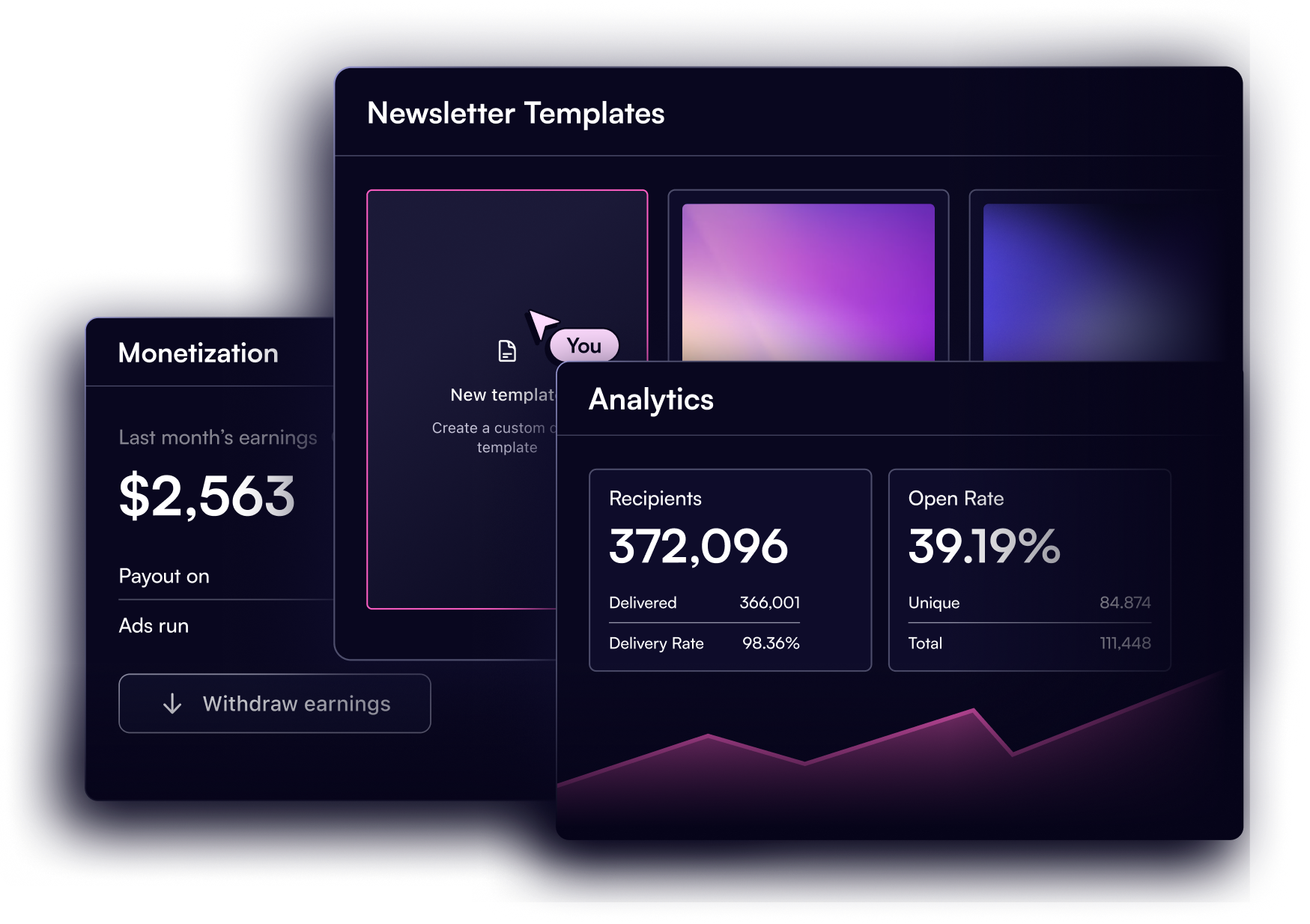
It has also grown well past email. Every plan now includes a website, podcast hosting, a community space and digital products, and the Lite plan adds automations, A/B tests and an MCP server that lets Claude or ChatGPT read and, since recently, write to your publication. For anyone who cares about SEO, the hosted website is a real advantage over pure email tools, because each issue becomes a page that can rank.
Where it falls short is the October price change. Lite now covers lists up to 100,000 and Pro up to 250,000, but the monthly bill climbs with list size, and The Verge reported that Lite at 10,000 subscribers went from $109 to $139 a month on monthly billing. Some publishers also complained that ad rates had dropped. The pricing page shows yearly prices only, so check the monthly figure for your list size before you commit.
Pick beehiiv if the newsletter is the business and you want growth and ad revenue built in. I go through it in more detail in my beehiiv review.
2. Kit (formerly ConvertKit)
Kit is the platform for people whose newsletter feeds a business: an author with a book, a coach with a programme, a YouTuber with a course. Its strength is automation that a non-technical person can build. Visual Automations turn a landing page sign-up into a welcome sequence, tag people by what they click and move them towards a sale, all on one canvas.
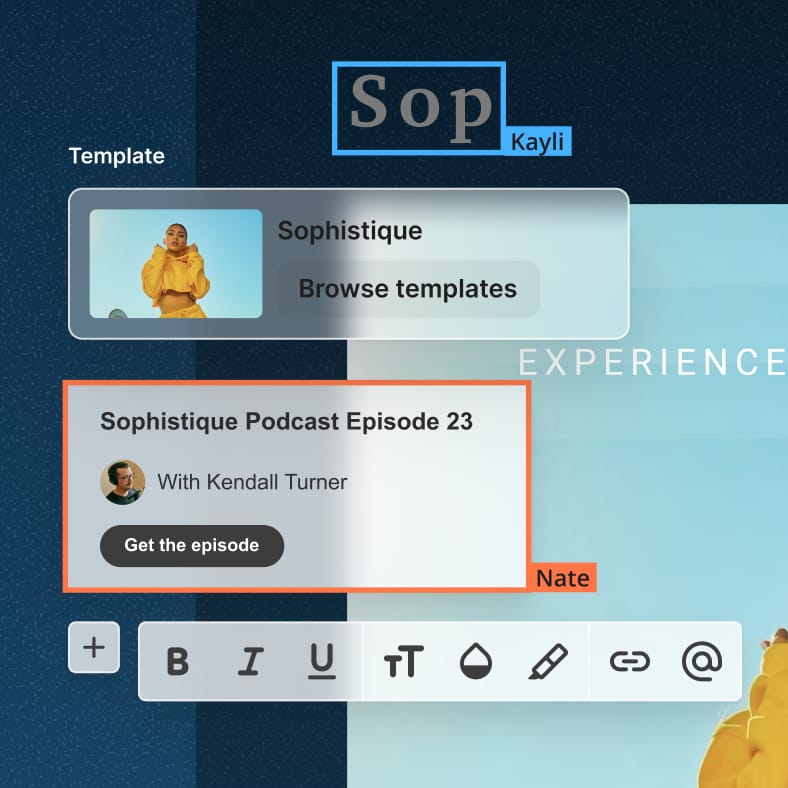
The free plan is the most generous on this list: up to 10,000 subscribers with unlimited broadcasts, landing pages, forms and the ability to sell digital products and subscriptions. Paid plans add automations, Kit’s own MCP server, SMS, a creator recommendation network and, on Pro, a referral system and deliverability reports.
The catch is how fast the bill grows. The pricing page quotes Creator at $33 a month, or $390 a year, for 1,000 subscribers and Pro at $50 for the first year only, with $66 shown as the regular price. Kit also lists a 3.5% plus 30 cents transaction fee on sales, which includes card processing. There is no native ad marketplace and no hosted website as complete as beehiiv’s or Ghost’s.
Pick Kit if you sell something and need email to do the selling while you sleep.
3. Substack
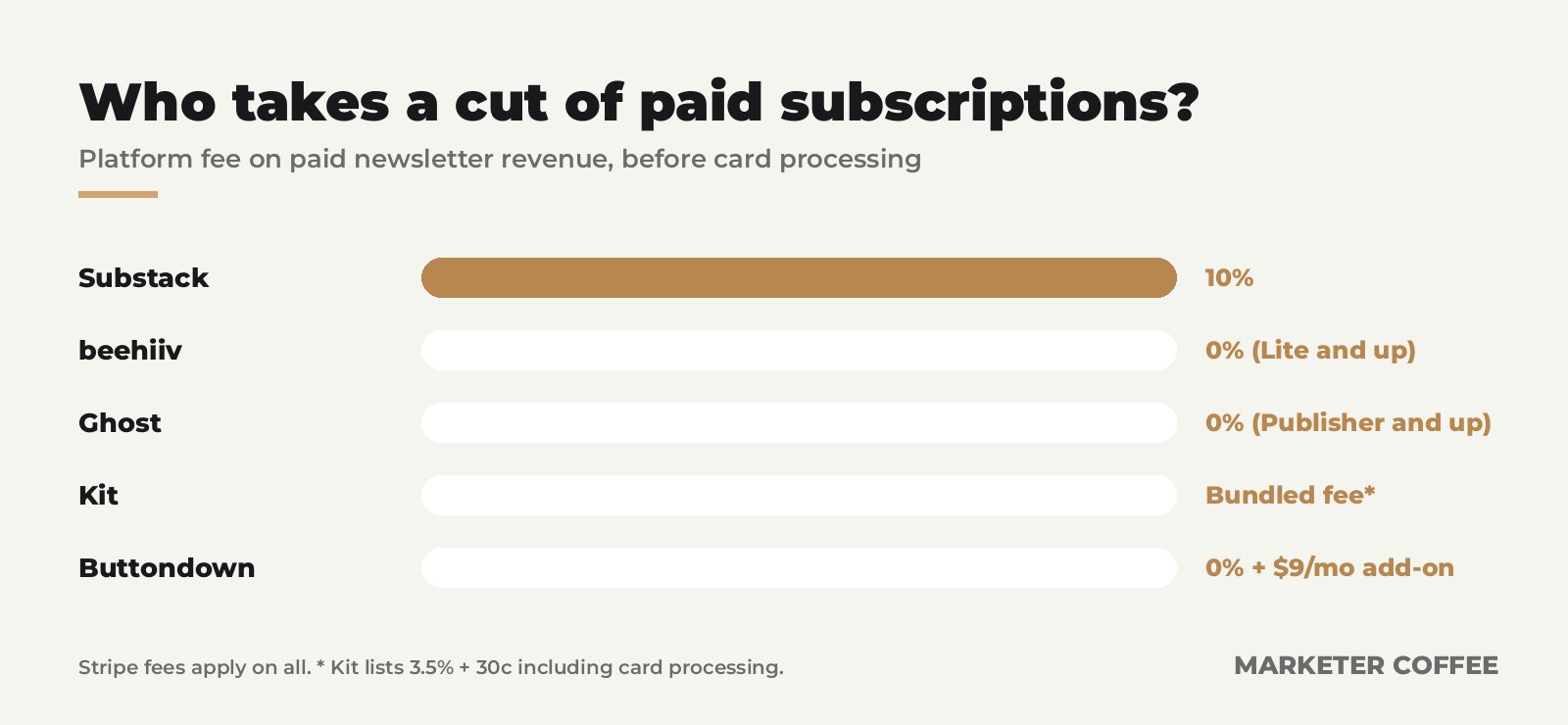
Substack costs nothing until you earn something. You sign up, write, and turn on paid subscriptions when you are ready; Substack keeps 10% of what readers pay, and card processing comes on top. The company said it passed five million paid subscriptions in March 2025, and in January 2026 it launched Substack TV, a beta app for Apple TV and Google TV.
Its real advantage is the network. The Substack app, Notes and cross-publication recommendations put your work in front of readers who already pay for other newsletters, which no other platform here can match for a writer starting from zero. The editor is simple, and podcasts, video and live sessions sit in the same place.
The 10% is what makes people leave. At $10,000 a month in subscriptions, Substack takes $1,000, which pays for a lot of beehiiv or Ghost. Customization is limited, your readers come to know Substack’s brand as much as yours, and the archive helps Substack’s domain authority more than your own unless you set up a custom domain. Substack’s own page on going paid explains the split.
Pick Substack if you are a writer first and want to test whether people will pay before you spend anything.
4. Ghost
Ghost is a publishing platform first and a newsletter tool second, which is exactly why some serious independent publications use it. You get a real website with themes, tags, authors and a members area, and every post can go to email, the web or both. It is open source, run by a non-profit foundation, and you can host it yourself if you have the skills.
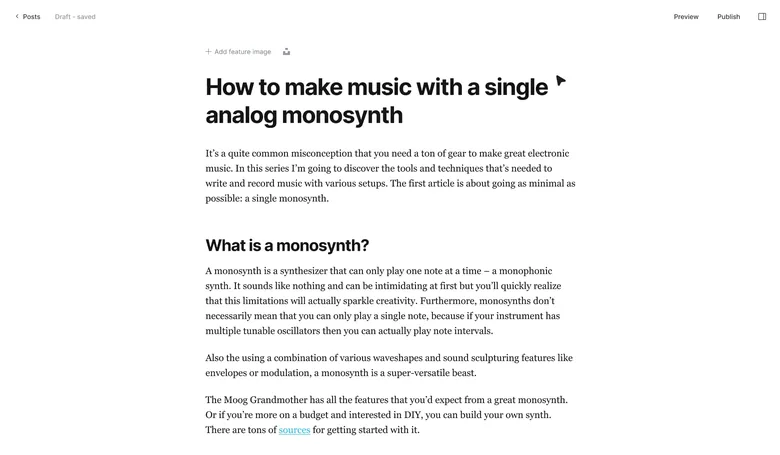
From an SEO point of view, Ghost is the strongest option here. Your archive lives on your domain, the templates are fast and the technical basics are handled well, so each issue can become a page that ranks. The Publisher plan and above take 0% of paid memberships, and native analytics, offers and promotions are built in.
The cheapest Starter plan does not include paid subscriptions at all, so most paid newsletters start at $29 a month on Ghost(Pro), and the price rises with members. Growth tools are thinner than beehiiv’s: there is a recommendations feature, but no ad marketplace and no referral programme out of the box. Self-hosting saves money and costs you time.
Pick Ghost if you are building a publication and want the website, not just the email, to be yours.
5. MailerLite
MailerLite is the tool I would point a small business owner to if they asked for “something like Mailchimp, but cheaper and easier”. The drag-and-drop editor is clean, automations are simple to set up, and it includes landing pages, sign-up forms, a website builder and paid newsletter subscriptions through Stripe.

It has kept up with the AI shift better than its price suggests. There is an MCP server for Claude and ChatGPT on every plan, so you can ask an assistant to compare your last ten campaigns or draft the next one, with full API and MCP access from the first paid tier.
The free plan has shrunk to 250 subscribers, which is now a trial in practice. The plans have also been renamed to Comfort and Power, and the pricing page only shows starting prices of $12 and $25 a month, so you need to move the slider to see what your list size costs. There is no recommendation network or ad marketplace, which matters if the newsletter itself is the product.
Pick MailerLite if the newsletter supports a business rather than being one.
6. Buttondown
Buttondown is a small, independent tool that does one thing carefully. You write in Markdown or a rich text editor, send from your own domain, and get a hosted archive. It has no tracking pixels by default if you do not want them, a good API, and a reputation among developers and technical writers for being pleasant to use.
The pricing model is unusual. The base plan is cheap, and features are add-ons: paid subscriptions, tagging, analytics, sponsorships and RSS-to-email cost $9 a month each, while automations and an archive on a custom domain cost $29 a month each. The pricing page did not show the base prices to me, so the $9 figure above comes from a third-party listing.
It has almost no growth tools and very few reviews on G2, so treat its rating as a single opinion. Pick Buttondown if you want a quiet, well-built tool and do not need a recommendation network.
7. Mailchimp
Mailchimp is the name everyone knows, and it is still a solid choice when the newsletter sits next to a store or a booking system. It connects to most ecommerce platforms, has decent templates and reporting, and the Standard plan adds predictive segmentation, dynamic content and generative AI at no extra cost.

As a pure newsletter tool it has fallen behind. The free plan now allows 250 contacts and 500 emails a month, it has no paid subscriptions of the kind beehiiv or Substack offer, and pricing by contacts means unsubscribed or inactive people can still cost you money if you do not clean the list. Mailchimp’s pricing also jumps sharply at Premium, which starts at $350 a month.
Pick Mailchimp if your newsletter is really a store’s email programme. For ecommerce brands, the comparison with Klaviyo and Omnisend is in my email marketing services ranking.
8. Brevo
Brevo, formerly Sendinblue, prices by emails sent rather than by contacts. That one detail makes it the cheapest option on this list for a company with a large list that sends a monthly newsletter, because you do not pay for people who sit in the database between sends.

It also covers SMS, WhatsApp and transactional email, has a CRM and recently added AI agents for marketing and data analysis. For a business that wants one tool for newsletters, order confirmations and the occasional SMS, that range is useful.
It is not a creator platform. There is no paid subscription model, no recommendation network and no hosted publication worth the name. The free plan’s 300-a-day limit also means a list of 2,000 needs seven days to receive one newsletter. The pricing page did not render prices for me, so the Starter figure comes from a third-party comparison.
What Is the Best Free Newsletter Platform?
The best free newsletter platform is Kit if you need a large list, because its free plan allows up to 10,000 subscribers, and beehiiv if you want growth tools and a website, with up to 2,500 subscribers free.
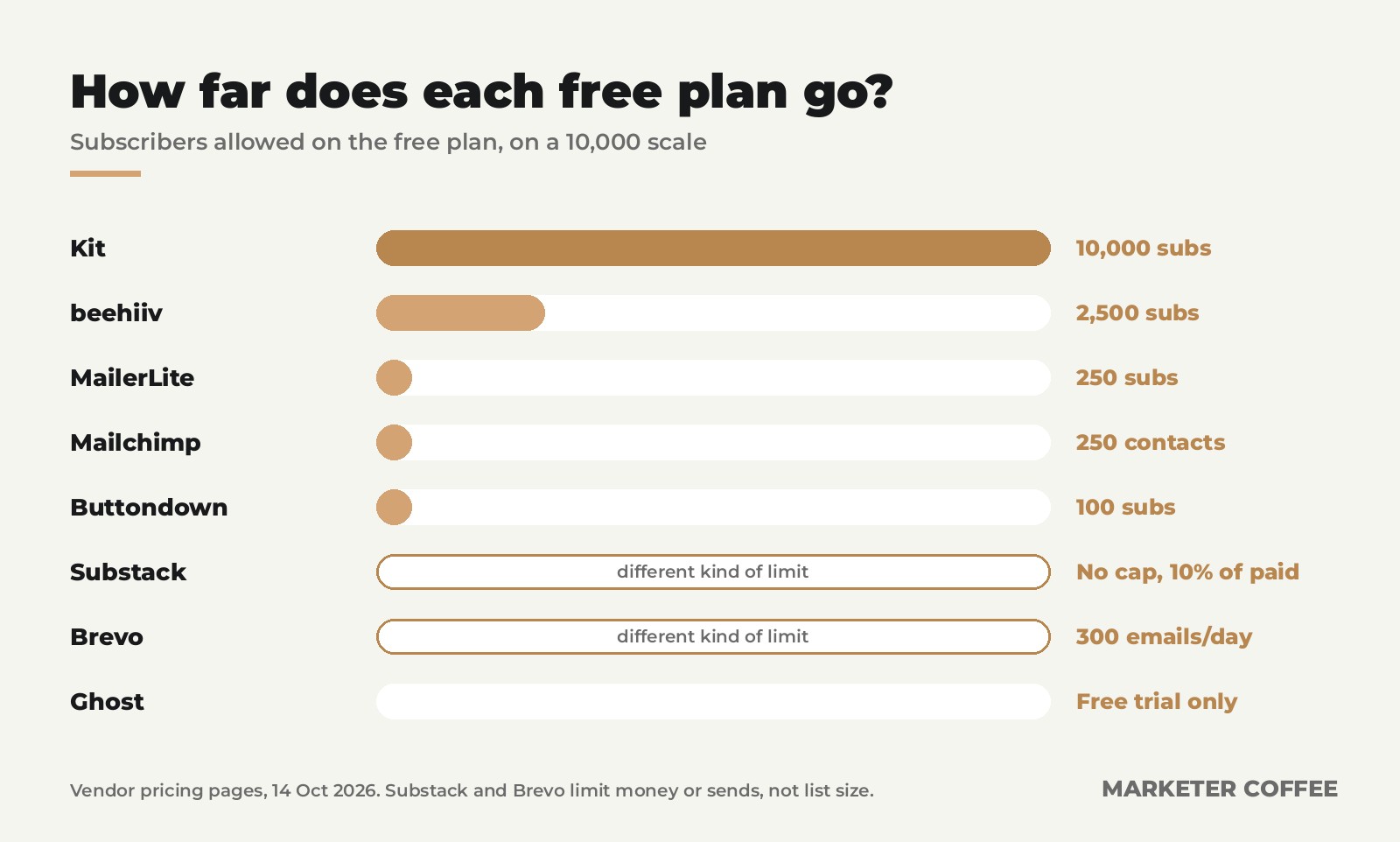
Substack is free too, but in a different way: there is no list limit, and you pay 10% once readers pay you. Mailchimp and MailerLite now stop at 250, which is enough to learn the tool and not enough to run a newsletter. Ghost has no free hosted plan, though the software itself is free if you host it.
Is beehiiv or Substack Better?
beehiiv is better if you want to own the business and keep more of the revenue, and Substack is better if you are a writer who needs readers more than tools.
The money question is simple arithmetic. Substack takes 10% of paid revenue; beehiiv takes 0% and charges a monthly fee instead. Once paid revenue passes a few thousand dollars a month, beehiiv’s subscription costs less than Substack’s cut. Below that, Substack is cheaper and its network can bring readers you would not find otherwise. beehiiv’s ad marketplace and website builder matter more for publishers who earn from sponsors, and its archive helps your own domain.
Can a Newsletter Help Your SEO?
A newsletter helps SEO when its issues are published as indexable pages on your own domain, and it helps indirectly by bringing people back to content that then earns links and mentions.
Email itself does not rank. What ranks is the web version of each issue, so the questions to ask are whether the archive sits on your domain, whether each post gets its own URL and title, and whether the platform lets you control metadata. Ghost and beehiiv do this well. Substack does it on a custom domain. Tools without a real archive leave that traffic on the table. If the newsletter is part of a wider content plan, it belongs in your SEO strategy rather than beside it, and for stores, in your ecommerce SEO work. A good sign-up page matters too; I compare tools for that in the guide to landing page builders.
FAQ: Newsletter Platforms
Short answers to common questions about choosing a newsletter builder.
What is the best newsletter platform overall?
beehiiv is the best newsletter platform for most people who treat their newsletter as a business, thanks to its recommendation network, ad marketplace, 0% fee on paid subscriptions and hosted website. Kit is the better choice for creators who sell their own products.
What is the cheapest newsletter platform?
Kit’s free plan is the cheapest way to run a real newsletter, with up to 10,000 subscribers at no cost. For paid plans, MailerLite starts at $12 a month and Brevo is cheapest for large lists that send rarely, because it charges per email rather than per contact.
Which newsletter platform takes no cut of paid subscriptions?
beehiiv on Lite and above and Ghost on Publisher and above take 0% of paid subscription revenue. You still pay Stripe’s card processing fees. Substack takes 10%.
Can I move my newsletter from Substack to beehiiv or Ghost?
Yes. beehiiv, Ghost and Kit all import Substack subscriber lists and posts, and paid subscribers can usually be moved through Stripe. Set up redirects from the old archive if it was on a custom domain, so search engines follow the posts to the new address.
Do I need a newsletter platform or an email marketing service?
Choose a newsletter platform if the emails are the product and you want paid subscriptions, recommendations or sponsorships. Choose an email marketing service if the emails support a store or a sales process and you need automation, segmentation and integrations.
Turn Your Newsletter Archive Into Search Traffic
A newsletter builds the audience you own. Search brings the readers who have not found you yet. Marketer Coffee is a Poland-based SEO agency that works with SaaS and ecommerce brands across the US, UK and Europe, at rates 40% to 60% below comparable US and UK agencies, and we help companies turn the content they already publish, newsletters included, into pages that rank. Every engagement starts with a free preliminary audit and a 90-day plan.
See how we work in SaaS SEO Services, Ecommerce SEO Services and International SEO Services. For a sense of what content without link building can do, the Planika Fires case study shows a previously unindexed domain reaching 1,052 monthly US visits from seven articles.
Written by Adrian Dąbrowiecki, founder of Marketer Coffee and SEO consultant with 7+ years in SaaS and ecommerce, specializing in topical authority and semantic SEO. Prices checked on each vendor’s pricing page on 14 October 2026; Buttondown and Brevo base prices come from third-party listings (Toolradar, Moosend) because their pricing pages did not display them. Ratings: G2. Sources: beehiiv, The State of Newsletters 2026; PPC Land on beehiiv’s October 2026 pricing; GroupMail on Mailchimp’s 2026 free plan; Substack (Wikipedia). Screenshots belong to their respective vendors. No affiliate links.