




beehiiv is the best choice in 2026 for people who run a newsletter as a business and want growth and monetization built in. It is a worse fit if you mainly need ecommerce automation or want the lowest possible bill as your list grows. I am Adrian Dąbrowiecki, founder of Marketer Coffee, an SEO agency for SaaS and ecommerce brands. This beehiiv review is based on beehiiv’s own documentation, its pricing page as of 14 October 2026, public reporting on the October price change and user reviews. It covers what the platform does well, where it falls short, what it really costs and which alternatives make more sense in which cases.
The timing matters. On 1 October 2026 beehiiv renamed its plans from Launch, Scale and Max to Free, Lite and Pro, raised the subscriber limits, and changed prices. New customers pay the new rates now, and existing customers move over at their first renewal on or after 1 November. If you read a beehiiv review written before October, its pricing section is out of date.
What Is beehiiv?
beehiiv is a newsletter platform that combines an email editor, a hosted website, subscriber growth tools and built-in ways to earn money, such as paid subscriptions and a sponsorship marketplace.
It launched in 2021, started by people from the team behind the Morning Brew newsletter, and it was designed around their problem: how to grow a free newsletter to a large audience and make it pay. That origin explains most of its design choices. Where Mailchimp is built for a business that sends email, beehiiv is built for a business that is the email.
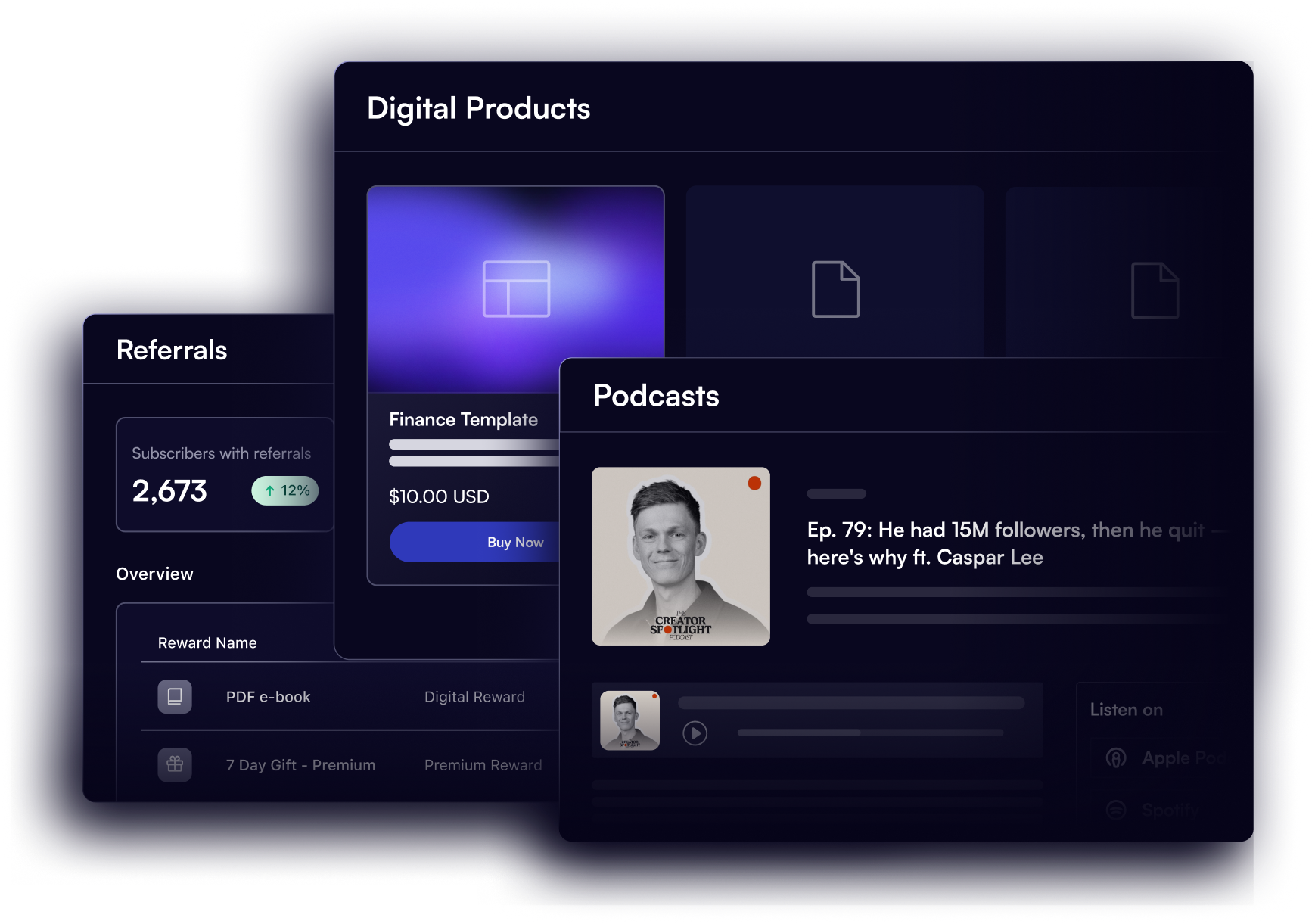
It has since spread well beyond newsletters. Every plan now includes a website, podcast hosting, digital products and a community space, and beehiiv has added an MCP server so AI assistants can work with your publication. In its State of Newsletters 2026 report, beehiiv says it sent more than 28 billion emails in 2025 and reached more than 255 million unique readers.
What beehiiv Does Well
beehiiv does three things better than most of its competitors: it helps a newsletter grow, it gives you several ways to earn from it, and it publishes everything on a website you can rank in search.
Growth comes first. The recommendation network lets you suggest other newsletters to your new subscribers and get recommended by them in return, which is how many small newsletters get their first few thousand readers. On top of that, there are referral programmes, polls, A/B testing and audience segments. For most owned channels, the hardest part is the first thousand people, which is why I would weight tools that solve distribution above tools that solve design.
Monetization is the second strength. Paid subscriptions carry no platform fee on any paid plan; beehiiv’s pricing page states that it takes 0% of paid subscription and digital product revenue, so you pay only Stripe’s 2.9% plus 30 cents per transaction. Compare that with Substack’s 10%. There is also the Ad Network. If you are on Lite or above, beehiiv shows you up to 15 sponsorship offers, you pick the ones that fit, add up to three ads per post and get paid on the 20th of the following month through Stripe. Offers pay either per thousand unique opens or per verified click, and you see an estimated payout before you accept. beehiiv also launched On-Demand Ads for premium sponsors.

The third strength is the one I care most about as an SEO consultant. Every issue is published as a web page on a site beehiiv hosts for you, and you can put it on your own domain. That turns a newsletter archive into a library of pages that can rank, attract links and send new subscribers back to you. Email-only tools cannot do that, and Substack does it mostly for Substack’s own domain unless you pay for a custom one.
The AI side has moved quickly too. The beehiiv MCP server is now available to everyone on Lite and above, and it recently gained write access, so an assistant like Claude can do more than read your stats. Pro includes AI credits inside the product. I would still treat AI as an assistant for analysis and first drafts rather than a writer for a newsletter whose value is a human voice.
Where beehiiv Falls Short
beehiiv falls short on price predictability after the October 2026 change, on deep marketing automation, and on how much of its monetization story depends on factors outside your control.
Price is the main complaint right now. According to reporting by The Verge, summarized by PPC Land, Lite at 10,000 subscribers went from $109 to $139 a month on monthly billing, and Pro at the same size from $219 to $239. PPC Land adds that beehiiv’s own page shows $119 and $199 for those tiers on yearly billing. Either way, the bill now rises steeply with list size, and a publisher with 10,000 free subscribers and little revenue pays real money for growth tools they may not be using yet. Matt Brown of Extra Points argued publicly that for publishers under 10,000 subscribers, especially outside the US, the cost may not be worth it.
Ad revenue is the second weak spot. The Ad Network is a genuine advantage, but its value depends on demand from advertisers, your audience’s location and your open rates. After the price change, some publishers said sponsor choices and ad rates had dropped. beehiiv’s own pricing page lists ad monetization at an average of $39 a month on Lite, which is a useful reality check: for most small newsletters, ads cover part of the bill, not a salary.
Automation is the third. beehiiv has automations, now in their fourth version, and they cover welcome sequences, onboarding and simple branches well. They are not built for an online store. There is no deep product catalogue sync, no abandoned cart flow based on browsing data, and no SMS. If email exists to sell products from a shop, an ecommerce tool like Klaviyo or Omnisend will do far more with the same list.
Smaller points: the free plan keeps beehiiv branding, analytics on Free look back only 30 days, and removing branding requires Pro. G2 also has only 40 reviews of beehiiv, rated 4.5 out of 5, which is a small sample for a platform of this size.
beehiiv Pricing in 2026
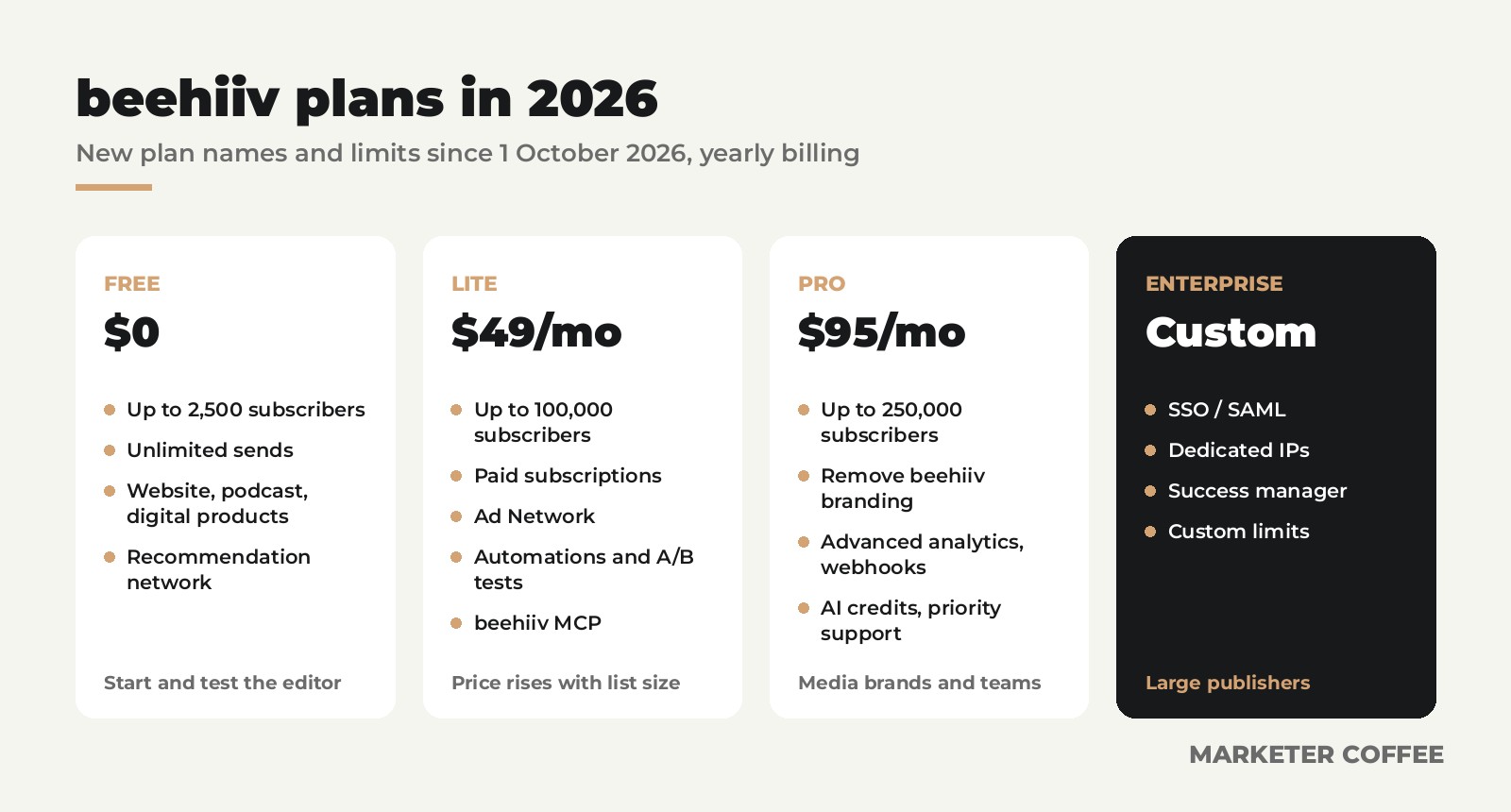
beehiiv has four plans in 2026: Free up to 2,500 subscribers, Lite from $49 a month, Pro from $95 a month and custom-priced Enterprise, with prices on yearly billing rising as your list grows.
| Plan | Price (billed yearly) | Subscribers | What it adds |
|---|---|---|---|
| Free | $0 | Up to 2,500 | Unlimited sends, website, landing pages, recommendation network, API; 1 seat; beehiiv branding |
| Lite | From $49/mo | Up to 100,000 | Paid subscriptions, Ad Network, automations, A/B tests, polls, beehiiv MCP |
| Pro | From $95/mo | Up to 250,000 | No branding, advanced analytics, AI credits, webhooks, dynamic content, priority support |
| Enterprise | Custom | Custom | SSO and SAML, dedicated IPs, success manager, custom limits |
The pricing page shows yearly prices and says yearly billing saves up to 20%. Lite and Pro come with a free trial and no card required, though the page does not state its length. The starting prices apply to the smallest list size in each plan; at 10,000 subscribers, PPC Land reports $119 a month for Lite and $199 for Pro on yearly billing. Annual customers keep their old price until the end of their term, and monthly customers get at least 30 days’ notice before a change.
The way I would read these numbers: Free is enough to test the editor and the growth network. Lite is the real starting plan for anyone who wants paid subscriptions or ads. Pro makes sense when the newsletter is a brand and you no longer want beehiiv’s logo on it, or when you need webhooks and advanced analytics for a team.
Who Should Use beehiiv?
beehiiv is the right choice for independent publishers, media startups and creators whose newsletter is the product, and who plan to earn from subscriptions, sponsors or both.
It also suits B2B companies that run a newsletter as a media property rather than as a sales funnel. A SaaS company publishing an industry newsletter, for example, gets a strong editor, a website that can rank and a growth network, without needing a full marketing automation suite. If that newsletter is part of your content plan, it is worth thinking about how its archive supports your wider B2B SaaS SEO.
beehiiv is the wrong choice for an online store whose emails exist to drive orders, for a coach or course creator who needs long, branching sales sequences, and for a writer who wants to test a paid newsletter with zero fixed cost. Those people are better served by the alternatives below.
How to Set Up beehiiv So the Archive Helps Your SEO
To make a beehiiv newsletter useful for search, publish it on your own domain, give every issue a title and URL written for a search query, and link the archive to the rest of your site.
Most newsletters are written for the inbox and forgotten on the web. That is a waste, because a good issue often answers exactly the kind of question people type into Google. These are the steps I would take on day one:
- Connect a custom domain or subdomain, such as news.yourbrand.com, so the authority that each post earns builds up for your brand rather than for a beehiiv address.
- Write the web title and URL of each post separately from the subject line. A subject line is written to be opened; a page title should match what someone would search for.
- Fill in the SEO title and description for every post, and add a short introduction that makes sense to a reader arriving from search, not only to a subscriber.
- Link from the newsletter archive to your main site and back, so readers and search engines can move between them. A strong sign-up page helps here; I compare tools for that in my guide to landing page builders.
- Check in Google Search Console after a few weeks which issues get impressions, and update those first. The method I use is described in how to track SEO results.
None of this needs the Pro plan. It needs a decision, early on, that the archive is a content asset. Moving years of posts to a new domain later is possible with redirects, but it almost always costs some traffic in the transition.
beehiiv Alternatives
The main beehiiv alternatives are Substack for writers who want a built-in readership, Kit for creators who sell products, Ghost for publishers who want full ownership, and Klaviyo or MailerLite for businesses whose email supports a store or a service.
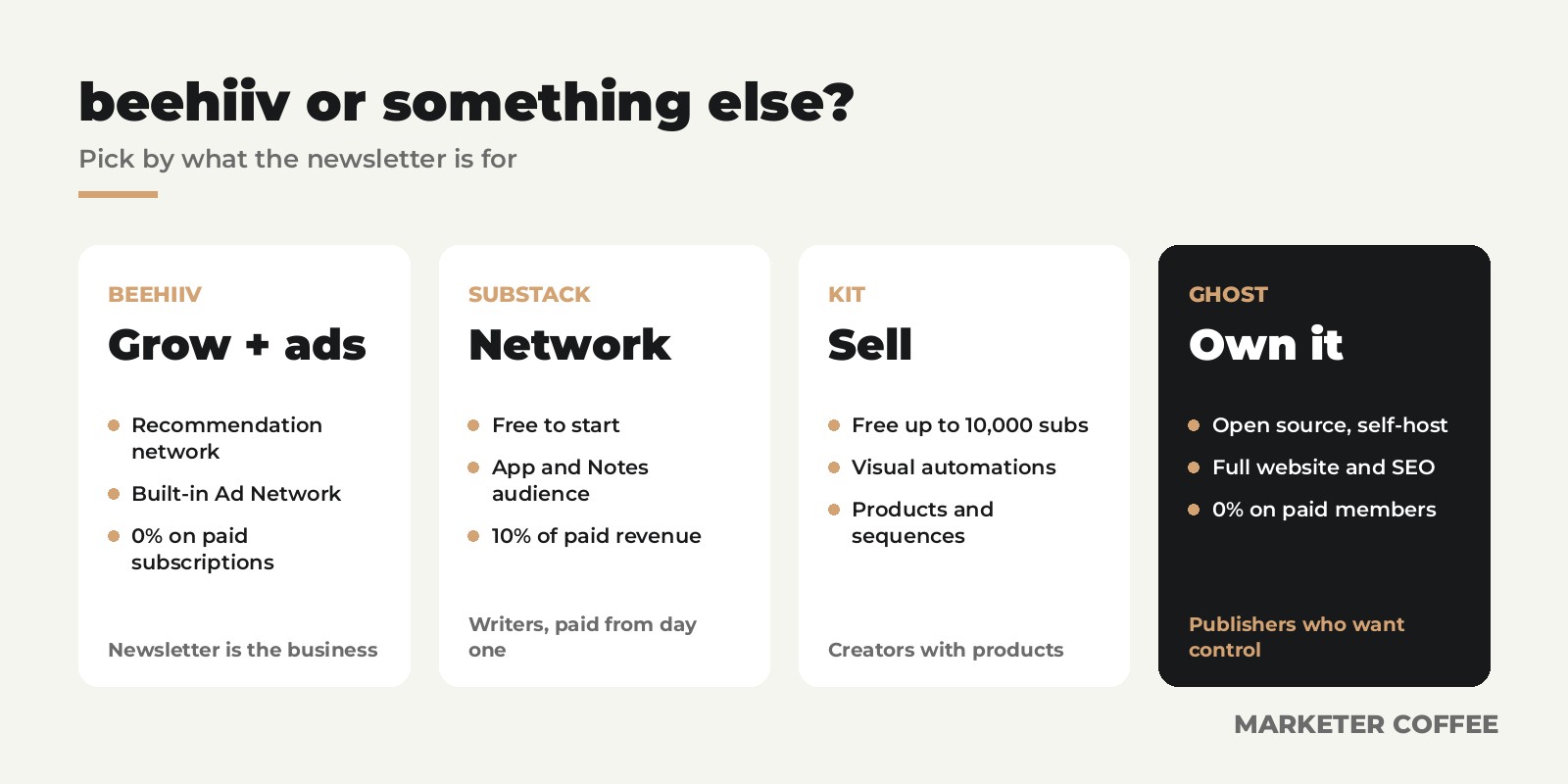
Substack is free to start and takes 10% of paid revenue, so it is cheaper than beehiiv until your paid income reaches a few thousand dollars a month. Its app and Notes give writers an audience beehiiv cannot match. Kit’s free plan allows up to 10,000 subscribers and its visual automations are better for selling courses and books. Ghost is open source, takes 0% of paid memberships from the Publisher plan and gives you the strongest website for SEO, at the cost of thinner growth tools. I compare all of them, with prices, in my ranking of the best newsletter platforms.
If your emails serve a business rather than being the business, look at the best email marketing services instead, where Klaviyo and Omnisend lead for ecommerce and MailerLite for small companies.
Verdict: Is beehiiv Worth It?
beehiiv is worth it if your newsletter is a business you intend to grow, because it combines growth, monetization and a rankable website in one place better than any competitor, but it is no longer the cheap option it was before October 2026.
I would pick beehiiv for a new independent publication, a media brand or a B2B newsletter that should earn its own audience. I would not pick it for a store, and I would think twice if the list is large, the revenue is small and the main need is simply sending a weekly email. In that case, Kit’s free plan, Substack or MailerLite will do the job for less. If you do choose beehiiv, put the publication on your own domain from day one and treat the archive as an SEO asset, not a by-product.
FAQ: beehiiv
Short answers to the questions people ask most about beehiiv.
Is beehiiv free?
Yes. beehiiv has a free plan for up to 2,500 subscribers with unlimited sends, a website, landing pages and the recommendation network. Paid subscriptions, the Ad Network and automations require Lite, which starts at $49 a month on yearly billing.
Does beehiiv take a cut of paid subscriptions?
No. beehiiv takes 0% of paid subscription and digital product revenue. You pay Stripe’s standard processing fee of 2.9% plus 30 cents per transaction.
How does the beehiiv Ad Network pay?
Publishers on Lite or above choose from sponsorship offers that pay per thousand unique opens or per verified click. Earnings are paid on the 20th of the following month into a beehiiv wallet through Stripe Express.
Is beehiiv better than Substack?
beehiiv is better for publishers who want to keep all subscription revenue, earn from sponsors and own their website. Substack is better for writers who want to start for free and reach readers through Substack’s app and network.
Did beehiiv raise its prices in 2026?
Yes. On 1 October 2026 beehiiv renamed its plans to Free, Lite and Pro and changed prices. Existing customers move to the new pricing at their first renewal on or after 1 November 2026.
Make Your Newsletter Archive Work in Search
A newsletter gives you the audience you own, and search brings the readers who have not found you yet. Marketer Coffee is a Poland-based SEO agency for SaaS and ecommerce brands in the US, UK and Europe, working at rates 40% to 60% below comparable US and UK agencies. We help companies turn what they already publish, newsletter archives included, into pages that rank. Every engagement starts with a free preliminary audit and a 90-day plan.
See the details in SaaS SEO Services, Ecommerce SEO Services and International SEO Services, or look at the Planika Fires case study, where a previously unindexed domain reached 1,052 monthly US visits with seven articles and no link building.
Written by Adrian Dąbrowiecki, founder of Marketer Coffee and SEO consultant with 7+ years in SaaS and ecommerce, specializing in topical authority and semantic SEO. Prices and plan details checked on beehiiv’s pricing page on 14 October 2026. Ad Network details from beehiiv’s Ad Network page. Rating: G2. Sources: beehiiv, The State of Newsletters 2026; PPC Land, citing The Verge, on beehiiv’s October 2026 pricing; beehiiv product updates. Screenshots belong to beehiiv. No affiliate links.

Pingback: 8 Best Newsletter Platforms in 2026 (Free and Paid)