
The best landing page builders in 2026 are Unbounce for paid campaigns that live on A/B tests, Landingi for teams that run many pages in many languages, Instapage for ad-to-page personalization, and HubSpot when the page has to feed a CRM. I am Adrian Dąbrowiecki, an SEO consultant who spends a lot of time on landing pages from the search side, and I should say up front that I write for Landingi and have worked on its SEO. Below are ten landing page creators with current prices, what each one does well, where each one falls short, and how to choose between a dedicated builder and a website platform.
The biggest change this year is that landing page builders started talking to AI assistants. Unbounce and Leadpages now ship MCP servers that let Claude or ChatGPT build pages, start A/B tests and pull reports, and Landingi has announced Orbit, its own MCP connection. Every major builder also generates a first draft from a prompt now, so the difference between tools has moved from “can it make a page” to “what happens after the page is live”.
What Is a Landing Page Builder?
A landing page builder is software that lets you design, publish and test single-purpose web pages, usually for an ad campaign or an offer, without writing code or touching your main website.
The point of a separate tool is speed and focus. A marketer can launch a page for a Google Ads campaign in an afternoon, connect the form to a CRM and split traffic between two versions, all without a developer ticket. The page lives on a subdomain like go.yourbrand.com, so a broken experiment never touches the main site.
The line between landing page builders and website builders has blurred. Webflow, Framer and Elementor can build excellent landing pages too, and Leadpages now builds multi-page sites. The practical difference is in testing and traffic tools. Dedicated builders give you A/B testing, dynamic text that matches the ad a visitor clicked, and conversion reporting out of the box. Website platforms give you better design freedom and pages that sit on your main domain, which matters if you want the page to rank in search, not just convert paid clicks.
How I Chose These Tools
I looked at what each builder does after the page is published, because that is where most of the value is: testing, personalization, reporting, integrations and how easily the pages can be indexed when they should be. I also weighed price against the traffic and page limits you actually get.
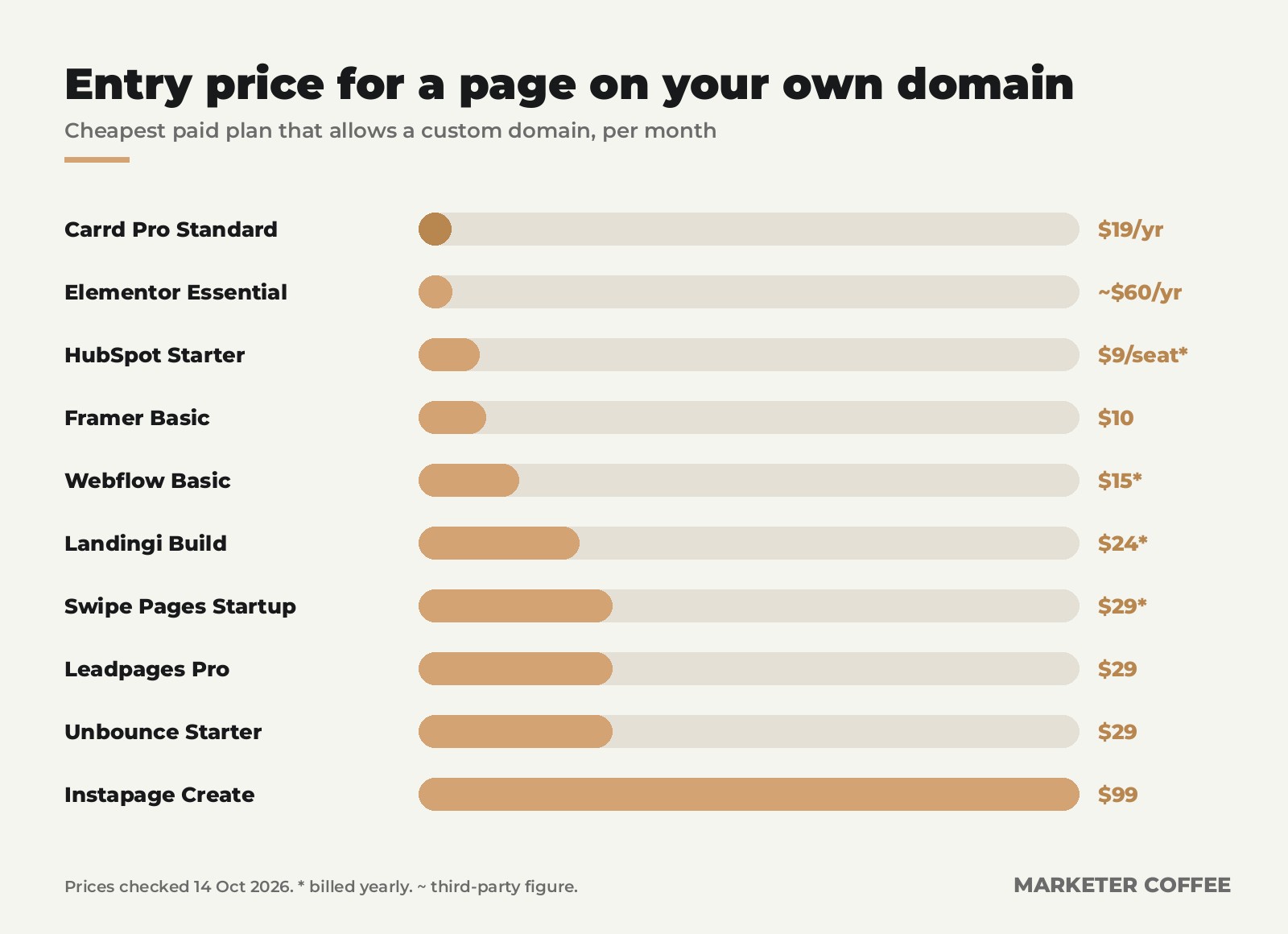
Every price below was checked on the vendor’s own pricing page on 14 October 2026. Where a vendor shows only yearly billing or hides the figure, I say so. Ratings come from G2. None of the links in this article are affiliate links.
A disclosure that matters more than usual here. I write content for Landingi and have worked on its SEO, including the programme in our Landingi case study. That means I know the product well and I also have a reason to be biased. I ranked it second, behind Unbounce, because Unbounce still has the more mature testing and AI traffic tools, and I have tried to describe Landingi’s weak spots as plainly as everyone else’s. Treat my view of it with that in mind.
For context on what “good” looks like: Unbounce’s Conversion Benchmark Report, built on more than 41,000 landing pages and 57 million conversions, put the median landing page conversion rate across industries at 6.6%. The builder does not get you there on its own. It just makes testing your way toward it cheaper.
10 Best Landing Page Builders in 2026
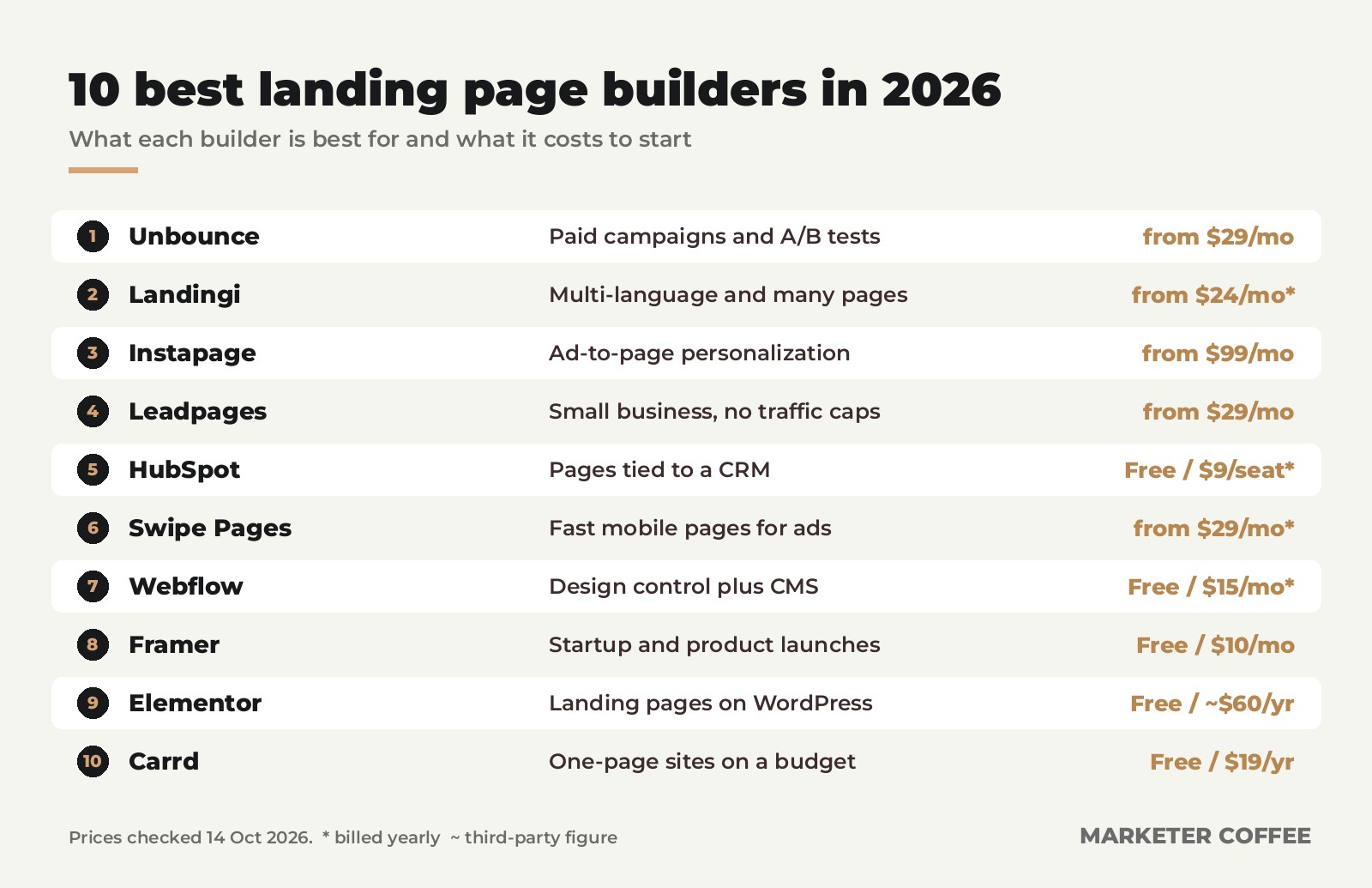
The ten tools are ranked by how well they handle the full job of a campaign page, from building it to testing and improving it, with price as a tiebreaker.
| Tool | Best for | Starting price | Free option |
|---|---|---|---|
| Unbounce | Paid campaigns and A/B testing | $29/mo (Starter) | 14-day trial |
| Landingi | Many pages, many languages | $24/mo, billed yearly | 14-day trial |
| Instapage | Ad-to-page personalization | $99/mo | 14-day trial |
| Leadpages | Small businesses, no traffic caps | $29/mo | 7-day trial |
| HubSpot | Pages connected to a CRM | $9 per seat/mo, billed yearly | Free tools |
| Swipe Pages | Fast mobile pages for ads | $29/mo, billed yearly | 14-day trial |
| Webflow | Design control with a CMS | $15/mo, billed yearly | Free plan |
| Framer | Startup and product launch pages | $10/mo | Free plan |
| Elementor | Landing pages inside WordPress | About $60/yr (Essential) | Free plugin |
| Carrd | One-page sites on a tiny budget | $19/yr (Pro Standard) | Free plan |
1. Unbounce
Unbounce is the builder I would hand to a performance marketing team that lives in Google Ads and Meta. The editor is flexible, popups and sticky bars are built in, and A/B testing and dynamic text replacement are standard from the Experiment plan. Smart Traffic, its AI routing feature, sends each visitor to the variant they are most likely to convert on, which is useful when you do not have enough traffic for a clean A/B test.
The newest part is the MCP server, available on all plans including the trial. It lets you build pages, start tests, deploy winning variants and pull performance reports from Claude or ChatGPT. For an agency managing dozens of campaign pages, that is the first feature in years that changes daily work rather than adding another menu.
Where it falls short is the plan ladder. Starter is limited to five pages and 500 visitors a month, which is a trial in disguise. Real work starts at Build for $99 a month, A/B testing needs Experiment at $149, and Smart Traffic needs Optimize at $249. Yearly billing takes about 25% off, according to the pricing page. Pick Unbounce if testing is the reason you want a landing page tool in the first place.
2. Landingi
Disclosure first: I write for Landingi and have worked on its SEO, so read this section knowing that. Landingi is a Polish landing page platform built for scale. Its strongest features are the ones that matter when you run more than a handful of pages: Smart Sections that update a shared header or offer block across every page at once, automatic translation of content, forms and SEO settings into more than 35 languages, and programmatic landing pages that generate hundreds of pages from one template and a CSV or API feed.
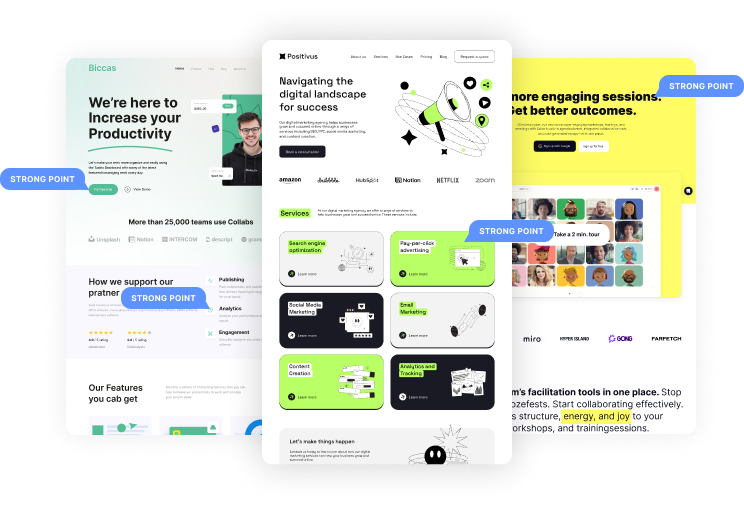
The AI layer has grown this year. Lunar generates a full editable page from a brief and is included from the Build plan. Solis reviews page performance and suggests changes, and Orbit connects Landingi to external AI assistants over MCP, although at the time of writing the site still calls Orbit “coming soon” in one place and available in another. The editor uses free placement rather than a strict grid, which designers like and which can make mobile layouts need more manual checking.
The weak spots are real. There is no free plan, the trial is capped at 200 visits, and the Build plan allows only 10 pages and 2,000 visits a month. A/B testing, Smart Sections, EventTracker and multi-language features start at Optimize, which is $119 a month on yearly billing; the pricing page does not list monthly-billing prices. Pick Landingi if you run campaigns across several countries or need dozens of near-identical pages. Pick Unbounce if you run a few pages and test them hard.
3. Instapage
Instapage is built for advertisers who want every ad group to land on a page that says exactly what the ad said. AdMap shows your campaigns, ad groups and ads next to the pages they point to, and Collections turn one page into many variants for different audiences, locations or use cases. Global Blocks update shared elements across all of them.

The builder itself is precise and fast, with real-time collaboration and comment threads that suit agencies sending pages for client review. AI writes headlines and full page variations for testing, and AI experiments route ad traffic toward the better variant.
The cost is the barrier. There is no plan under $99 a month, the trial requires a card and caps visitors at 2,500, and the Convert tier with the most personalization is sales-only. Check the current limits on the plans page. If you spend serious money on paid search, the price is small next to the ad budget. If you do not, it is hard to justify.
4. Leadpages
Leadpages has reinvented itself around AI this year. You describe what you sell and it drafts a page, then you can expand that page into a multi-page site with a blog. Routines run scheduled AI tasks, such as weekly performance summaries or monthly A/B test ideas, and an MCP server lets you publish pages from Claude, ChatGPT, Cursor or automation tools like n8n and Make.
The pricing model is its strongest point. No plan has a traffic cap, which is unusual in this category and helpful for a small business whose page suddenly gets shared. A/B testing starts at Grow, and Smart Traffic, heatmaps and multivariate tests sit in Optimize at $199 a month.
The pricing page is not fully consistent: the FAQ mentions a $399 Scale plan and page limits that the main table does not show, so confirm with sales before you commit. The trial is also only seven days. Pick Leadpages if you are a small team that wants AI to do most of the drafting and does not want to watch visitor quotas.
5. HubSpot
HubSpot’s landing page builder is part of Content Hub, and you can start for free. Its value is not the editor, which is decent and template-driven, but what happens to a lead after the form is submitted. The contact lands in the CRM, joins the right list, triggers an email and shows up in the same attribution report as your ads and emails.
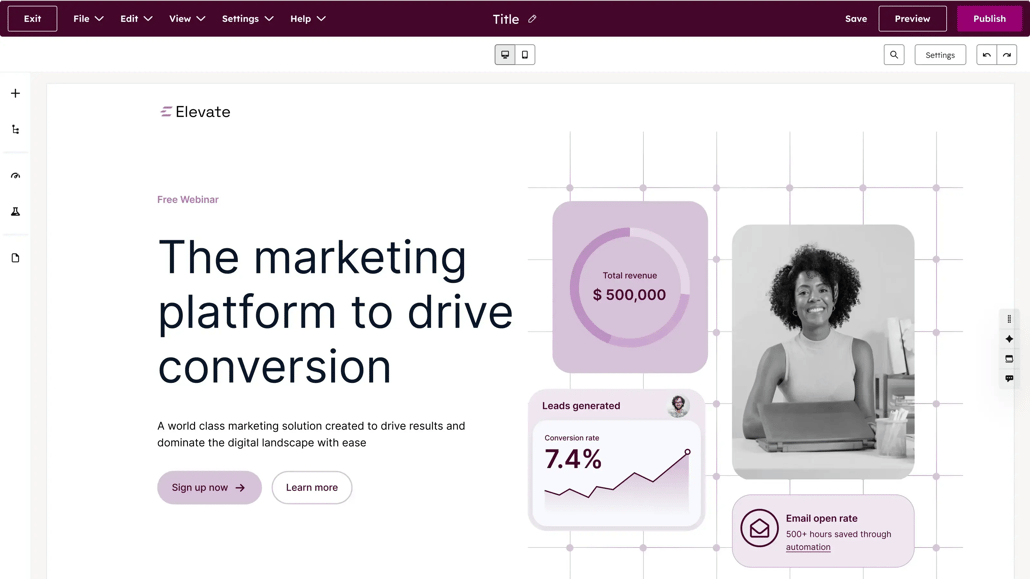
Personalization by lifecycle stage or list membership is a quiet strength. A returning customer and a first-time visitor can see different headlines on the same URL, with no extra tool. An AI builder drafts pages from a prompt too.
The catch is how HubSpot prices growth. Starter is cheap, but A/B testing and the stronger reporting sit in Professional, which HubSpot’s own pricing guide lists at $800 a month for three seats plus a $3,000 onboarding fee. The main pricing page did not render its figures for me, so the Starter number comes from HubSpot’s pricing guide. Pick HubSpot if your company already runs on it. Do not move to HubSpot just for the landing pages.
6. Swipe Pages
Swipe Pages is the smallest company on this list and the highest rated on G2. It is built mobile-first, with AMP support and a reputation for pages that load quickly, which matters for ad Quality Scores and for anyone buying mobile traffic. A/B testing, funnels and an AI page builder are included, and pages, conversions and funnels are unlimited on every plan.
It is a landing page tool and nothing else. Reviewers on G2 ask for more templates and more native integrations, and it does not build multi-page websites. Visits are capped by plan, with overages at $5 per extra 5,000 visits.
The pricing page shows only yearly prices: $29, $69 and $149 a month for Startup, Marketer and Agency. The Agency plan includes unlimited client subaccounts, which makes it one of the cheaper options for agencies building pages for many clients.
7. Webflow
Webflow is a website platform, not a landing page tool, but many SaaS teams build their campaign pages in it because the pages sit on the main domain and share the site’s design system. The visual editor gives designers almost full control over layout and interactions, and the CMS makes it easy to produce pages from structured content.
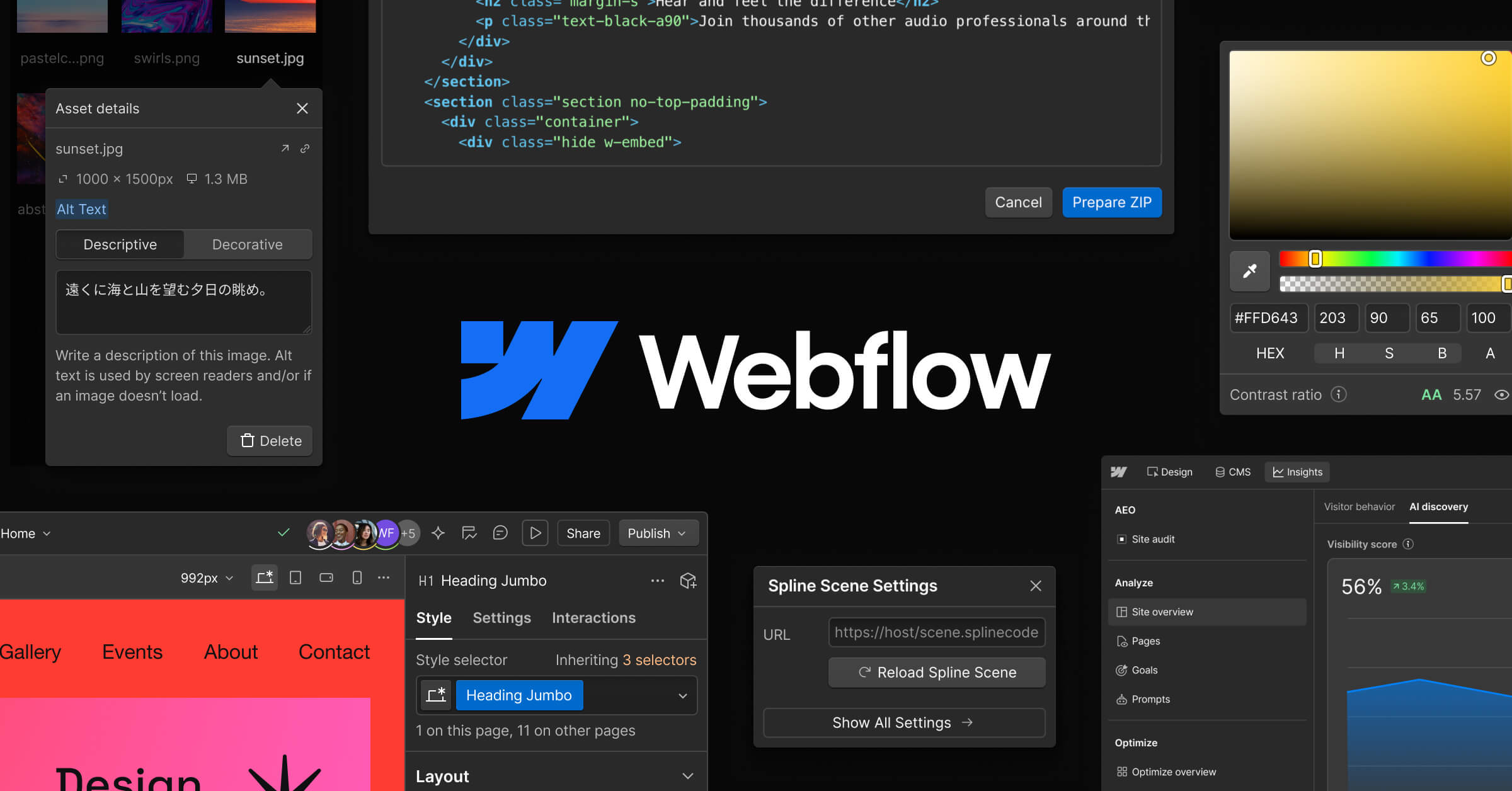
Webflow AI now builds sections and full sites, generates code components and suggests SEO and AEO fixes. A/B testing is not native; it comes through the paid Webflow Optimize add-on. That is the main reason it ranks below the dedicated builders for campaign work.
The site plans start at $15 a month for Basic with a custom domain, and Premium at $25 adds the CMS. Team features need a separate Workspace plan. Pick Webflow if your landing pages should also earn organic traffic, which a subdomain on a dedicated builder rarely does well.
8. Framer
Framer is where many startups build their first site and their launch pages, because it produces polished, animated pages faster than anything else here. It works like a design tool, so designers can publish directly without handing a file to a developer. AI agents, powered by monthly credits, help draft pages, sections and translations.
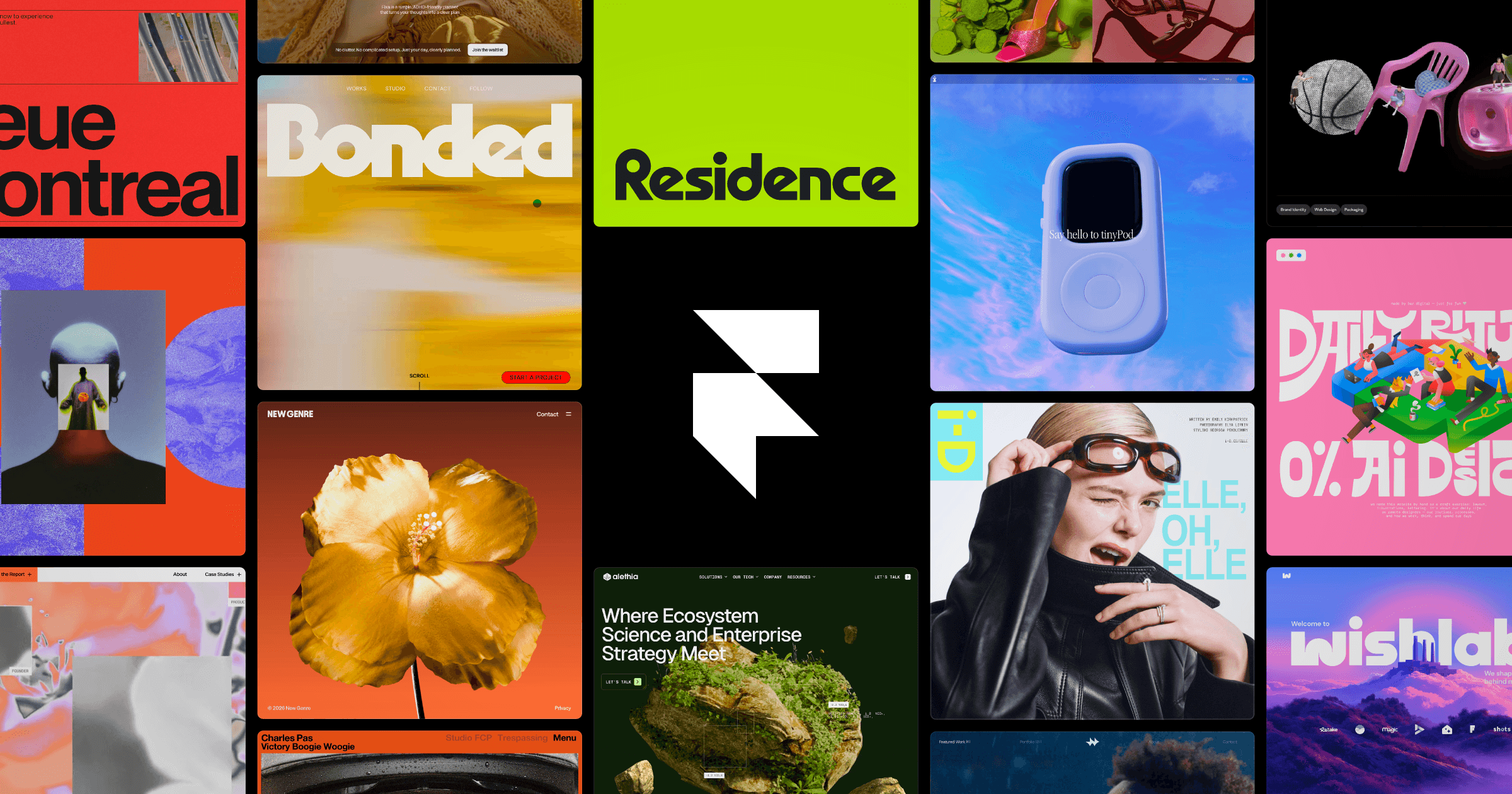
Like Webflow, it is not a conversion tool first. There is no built-in A/B testing to match Unbounce or Landingi, form handling is basic, and AI translation locales cost $20 each. The pricing page lists Basic at $10 and Pro at $30 a month, with the free plan limited to a Framer subdomain. Pick Framer if the page has to look exceptional and you will measure conversions in a separate analytics tool.
9. Elementor
If your site already runs on WordPress, Elementor is the cheapest way to build landing pages that live on your own domain, use your own hosting and share your SEO plugin’s settings. The free plugin covers the basics; Pro adds the form builder, popups and theme building. The One plans add Elementor AI for copy, images, layouts and code, and Angie, its agentic AI, builds WordPress assets from a prompt.
The weak points are the usual WordPress ones. Pages can get heavy and slow if nobody watches the widgets and plugins, and there is no native A/B testing. Elementor’s pricing page did not show figures when I checked; the $60 a year for Essential comes from a third-party summary dated September 2026 and matches the “from $60/year” in Elementor’s own page description.
10. Carrd
Carrd builds one-page sites and nothing more, and it is by far the cheapest tool here. Pro Standard costs $19 a year and gives you ten sites with custom domains, forms and embeds. For a waitlist page, an event, a personal page or a quick test of a product idea, it does the job in an hour.
There is no A/B testing, no CRM, no personalization and no AI drafting worth mentioning. Pro Lite at $9 a year does not even include custom domains or forms, so most people need Standard. The Pro plans page lists every tier. Pick Carrd when the page only has to exist and look clean.
Which Landing Page Builder Should You Choose?
Choose by what the page has to do after launch: paid traffic needs testing, scale needs templates and translation, lead nurturing needs a CRM, and organic search needs your main domain.
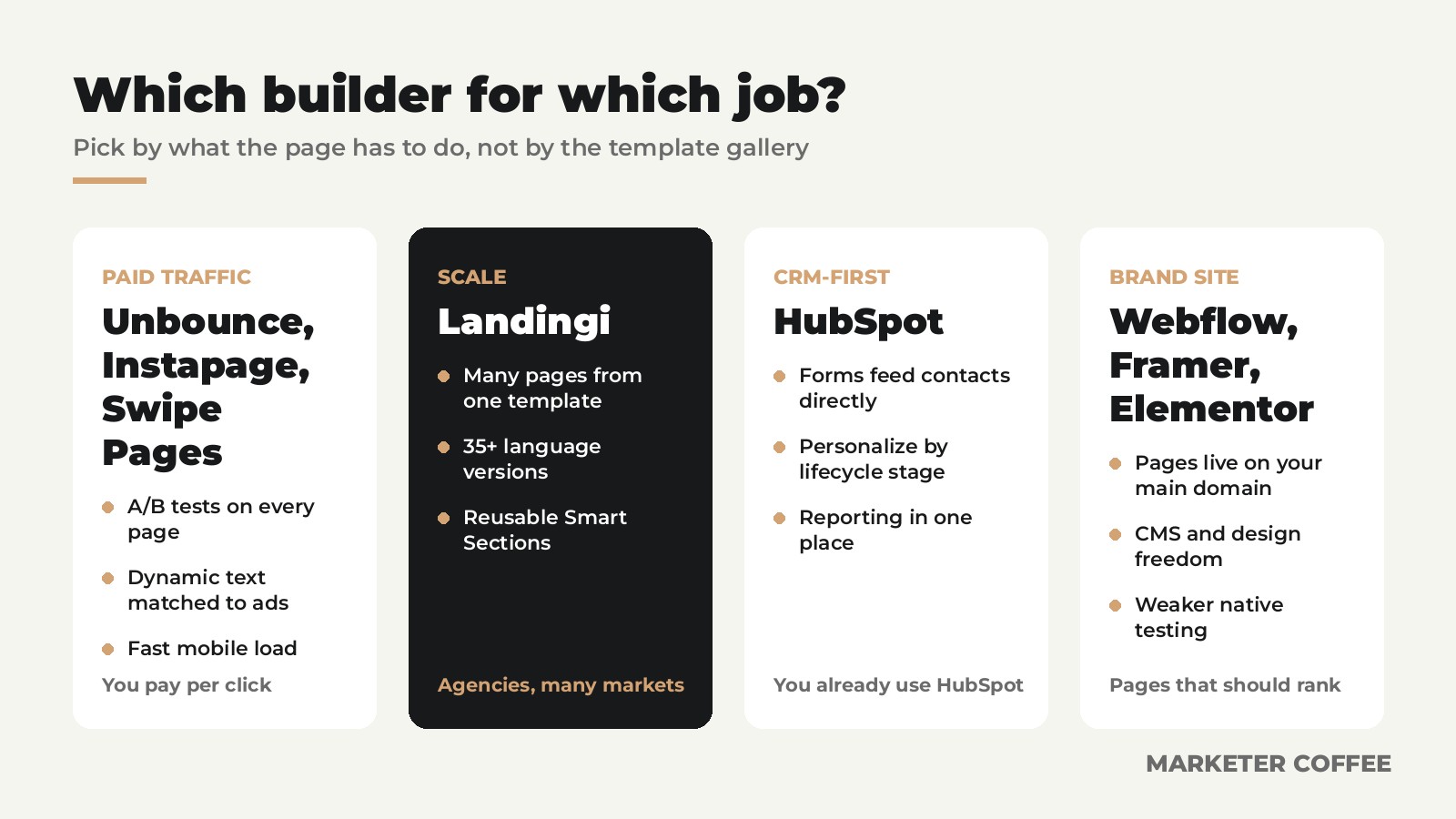
If you pay per click, the testing tools matter most, so look at Unbounce, Instapage or Swipe Pages. If you run many pages, many markets or programmatic campaigns, Landingi’s Smart Sections, translation and bulk generation save the most time. If your sales team works in HubSpot, use HubSpot’s pages and accept the limits. If the page should also rank in Google, build it on your main site with Webflow, Framer or Elementor, because a subdomain on a separate tool rarely builds much authority.
Whichever you pick, set up conversion tracking before the first visitor arrives. Builder dashboards count form submissions; they do not tell you which of those became customers. How I track that end to end is in Measuring SEO: How to track SEO results?, and the tools I would use for it are in the best marketing analytics tools.
What Is the Best Free Landing Page Builder?
The best free landing page builder is HubSpot, because its free tools include landing pages connected to a free CRM, so leads do not end up in a spreadsheet.
Webflow, Framer and Carrd also have free plans, but all three limit you to their own subdomain, which looks unprofessional on an ad. Elementor’s free plugin is a good option if you already pay for WordPress hosting. The dedicated builders, Unbounce, Landingi, Instapage, Leadpages and Swipe Pages, offer only trials.
Are Landing Pages Good for SEO?
Landing pages built for ads are usually poor for SEO, because they are thin, single-purpose and often set to noindex, while pages built for search need depth, internal links and a place on your main domain.
The two jobs pull in different directions. An ad page should remove distractions; a search page has to answer the query better than ten competitors. If a page needs to do both, build it on your main site and test it there. For the wider stack of tools that make organic pages work, see the best SEO tools in 2026, and if you are choosing a site platform at the same time, the best AI website builders compares them on SEO readiness.
FAQ: Landing Page Builders
Short answers to the questions that come up most when teams choose a landing page creator.
What is the best landing page builder overall?
Unbounce is the best landing page builder overall for paid campaigns, thanks to its A/B testing, Smart Traffic and new MCP server. Landingi is the stronger choice for teams running many pages in several languages.
What is the cheapest landing page builder?
Carrd is the cheapest, at $19 a year for ten sites with custom domains. Among dedicated builders with A/B testing, Swipe Pages at $29 a month on yearly billing is the cheapest, followed by Leadpages Grow at $99 a month.
Which landing page builders have A/B testing?
Unbounce, Landingi, Instapage, Leadpages, Swipe Pages and HubSpot Professional all include A/B testing. Webflow offers it through the paid Optimize add-on, while Framer, Elementor and Carrd have no native A/B testing.
Can AI build a landing page for me?
Yes. Landingi, Leadpages, Unbounce, HubSpot, Webflow, Framer and Elementor all generate a first draft from a prompt. The draft still needs a human to check the offer, the copy and the tracking before it goes live.
Do I need a landing page builder if I have WordPress?
Not necessarily. Elementor or a similar WordPress builder can create landing pages on your own domain. A dedicated builder becomes worth it when you need A/B testing, dynamic text for ads or many pages managed by marketers without touching the main site.
Turn Landing Pages Into Organic Traffic
A landing page builder gets a campaign live. Getting the pages that matter to rank, in several markets, is a separate job, and it is the one we do at Marketer Coffee. We are a Poland-based SEO agency working with SaaS and ecommerce brands across the US, UK and Europe, at rates 40% to 60% below comparable US and UK agencies, and every engagement starts with a free preliminary audit and a 90-day plan.
See how we work in SaaS SEO Services, International SEO Services or Ecommerce SEO Services. The Landingi case study shows the result of that work for a landing page company itself: 375% organic growth over 29 months across eight language versions.
Written by Adrian Dąbrowiecki, founder of Marketer Coffee and SEO consultant with 7+ years in SaaS and ecommerce. Disclosure: Adrian writes content for Landingi and has worked on its SEO. Prices checked on each vendor’s pricing page on 14 October 2026; HubSpot Starter comes from HubSpot’s pricing guide and Elementor Essential from The Plus Addons (September 2026) because their pricing pages did not display figures. Ratings: G2. Statistics: Unbounce, Conversion Benchmark Report. Screenshots belong to their respective vendors. No affiliate links.