



What is a subdirectory in a URL?
A subdirectory is a path segment between the domain and the page that groups related URLs under one folder. In https://example.com/de/shop/shoes/ the domain is example.com, /de/ is the language subdirectory and /shop/shoes/ are nested folders below it. Google’s SEO Starter Guide recommends grouping topically similar pages into directories on sites with more than a few thousand URLs, because it helps Google learn how often each section changes and crawl it at the right rate.
Subdirectories serve 2 main purposes in SEO:
- Content sections: /blog/, /help/, /category/.
- Market versions: /pl/, /de/, /en-gb/, /cs/.
Subdirectory vs subdomain vs ccTLD
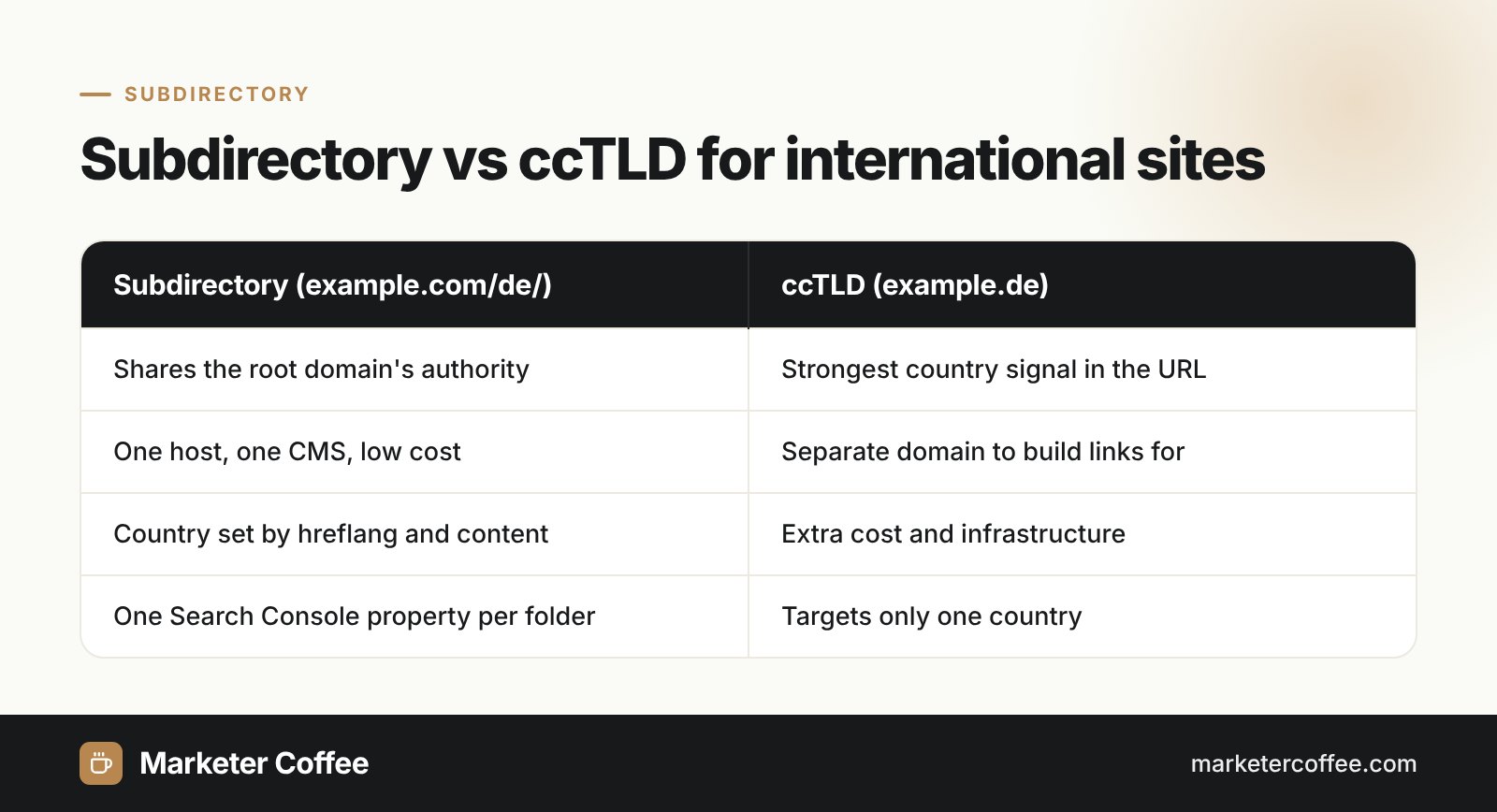
A subdirectory is the simplest of the 3 structures, but it gives Google the weakest country signal from the URL alone. Google Search Central compares the options in its guide to multi-regional sites, which was last updated in December 2025:
| Structure | Example | Strengths | Weaknesses |
|---|---|---|---|
| ccTLD | example.de | Strongest country signal, clear separation | Cost, extra infrastructure, one country per domain |
| Subdomain | de.example.com | Easy setup, separate hosting possible | Unclear if “de” means language or country |
| Subdirectory | example.com/de/ | Easy setup, low maintenance, one host | Country not obvious from URL, one server location |
| URL parameter | example.com?loc=de | None worth the risk | Not recommended by Google |
Read more in the entries on the ccTLD and the subdomain.
How do subdirectories work in international SEO?
Subdirectories work in international SEO by putting each market in its own folder on one domain and connecting the folders with hreflang. Because the URL itself does not tell Google the target country, the other signals must do that job. The H3s below cover the 3 signals I set up on every subfolder launch.
Hreflang between folders
Each page in /pl/, /de/ and /cs/ lists all its equivalents with hreflang annotations, plus an x-default for unmatched users. A typical head contains lines like <link rel=”alternate” hreflang=”de-DE” href=”https://example.com/de/” />. Every folder version keeps a self-referencing canonical tag, never one pointing to the English folder.
Localized content and local signals
Google names local addresses, phone numbers, currency, language and links from local sites as country signals. A /de/ folder with translated text but Polish prices in złoty sends mixed signals, so I localize prices, shipping and contact data per folder.
Search Console per folder
Search Console accepts a URL-prefix property for a single subpath, such as https://example.com/de/, and allows up to 1,000 properties per account. I add one property per market folder, so each country gets its own performance and indexing reports. Google removed the International Targeting report on 22 September 2022, so country targeting per folder is no longer set in Search Console; it now depends on hreflang and content.
In practice, a move from subdomains to folders needs a 301 redirect for every URL, updated hreflang and XML sitemaps, and a new Search Console property. I always map old and new URLs 1:1, never redirecting everything to the homepage.
Pros and cons of subdirectories
Subdirectories suit most companies entering 2 to 10 markets with one team and one CMS:
- Shared authority: links to example.com/de/ strengthen the whole domain.
- Shared crawl capacity: Google treats each hostname as a separate site for crawl budget, so folders share one host’s capacity while subdomains get their own.
- Lower cost: one domain, one certificate, one deployment.
- Weaker local trust: some buyers in Germany or the Czech Republic prefer a .de or .cz address.
- Shared risk: a technical error or penalty on the root domain affects every market folder.
Subdirectories and AI search
For AI search, a subfolder structure keeps all language versions inside one brand entity and one domain, which makes it easier for systems like Google AI Overviews or ChatGPT to connect the German and Polish pages to the same company. Consistent brand data across folders supports entity SEO in every language.
Choosing between folders, subdomains and ccTLDs? See my international SEO consultancy.
Frequently asked questions about Subdirectory
Is a subdirectory better than a subdomain for SEO?
A subdirectory is usually the safer choice for multi-market sites, because all versions share one domain's authority and one host. Google lists both as valid options, and subdomains make sense when markets need separate hosting or teams.
How do I target a country with a subdirectory?
Target a country with hreflang annotations, localized content, local currency and contact details. Google removed the Search Console country targeting setting in September 2022, so these signals now do the work.
Can I add a subdirectory to Google Search Console?
Yes, Search Console accepts a URL-prefix property for a subpath such as https://example.com/de/. It shows data only for URLs inside that folder, which gives you a per-market report.
What is the difference between a subdirectory and a subfolder?
There is no difference: subdirectory and subfolder are two names for the same part of a URL path. SEO tools and Google documentation use both terms.
Related terms
- Managing multi-regional and multilingual sites · Google Search Central
- Crawl budget management for large sites · Google Search Central
- Add a website property to Search Console · Google Search Console Help
- Google Search Console to remove International Targeting report · Search Engine Land
- SEO Starter Guide · Google Search Central
