



What is a backlink?
A backlink is an inbound link from an external domain to a page on your site, also called an incoming link, and every search engine uses it as a ranking and discovery signal. From the linking site’s point of view, the same link is an outbound link. SEO tools count both individual backlinks and referring domains, which are the unique websites that link to you.
How do backlinks work in Google?
Backlinks work as citations that pass authority and context from one page to another. In their 1998 Stanford paper, Brin and Page described PageRank as a score that grows when many pages, or a few important pages, link to a page. Each linking page splits its value between all of its outbound links. The paper also showed that anchor text often describes the target page better than the page itself, which is why anchor text still matters in link building.
Key dates in backlink history
| Year | Event |
|---|---|
| 1998 | PageRank described by Brin and Page at Stanford |
| 2005 | rel=”nofollow” introduced to fight comment spam |
| 2012 | Google Penguin launched on 24 April against link schemes |
| 2019 | rel=”sponsored” and rel=”ugc” announced on 10 September |
| 2020 | nofollow treated as a hint for crawling and indexing from 1 March |
Types of backlinks
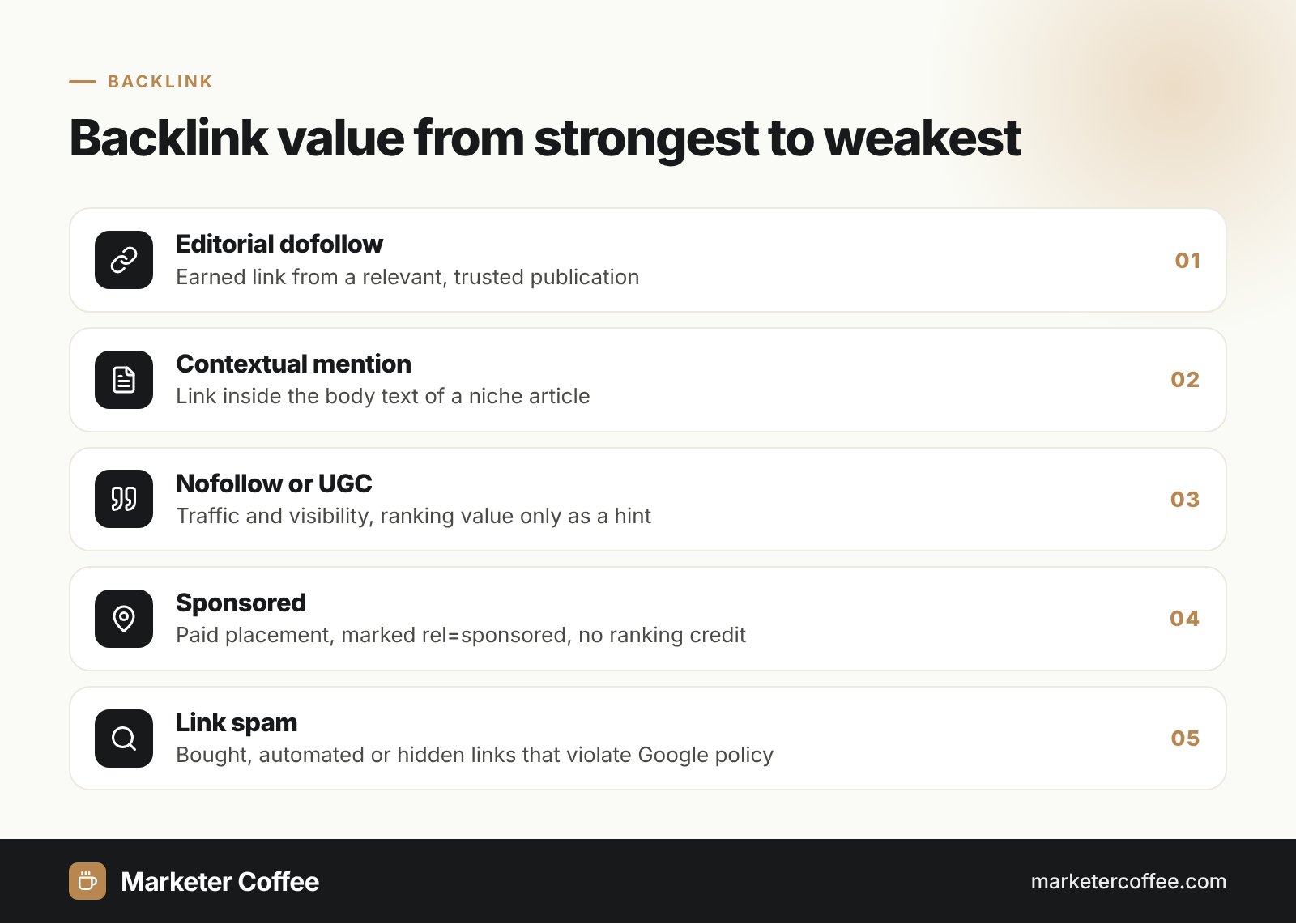
Backlinks are classified by the rel attribute that tells Google how to treat the link. Google Search Central lists three qualifiers, and a link without any qualifier is commonly called dofollow.
Dofollow links
Dofollow links have no rel qualifier and can pass ranking credit. They are the main goal of editorial link building.
Nofollow links
Nofollow links tell Google not to associate your site with the target. Since 2020 Google treats nofollow as a hint, so it may still use the link.
Sponsored links
Sponsored links mark adverts and paid placements. Google prefers rel=”sponsored” for paid links, though nofollow remains acceptable.
UGC links
UGC links mark user-generated content such as comments and forum posts.
Backlinks in SEO and AI search
Backlinks matter to marketers because they help Google discover, trust and rank a page, and they spread brand mentions that AI models learn from. In my SEO strategy work I focus on links from sites that are topically close and send real visitors. For AI search, editorial mentions on trusted publications increase the chance that a brand is cited by tools such as ChatGPT or Google AI Mode, which is a core part of GEO.
- Publish data, studies and tools that others want to cite.
- Pitch expert comments to journalists and industry media.
- Reclaim unlinked brand mentions with a short email.
- Analyse competitors’ referring domains, as in my SEO competitor analysis guide.
Good vs toxic backlinks
A good backlink is an editorial link from a relevant, trusted site, while a toxic backlink comes from a scheme meant to manipulate rankings. Google’s spam policies list buying links, excessive link exchanges, automated link creation and low-quality directories as link spam. Paid links are allowed only when marked with rel=”sponsored” or rel=”nofollow”. Aggressive tactics fall under black hat SEO and can also be pointed at your site by competitors.
| Good backlink | Toxic backlink |
|---|---|
| Earned editorially | Bought without rel=”sponsored” |
| Topically relevant site | Unrelated link farm or directory |
| Natural anchor text | Exact-match anchors repeated at scale |
| Sends real referral traffic | Hidden in footers or widgets |
How to check your backlinks
You check backlinks in Google Search Console’s Links report and in third-party link indexes. Search Console shows top linking sites and top linked pages straight from Google’s data, while tools such as Ahrefs, Semrush and Majestic add metrics, anchor text and lost links. I review new referring domains monthly and flag sudden spikes of irrelevant links for a closer look.
Frequently asked questions about Backlink
What is a backlink in SEO?
A backlink is a link from another website to a page on your site. Google treats relevant backlinks as signals of trust and uses them to discover and rank pages.
Are nofollow backlinks useful?
Nofollow backlinks can still send traffic and build brand awareness. Since 1 March 2020 Google treats nofollow as a hint, so it may use such links for crawling and indexing.
Is buying backlinks allowed?
Buying backlinks that pass ranking credit violates Google's spam policies. Paid links are allowed only when marked with rel="sponsored" or rel="nofollow".
How many backlinks do I need to rank?
No fixed number exists, because it depends on how many quality referring domains the top-ranking competitors have. Compare your referring domains with the pages that rank for your target keyword.
Related terms
- The Anatomy of a Large-Scale Hypertextual Web Search Engine · Stanford University
- Qualify your outbound links to Google · Google Search Central
- Spam policies for Google web search · Google Search Central
- Evolving nofollow: new ways to identify the nature of links · Google Search Central Blog
- Google Penguin Update · Sistrix
- 96.55% of Content Gets No Traffic From Google · Ahrefs
