What is a search engine?
A search engine is a system that matches a query with documents from its own index and ranks them by relevance and quality. It does not search the live web at the moment you type; it searches a copy of pages it has already collected. Google, Bing (the default engine in Microsoft Edge), Baidu, Yandex and Seznam all follow this model.
How does a search engine work?
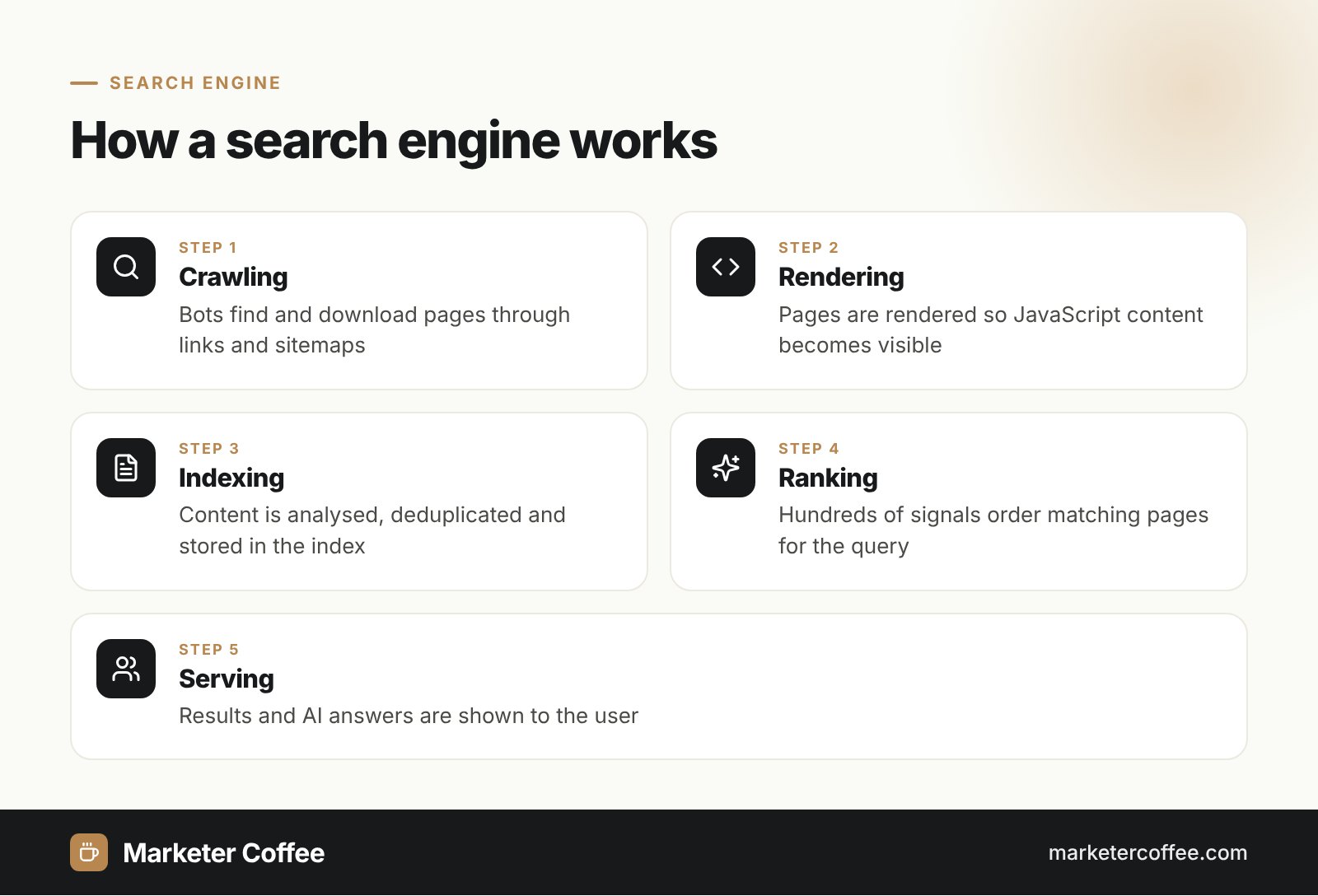
A search engine works in three stages: crawling, indexing and serving results, as Google Search Central describes them. Each stage can filter a page out, so not every URL reaches the results.
Crawling
Crawlers such as Googlebot download pages they find through links, sitemaps and previously known URLs. Googlebot renders pages with a recent version of Chrome so it can see content loaded by JavaScript. How often a site is crawled depends on its crawl budget.
Indexing
The engine analyses text, title elements and image alt attributes, groups duplicates and picks a canonical URL. Google stores the result on thousands of computers.
Serving results
For each query the engine selects matching pages from the index and orders them using hundreds of factors, including language, location and device. Backlinks have been part of this ranking since Sergey Brin and Larry Page described PageRank at Stanford in 1998.
History of search engines
The history of search engines starts with Archie in 1990 and runs to AI answer engines in the 2020s.
| Year | Search engine |
|---|---|
| 1990 | Archie, the first index of FTP files |
| 1994 | WebCrawler, first full-text web search |
| 1995 | AltaVista and Yahoo Search |
| 1997 | Google.com domain registered, Yandex presented |
| 2000 | Baidu |
| 2008 | DuckDuckGo |
| 2009 | Bing replaces MSN Search |
Search engine market share in 2026
Google holds 89.94% of the global search market, according to Statcounter data for September 2026.
| Search engine | Worldwide share (Sept 2026) |
|---|---|
| 89.94% | |
| Bing | 5.29% |
| Yahoo | 1.36% |
| Yandex | 1.30% |
| DuckDuckGo | 0.74% |
| Baidu | 0.44% |
Types of search engines
Search engines fall into four main types that marketers meet in practice.
- General web search engines: Google, Bing, Yandex.
- Privacy search engines: DuckDuckGo, Ecosia.
- Vertical search engines: Amazon, YouTube, Booking.com.
- AI answer engines: Perplexity, ChatGPT search, Google AI Mode.
Search engine vs AI answer engine
A search engine returns a ranked list of pages, while an AI answer engine returns a written answer built from several pages. The two now overlap inside Google, which runs AI Overviews and AI Mode on the same index as its classic results.
| Aspect | Classic search engine | AI answer engine |
|---|---|---|
| Output | Ranked list of links | Generated answer with citations |
| Query handling | One query, one results page | Many sub-queries per prompt |
| User effort | Compare and click several results | Read one summary, click sources if needed |
| Main SEO goal | Ranking position and CTR | Citation and brand mention |
Search engines in SEO and AI search
Search engines matter to marketers because organic visibility depends on passing all three stages for every important URL. In international projects I check which engine leads each market first: Google wins almost everywhere, but Seznam still matters in the Czech Republic and Yandex in Russia. AI features have changed what a “result” is. Google’s AI Mode and AI Overviews now cite pages inside a generated answer, and those clicks are counted in Search Console’s Web report. My SEO strategy work therefore covers both blue links and AI citations, and my history of SEO article shows how ranking has evolved.
Frequently asked questions about Search engine
What is the most popular search engine?
Google is the most popular search engine with an 89.94% worldwide share in September 2026, according to Statcounter. Bing is second with 5.29%.
What was the first search engine?
Archie, launched in 1990, is considered the first search engine. It indexed files on FTP servers, while WebCrawler in 1994 was the first to index the full text of web pages.
How does a search engine rank pages?
A search engine ranks pages by matching the query with indexed documents and weighing hundreds of signals such as relevance, quality, links, language and location. Google says it does not accept payment for higher organic rankings.
Is ChatGPT a search engine?
ChatGPT search works as an AI answer engine: it runs web searches and writes a summary with cited sources. It does not maintain a full web index in the same way as Google or Bing.
Related terms
- In-depth guide to how Google Search works · Google Search Central
- Search Engine Market Share Worldwide · Statcounter Global Stats
- Search Engine Market Share Poland · Statcounter Global Stats
- Timeline of web search engines · Wikipedia
- The Anatomy of a Large-Scale Hypertextual Web Search Engine · Stanford University