What is the Internet of Things?
The Internet of Things is the extension of the internet from computers and phones to everyday objects such as TVs, watches, cars, meters and factory machines. Each “thing” has an identifier, a sensor or actuator and a connection, so it can report its state or receive commands. The term was coined by Kevin Ashton in 1999 during a presentation at Procter & Gamble, according to Professor Duncan McFarlane of the University of Cambridge. Ashton co-founded the Auto-ID Centre, a partnership of around 100 companies and 7 universities, including MIT and Cambridge, that worked on RFID as a successor to the barcode.
How does IoT work?
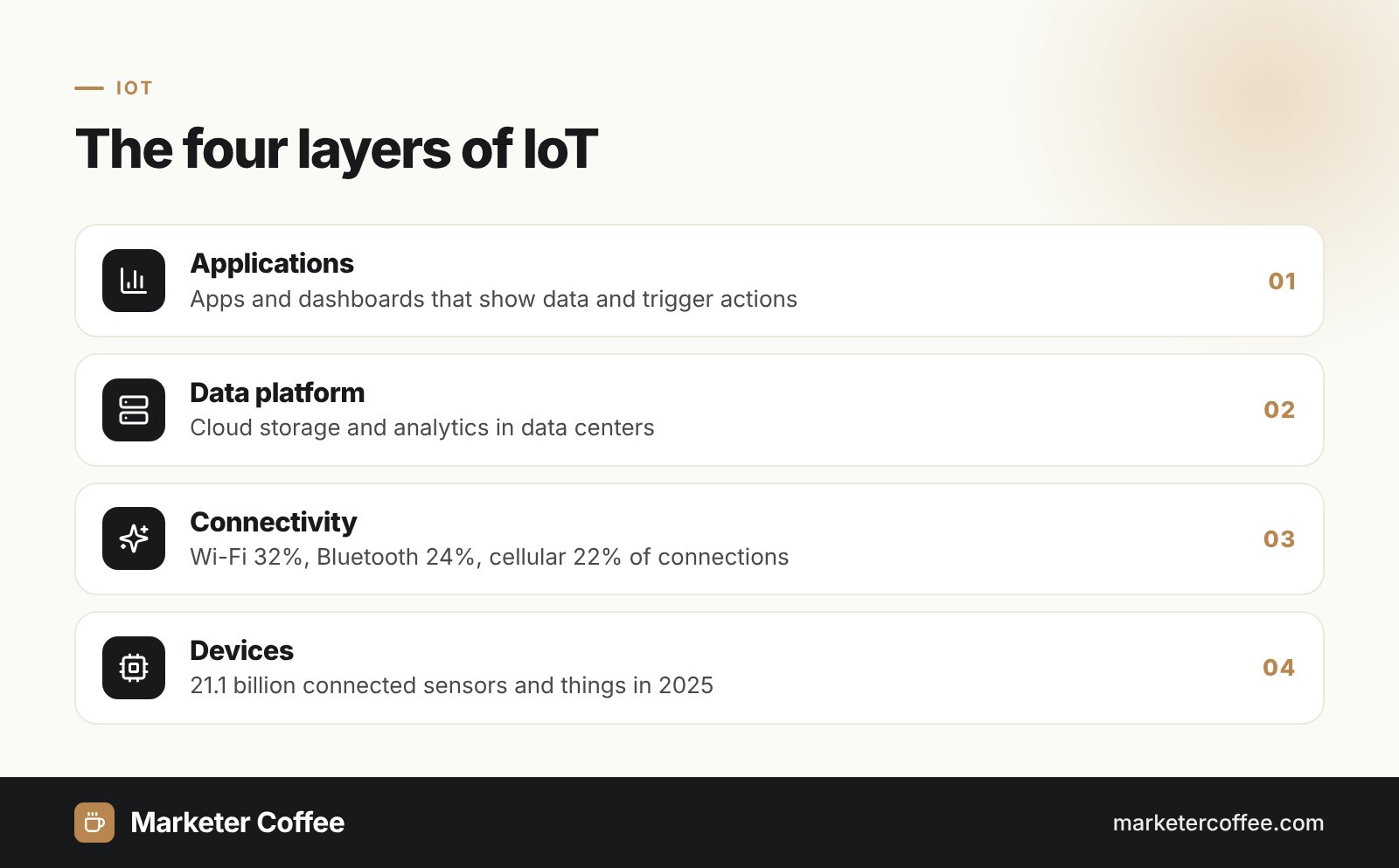
IoT works through four layers: devices, connectivity, a data platform and applications. The H3s below follow data from the sensor to the user.
Devices and sensors
Sensors measure temperature, motion, location or energy use. Many devices also use geolocation to add place data to each reading.
Connectivity
Devices send data over wireless networks. In 2025 Wi-Fi carried 32% of IoT connections, Bluetooth 24% and cellular networks such as 4G, 5G and NB-IoT 22%, according to IoT Analytics.
Data platform
Data lands in the cloud, usually in a data center, where it is stored, cleaned and analysed, often with machine learning.
Applications
Apps, dashboards and widgets show the results to people and trigger actions, such as switching off heating when a room is empty.
IoT in numbers
| Metric | Value | Source |
|---|---|---|
| Connected IoT devices, 2024 | 18.5 billion | IoT Analytics |
| Connected IoT devices, 2025 | 21.1 billion | IoT Analytics |
| Forecast for 2030 | 39 billion | IoT Analytics |
| EU residents using a connected device, 2024 | 70.9% | Eurostat |
| EU residents using a smart TV, 2024 | 57.9% | Eurostat |
Types of IoT
IoT is usually split into consumer, commercial and industrial applications.
- Consumer IoT: smart TVs, smartwatches, voice speakers and home appliances.
- Commercial IoT: smart shelves, beacons, connected vending machines and fleet tracking.
- Industrial IoT (IIoT): predictive maintenance, energy monitoring and supply chain sensors.
- Public IoT: smart city lighting, parking sensors and air quality stations.
IoT in marketing and SEO
IoT matters to marketers because connected devices create new touchpoints and first-party data about how products are used. A connected fridge or car can feed usage data into a CRM, which lets a brand time service reminders and upsell offers. Smart TVs, used by 57.9% of EU residents in 2024 according to Eurostat, are now a programmatic ad channel. For SEO, voice speakers and car dashboards read out one answer instead of ten links, so brands need content that AI assistants can quote, which is the focus of my AI SEO services. IoT also raises privacy duties: under GDPR, data from a device linked to a person is personal data.
IoT vs smart device
IoT is the whole system of devices, networks and platforms, while a smart device is a single connected object within it. A smartwatch on its own is a smart device; the watch, the phone app, the cloud account and the data it shares with a health service together form an IoT solution. For online stores selling such products, I treat compatibility, setup and integration questions as separate landing page topics, a practice I describe in my e-commerce SEO guide.
Pros and cons of IoT
| Pros | Cons |
|---|---|
| Real-time data on product use | Security risks from weak or unpatched devices |
| Automation that cuts costs | Privacy and GDPR compliance work |
| New services and subscription revenue | Fragmented standards and protocols |
| Personalised marketing triggers | Hardware and integration costs |
Frequently asked questions about Internet of Things
What is IoT in simple terms?
IoT means everyday objects connected to the internet that collect and share data on their own. Examples include smartwatches, smart TVs, connected cars and smart meters.
How many IoT devices are there?
IoT Analytics counted about 21.1 billion connected IoT devices worldwide in 2025. The firm expects the number to reach 39 billion by 2030.
Who invented the term Internet of Things?
Kevin Ashton coined the term Internet of Things in 1999 during a presentation at Procter & Gamble. He later co-founded the Auto-ID Centre, which worked with MIT and the University of Cambridge.
What are examples of IoT in marketing?
Examples include smart TV advertising, beacons that send offers in stores and connected products that trigger service reminders. Voice assistants also change how people search for products.
Related terms
- Number of connected IoT devices growing 14% to 21.1 billion globally in 2025 · IoT Analytics
- The origin of the Internet of Things · University of Cambridge, Institute for Manufacturing
- What internet-connected devices do EU citizens use the most? · Euronews (Eurostat data)