



How does barter work?
Barter works by both sides agreeing on the value of what they swap and settling the deal in goods or services instead of cash. A web developer builds a site for a restaurant and receives meals of the same value. Adam Smith pointed to its main limit, the “double coincidence of wants”: each side must want exactly what the other offers. Money solved this, which is why barter today appears in specific niches rather than everyday trade.
Types of barter
Barter takes three common forms in modern business:
- Direct barter: two companies swap services, for example advertising space for software licences.
- Barter exchanges: commercial networks with their own trade credits, which typically charge 8 to 15% commission per transaction.
- Influencer barter: a brand gives products or services to a creator in return for a post, video or review.
Barter in marketing and SEO
Barter is popular in influencer marketing because it lets small brands work with creators without a cash budget. It still counts as advertising: the product has market value, and in many countries it must be disclosed and taxed. In the US, the IRS treats the fair market value of bartered goods as taxable income for both sides.
Disclosure rules are also explicit in Europe. In Poland, for example, the consumer protection authority UOKiK published recommendations in September 2022 that require creators to label barter deals with tags such as “#reklama” (advertisement), and a generic “#collaboration” tag is not enough.
In SEO, barter carries a specific risk. Google’s spam policies list “exchanging goods or services for links” and sending a product in return for a review with a link as examples of link spam. A backlink earned through barter is acceptable only when it carries rel=”sponsored” or rel=”nofollow”. I explain more about manipulative link tactics in the article on black hat SEO.
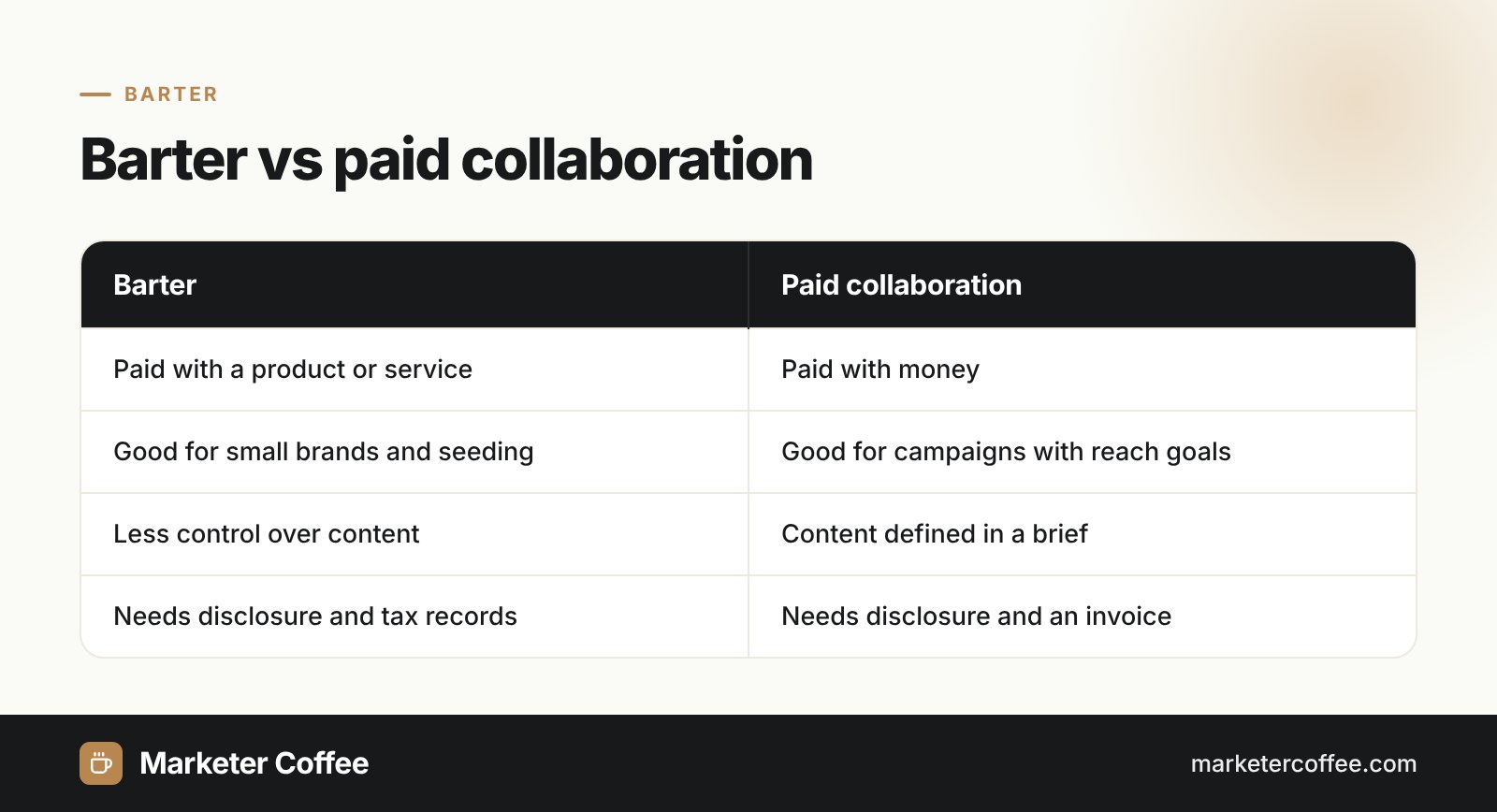
Barter vs paid collaboration
| Barter | Paid collaboration | |
|---|---|---|
| Payment | Product or service | Money |
| Best for | Small brands, product seeding | Campaigns with fixed reach goals |
| Control over content | Lower | Higher, set in the brief |
| Disclosure and tax | Required | Required |
Barter works best for buzz marketing and product seeding, where many creators test a product and a few posts may go viral. Treat it as a FMCG-style sampling channel rather than a guaranteed reach.
Frequently asked questions about Barter
What is an example of barter?
A graphic designer who creates a logo for a café in exchange for a month of free lunches is bartering. In marketing, a brand sending a free product to an influencer in return for a post is the most common example.
Is barter legal?
Barter is legal in most countries, but it is usually taxed like a normal sale. The IRS in the US, for example, treats the fair market value of bartered goods as income.
Can I exchange products for backlinks?
Google's spam policies classify exchanging goods or services for links as link spam. Such links are acceptable only with a rel="sponsored" or rel="nofollow" attribute.
Related terms
- Barter · Wikipedia
- Spam policies for Google web search: link spam · Google Search Central
- UOKiK: rekomendacje dotyczące oznaczania treści reklamowych przez influencerów · Spider's Web
- Umowa barterowa a podatek dochodowy i VAT · Poradnik Przedsiębiorcy
