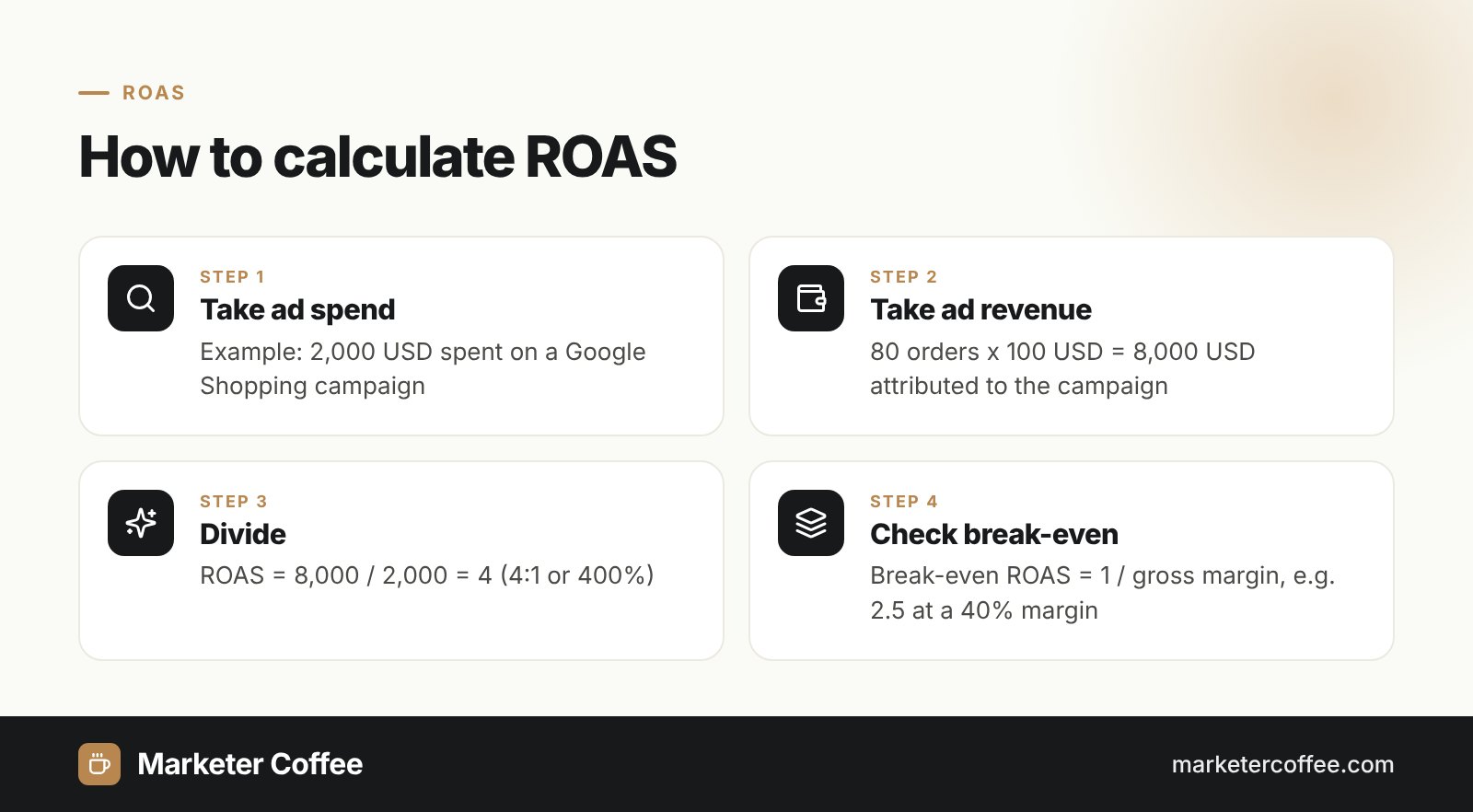
How to calculate ROAS: the formula
ROAS is calculated as revenue attributed to ads divided by the cost of those ads.
ROAS = ad revenue / ad spend
The result is shown as a ratio (4:1), a multiplier (4x) or a percentage (400%). Google Ads uses the percentage form: its Target ROAS bidding takes conversion value divided by cost and multiplies it by 100. Revenue here means the conversion value that the ad platform or analytics tool attributes to the campaign, not the company’s total sales.
ROAS example with numbers
ROAS is easiest to understand on one campaign with known cost and revenue. An online shoe store runs a Google Shopping campaign for one month:
- Ad spend: 2,000 USD
- Orders attributed to the campaign: 80
- Average order value: 100 USD
- Revenue: 80 x 100 = 8,000 USD
ROAS = 8,000 / 2,000 = 4, which is 4:1 or 400%. Every dollar spent on the campaign brought 4 dollars of revenue. Google’s own help page uses the same logic: a shoe store that wants 5 USD of sales for each 1 USD of ad cost sets a Target ROAS of 500%.
What is a good ROAS? Benchmarks
A good ROAS is one that stays above your break-even point after product costs, not a universal number. Still, benchmarks show what is typical. The table uses Triple Whale’s data for August 2025 to July 2026.
| Channel | ROAS | Sample |
|---|---|---|
| Google Ads | 3.27 | over 21,000 e-commerce brands |
| Meta ads (Facebook, Instagram) | 1.88 (median) | over 40,000 e-commerce brands |
Google’s Economic Impact methodology assumes, based on Hal Varian’s 2009 research, that businesses earn 2 USD of profit for every 1 USD spent on Google Ads. Search usually shows higher ROAS than social ads because it captures existing demand, while Meta ads often create demand earlier in the funnel.
Break-even ROAS
Break-even ROAS equals 1 divided by your gross margin. With a 40% margin, break-even ROAS is 1 / 0.4 = 2.5, so a campaign at ROAS 2 loses money even though revenue exceeds ad spend. I always calculate this number before setting a Target ROAS in Google Ads campaigns.
ROAS vs ROI
ROAS measures revenue per ad dollar, while ROI measures profit against the full investment.
| Feature | ROAS | ROI |
|---|---|---|
| Formula | Revenue / ad spend | (Profit minus total cost) / total cost |
| Costs included | Media cost only | Media, products, fees, team, tools |
| Typical use | Optimising campaigns and bids | Judging whether marketing pays off |
| Example above | 4 (400%) | Depends on margin and other costs |
ROAS also differs from CPA, which shows the cost of one conversion, and from customer acquisition cost, which spreads all sales and marketing costs over new customers. A store can have a high ROAS on returning buyers and still pay too much for new ones.
ROAS in practice: Google Ads, Meta and SEO
ROAS is the main bidding target for e-commerce campaigns. Google Ads Target ROAS needs conversion value tracking and at least 15 conversions in the past 30 days for Search and Shopping, and Performance Max campaigns use the same target. Meta’s value optimisation works on the same principle, which I set up in Meta Ads campaigns.
The weak spot of ROAS is attribution: each platform credits itself, so summing Google and Meta ROAS overstates the result. In my projects I compare platform ROAS with a blended figure (total revenue divided by total ad spend) and track organic revenue separately, because strong SEO lowers the ad spend needed for the same sales.
Frequently asked questions about ROAS
How do you calculate ROAS?
Divide the revenue attributed to ads by the ad spend. For example, 8,000 USD of revenue from 2,000 USD of ads gives a ROAS of 4, also written as 4:1 or 400%.
What is a good ROAS?
A good ROAS is any value above your break-even ROAS, which equals 1 divided by your gross margin. Triple Whale's 2025 to 2026 data shows a ROAS of 3.27 on Google Ads and a median of 1.88 on Meta ads for e-commerce brands.
What is the difference between ROAS and ROI?
ROAS divides revenue by ad spend only, while ROI compares profit with all costs of the investment. A campaign can have a high ROAS and a negative ROI when margins are low.
What does a ROAS of 300% mean?
A ROAS of 300% means that every 1 USD spent on ads brought 3 USD of revenue. Whether that is profitable depends on product margins and other costs.
Related terms
- About Target ROAS bidding · Google Ads Help
- Facebook Ads Benchmarks · Triple Whale
- Google Ads Benchmarks · Triple Whale
- Economic Impact methodology · Google