How do you calculate CPM?
You calculate CPM by dividing total ad cost by the number of impressions and multiplying by 1,000:
CPM = (ad cost / impressions) × 1,000
Worked example: an online store spends 600 USD on a Meta awareness campaign that delivers 50,000 impressions. CPM = (600 / 50,000) × 1,000 = 12 USD. Each thousand views costs 12 USD. You can also reverse the formula to plan reach: a 2,000 USD budget at a 12 USD CPM buys about 166,667 impressions.
CPM as a bidding model and as a metric
CPM appears in two roles: as a way of buying ads and as a reporting metric for any campaign. Google Ads describes CPM bidding as paying per one thousand views on the Google Display Network. Meta, TikTok, Snapchat and LinkedIn also charge per thousand impressions for reach and awareness objectives. Even when you pay per click, ad managers still report CPM so you can compare the cost of attention across channels.
vCPM: viewable CPM
vCPM charges only for impressions that could actually be seen. Google Ads converts standard CPM bids on the Display Network to vCPM automatically. The Media Rating Council defines a viewable display impression as at least 50% of the ad’s pixels on screen for 1 continuous second, and a viewable video impression as 50% of pixels for 2 continuous seconds.
Target CPM and eCPM
Target CPM (tCPM) is a Google Ads strategy that sets the average amount you want to pay per thousand impressions. eCPM (effective CPM) is the CPM calculated after the fact for campaigns bought on another model, such as CPC, which makes them comparable.
CPM benchmarks by platform
CPM benchmarks vary several times between platforms, mainly because of audience value and competition. The table uses 2025 figures compiled by Hawky from named industry sources.
| Platform | Typical CPM range (USD) | Source cited |
|---|---|---|
| Google Display Network | 2 to 4 | rockingweb (2025) |
| TikTok | 4 to 13 | Gupta Media (2025) |
| YouTube | 5 to 10 | Store Growers (2025) |
| Meta (Facebook, Instagram) | 8 to 15 | Sovran, Triple Whale (2025) |
| 30 to 40 | Closely (2025) |
Prices also move with the season. Meta’s Q2 2026 results show the average price per ad up 12% year over year, and CPMs on social platforms usually peak in November around Black Friday.
CPM vs CPC vs CPA
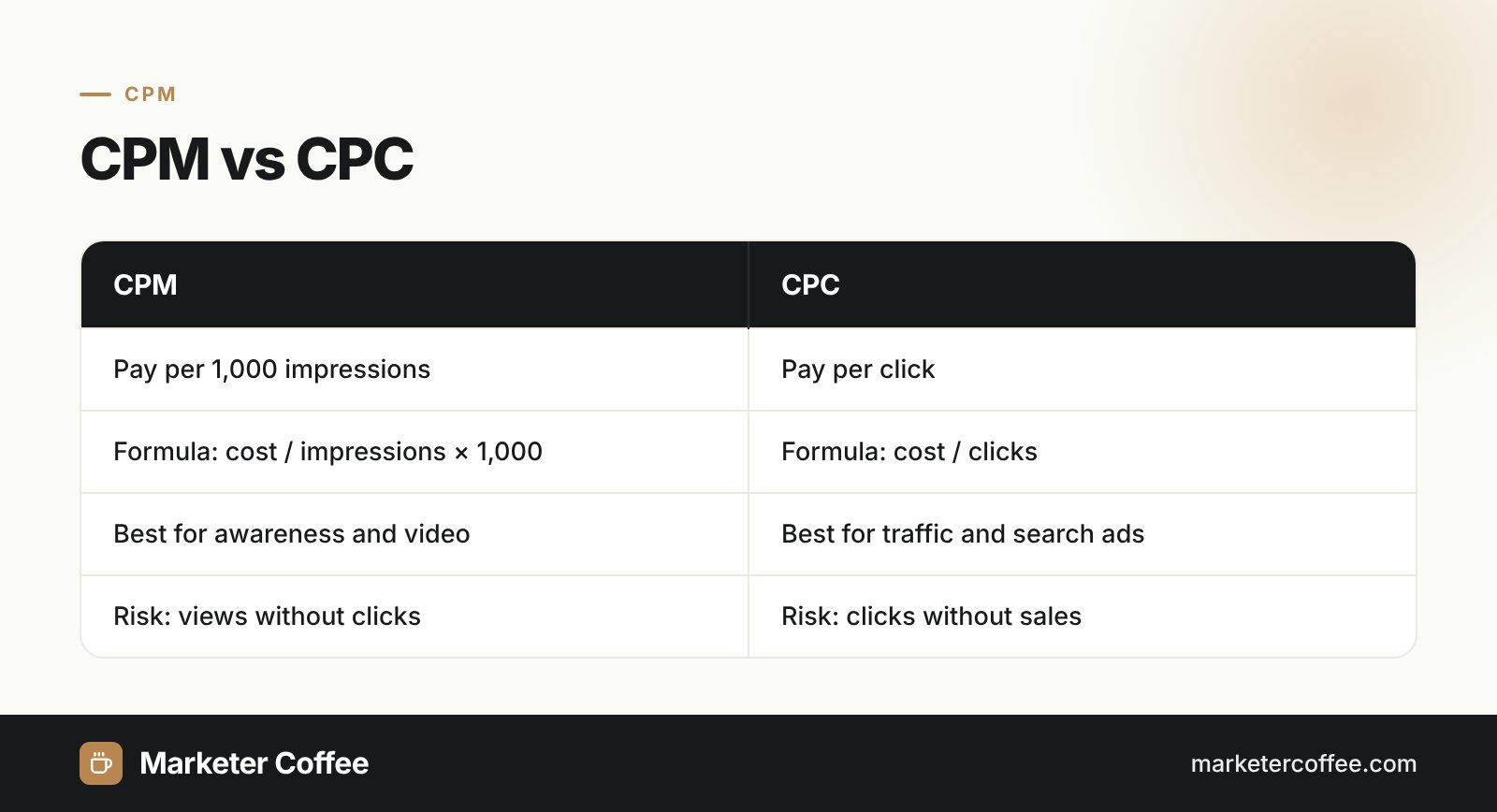
CPM differs from its neighbours because it prices exposure, not action. You can link them through CTR: CPC = CPM / (1,000 × CTR). With a 12 USD CPM and a 1% CTR, each click costs 1.20 USD.
| Metric | You pay for | Formula | Best for |
|---|---|---|---|
| CPM | 1,000 impressions | cost / impressions × 1,000 | Awareness, reach, video |
| CPC | A click | cost / clicks | Traffic, search ads |
| CPA | A conversion | cost / conversions | Sales and leads |
CPM in marketing practice
CPM is useful because it tells you how much reach costs before you judge results. A low CPM with a weak CTR means cheap but irrelevant reach, while a high CPM can still pay off when conversion rates are strong. I read CPM together with CTR and ROAS, never alone. In the Meta Ads and Google Ads campaigns we run, a sudden CPM jump is usually the first sign of ad fatigue or a too-narrow audience.
Frequently asked questions about CPM
What does CPM stand for?
CPM stands for cost per mille, where mille is Latin for thousand. It means the cost of 1,000 ad impressions.
How do you calculate CPM?
Divide the total ad cost by the number of impressions and multiply by 1,000. For example, 600 USD for 50,000 impressions gives a CPM of 12 USD.
What is a good CPM?
A good CPM depends on the platform, country and objective. 2025 benchmarks compiled by Hawky range from about 2 to 4 USD on the Google Display Network to 30 to 40 USD on LinkedIn.
What is the difference between CPM and CPC?
CPM is the cost of 1,000 impressions, while CPC is the cost of one click. You can convert them with CTR: CPC equals CPM divided by 1,000 times CTR.
Related terms
- Cost-per-thousand impressions (CPM): Definition · Google Ads Help
- MRC Viewable Ad Impression Measurement Guidelines · Media Rating Council
- What is a good CPM? Benchmarks by platform · Hawky
- Meta Reports Second Quarter 2026 Results · Meta Investor Relations