



How do you calculate CPC?
You calculate CPC by dividing total ad cost by the number of clicks:
CPC = ad spend / clicks
Worked example: a campaign spends 1,200 USD in a month and gets 400 clicks. The average CPC is 1,200 / 400 = 3.00 USD. If 20 of those visitors buy, the cost per acquisition is 1,200 / 20 = 60 USD, which shows why CPC alone never tells you whether a campaign is profitable.
Max CPC vs actual CPC
Google Ads distinguishes the bid you set from the price you really pay. The two values below explain the difference.
Maximum CPC
Maximum CPC is the highest amount you agree to pay for one click, set manually or by an automated bid strategy. Google never charges more than this ceiling.
Actual CPC
Actual CPC is the final amount charged for a click, and Google says it is often well below the maximum. It depends on Ad Rank, which combines your bid, ad and landing page quality, Ad Rank thresholds, auction competition, search context and the expected impact of assets. Google states that higher quality ads can often lead to lower CPCs, which is why Quality Score diagnostics matter.
CPC benchmarks in 2026
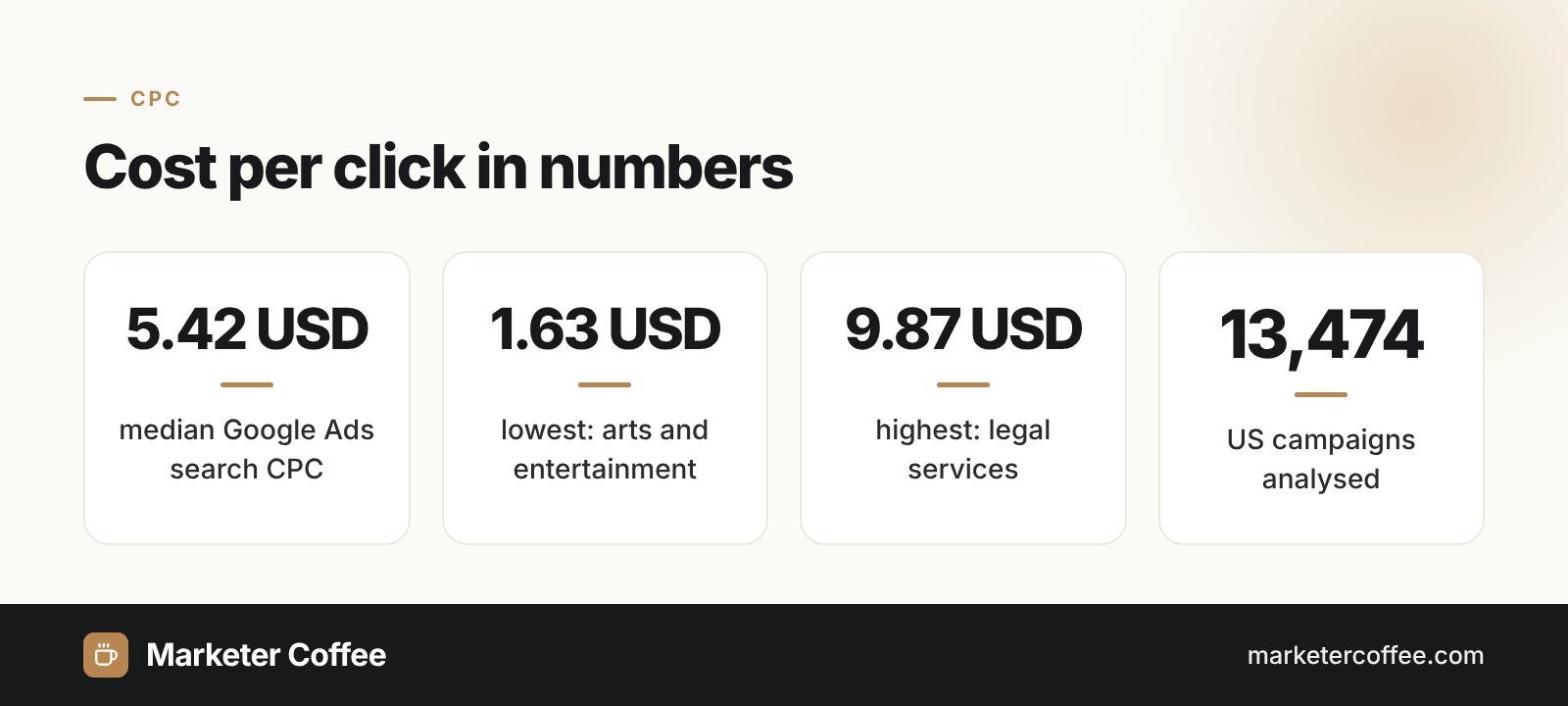
A typical Google Ads search click costs between about 1.60 USD and 10 USD depending on industry. WordStream analysed 13,474 US search campaigns from April 2025 to March 2026 and reports these medians:
| Metric | Median value |
|---|---|
| CPC, all industries | 5.42 USD |
| Lowest CPC (arts and entertainment) | 1.63 USD |
| Highest CPC (attorneys and legal services) | 9.87 USD |
| Click-through rate | 6.64% |
| Conversion rate | 8.18% |
Search Engine Land, reporting on WordStream data, notes that the average CPC was 4.66 USD a year earlier and that 87% of industries saw CPC increases. Treat these figures as a US reference point: CPCs in smaller European markets and in display or social campaigns are usually different, so compare against your own account history first.
CPC vs CPM, CPA and ROAS
CPC measures the price of traffic, not the value of that traffic. The table shows how it differs from neighbouring metrics.
| Metric | Formula | What it answers |
|---|---|---|
| CPC | cost / clicks | How much does one visit cost? |
| CPM | cost / impressions x 1,000 | How much do 1,000 ad views cost? |
| CPA | cost / conversions | How much does one sale or lead cost? |
| ROAS | revenue / cost | How much revenue does each unit of spend return? |
CPC also connects to CTR: with the same CPM, a higher click-through rate spreads cost over more clicks and lowers CPC.
How to lower CPC
You lower CPC mainly by raising ad quality and tightening targeting, not by cutting bids:
- Group keywords tightly so each ad matches the search intent.
- Improve landing pages so they answer the query above the fold.
- Add negative keywords to stop paying for irrelevant searches.
- Test ad copy and assets such as sitelinks to lift CTR.
- Shift budget to hours, devices and locations with the best conversion cost.
I manage paid search as part of Google Ads services and plan it together with SEO in PPC management projects.
Frequently asked questions about CPC
What is a good CPC?
A good CPC is one that keeps your cost per acquisition below the profit from a conversion. As a reference, WordStream's 2026 benchmarks show a median Google Ads search CPC of 5.42 USD in the US.
How is CPC calculated?
CPC is calculated by dividing total ad spend by the number of clicks. For example, 1,200 USD spent for 400 clicks gives a CPC of 3.00 USD.
What is the difference between CPC and PPC?
PPC (pay per click) is the advertising model in which you pay only when someone clicks. CPC is the metric that shows how much each of those clicks costs.
Why is my actual CPC lower than my max CPC?
Your actual CPC is usually lower because Google charges based on auction competition and ad quality, not your full bid. Google never charges more than the maximum CPC you set.
Related terms
- 2026 Google Ads Benchmarks · WordStream by LocaliQ
- Cost-per-click (CPC): Definition · Google Ads Help
- About Ad Rank · Google Ads Help
- About Quality Score · Google Ads Help
- Google Ads costs keep rising, but conversion rates improved in 2025 · Search Engine Land
