



How does Quality Score work?
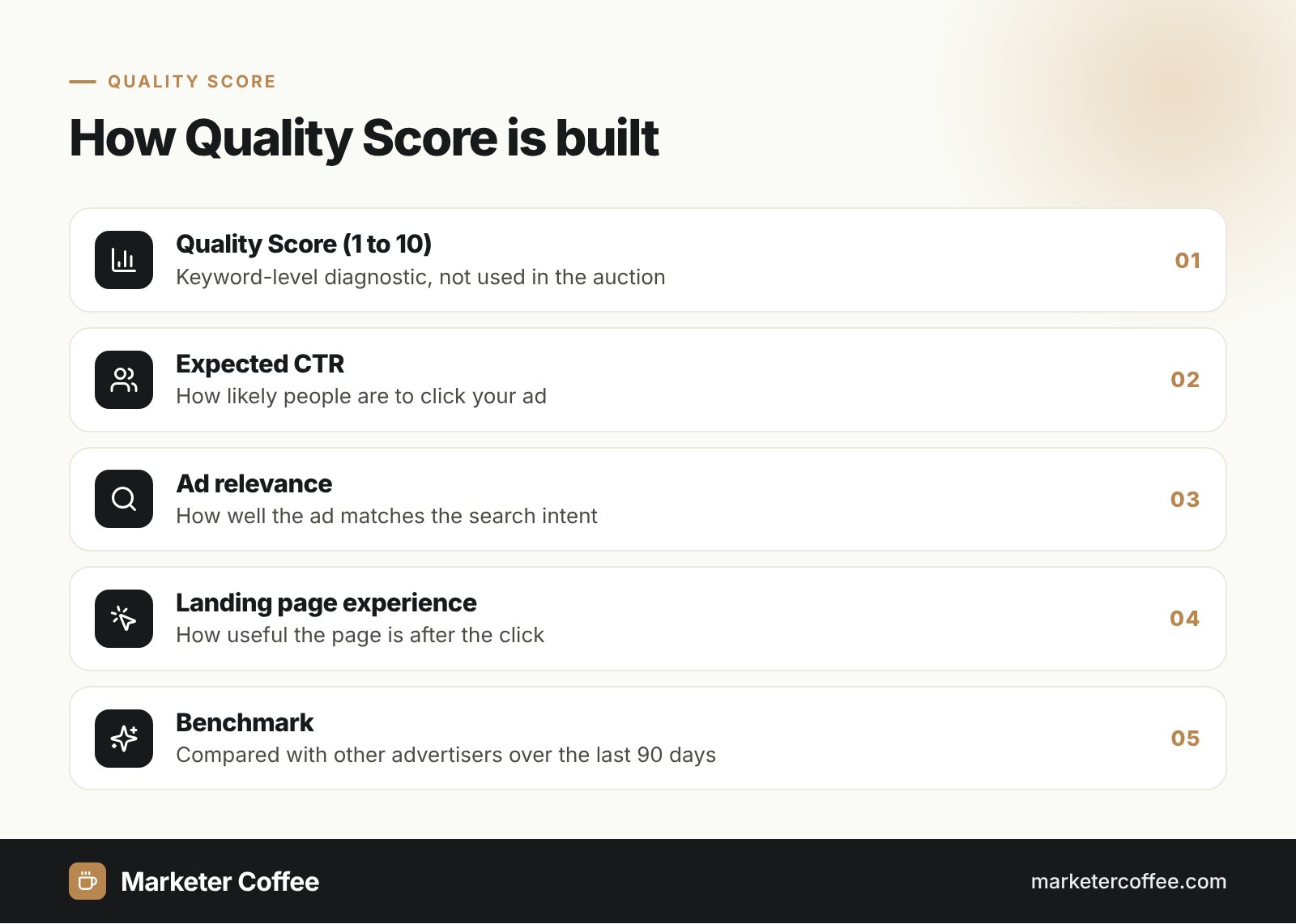
Quality Score works as a keyword-level report card that summarises how relevant and useful your ad experience is. Google compares your ads with those of other advertisers whose ads appeared for the exact same search over the previous 90 days. Because the score is based on exact-match impressions, changing a keyword’s match type does not change its Quality Score. When there is not enough exact-match data, the column shows a dash instead of a number.
The 3 components of Quality Score
Quality Score combines 3 components, each rated Above average, Average or Below average. The H3s explain what each one measures.
Expected click-through rate
Expected CTR estimates how likely people are to click your ad when it shows for the keyword. Strong ad copy and tight keyword grouping raise the CTR that this component predicts.
Ad relevance
Ad relevance measures how closely the ad text matches the intent behind the search. A keyword in an ad group that mixes unrelated themes usually gets a Below average rating here.
Landing page experience
Landing page experience rates how relevant and useful the page is for people who click. Google notes that information from its crawlers can be used in this assessment, which links paid search quality to classic on-page SEO work.
Quality Score, Ad Rank and CPC
Quality Score is a diagnostic, while Ad Rank is what actually decides the auction. Google lists 6 Ad Rank factors: your bid, ad and landing page quality, Ad Rank thresholds, auction competitiveness, search context and the expected impact of assets and formats. The table shows how the concepts relate.
| Concept | Role | Visible to advertiser |
|---|---|---|
| Quality Score | Diagnostic summary per keyword (1 to 10) | Yes, in the Keywords table |
| Ad quality (real time) | Input to Ad Rank in every auction | No |
| Ad Rank | Decides if and where the ad shows | No |
| Actual CPC | Price paid per click | Yes |
Google states that higher quality ads can often lead to lower CPCs. In practice, a keyword with Above average ratings usually wins better positions for the same bid, which also lowers CPA when conversion rates hold.
How to check Quality Score in Google Ads
You check Quality Score by adding its columns to the Keywords table:
- Open Campaigns, then Keywords.
- Click the columns icon and choose Modify columns.
- Expand the Quality score section.
- Add Quality Score, Exp. CTR, Ad Relevance and Landing Page Exp.
- Add the historical columns and segment by day to track changes over time.
How to improve Quality Score
You improve Quality Score by fixing whichever component is rated Average or Below average:
- Split broad ad groups into tight themes so each ad mirrors the keyword’s intent.
- Write headlines that repeat the user’s query and state a clear benefit.
- Send clicks to the most specific landing page, not the homepage.
- Speed up mobile pages and put the answer or offer above the fold.
- Add negative keywords so ads stop showing for searches they cannot satisfy.
Google warns that Quality Score is not a KPI: do not chase a 10 at the cost of conversions or ROAS. Use it to find weak keywords, then judge changes by business results.
I combine landing page fixes with campaign structure work in Google Ads services, and for international accounts each market’s pages get the same check.
Frequently asked questions about Quality Score
What is a good Quality Score?
A good Quality Score is one where all 3 components are rated Average or Above average. Google stresses that it is a diagnostic tool, not a KPI, so conversions and revenue matter more than the number itself.
Does Quality Score affect CPC?
Quality Score is not used in the auction, but the ad quality it reflects is part of Ad Rank. Google states that higher quality ads can often lead to lower CPCs.
Why does my keyword show no Quality Score?
A keyword shows a dash when there are not enough exact-match searches to calculate a score. Broadening the match type lets the keyword enter more auctions and gather data.
What are the 3 components of Quality Score?
The 3 components are expected click-through rate, ad relevance and landing page experience. Each is rated Above average, Average or Below average against other advertisers over the past 90 days.
Related terms
- About Quality Score · Google Ads Help
- Using Quality Score to guide optimizations · Google Ads Help
- About Ad Rank · Google Ads Help
