



How does Facebook work?
Facebook works by building a personal Feed for every user from friends, groups, pages and recommended content. Each person has a profile, adds friends, follows pages and joins groups, while businesses run pages and shops. The ranking system decides which posts appear first, and ads are mixed into the Feed, Stories, Reels, Marketplace and the right column.
The main parts of Facebook are:
- Profiles and Pages: personal accounts and public brand pages.
- Groups: communities built around a topic, place or interest.
- Feed, Stories and Reels: the main content surfaces.
- Marketplace: local buying and selling between users.
- Messenger: the chat app connected to Facebook accounts.
History of Facebook: key dates
Facebook started as a network for Harvard students created by Mark Zuckerberg and four co-founders: Eduardo Saverin, Andrew McCollum, Dustin Moskovitz and Chris Hughes.
| Date | Event |
|---|---|
| 4 February 2004 | TheFacebook launches for Harvard students |
| 2006 | Facebook opens to the general public |
| 9 February 2009 | The Like button goes live |
| 2012 | Facebook goes public and passes 1 billion monthly users in October |
| 28 October 2021 | The parent company renames itself Meta |
Facebook users in numbers
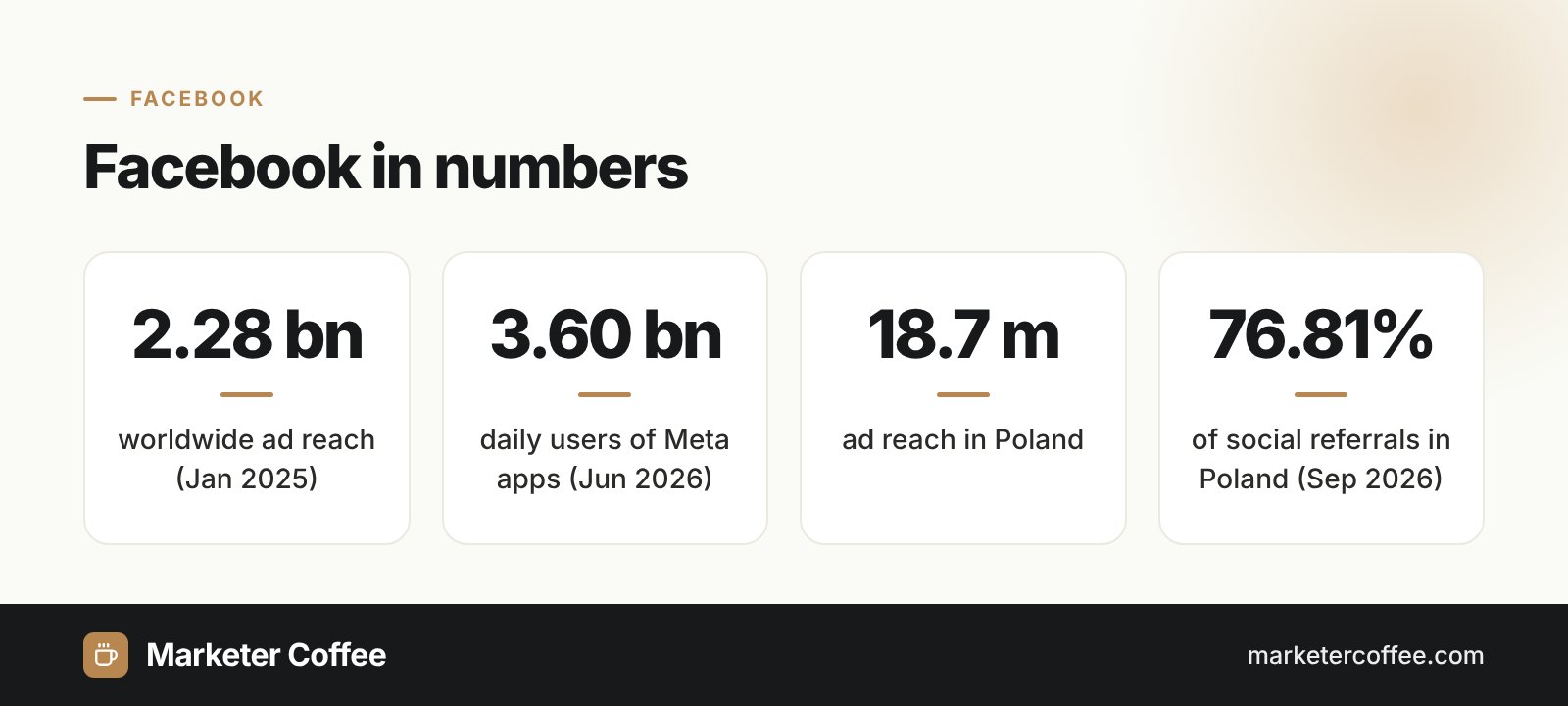
Facebook has the largest advertising audience of any social network. DataReportal counts 2.28 billion users reachable with Facebook ads in January 2025, 93.3 million more than a year earlier, with men making up 56.7% of that audience. The biggest markets are India (384 million), the United States (197 million) and Indonesia (122 million). Meta itself reported 3.60 billion daily active people across all its apps in June 2026 and Q2 2026 revenue of 60.80 billion USD.
In Poland, DataReportal’s Digital 2026 report puts Facebook’s ad reach at 18.7 million people, and Statcounter shows Facebook generating 76.81% of social media referral traffic in Poland in September 2026.
Facebook in marketing and SEO
Facebook matters to marketers because it combines huge reach with detailed targeting in one ad platform. The H3s below cover ads, organic reach and search.
Facebook Ads
Meta Ads Manager sells image, video, carousel, collection and lead ads, placed across Facebook, Instagram, Messenger and Audience Network. Most campaigns are bought in an auction, so the price per thousand impressions (CPM) rises in competitive months like November. I plan these campaigns together with the Meta Ads services team.
Advertising on Facebook is getting more expensive per placement. In its Q2 2026 results, Meta reported that ad impressions across its apps grew by 14% year over year, while the average price per ad rose by 12%. In practice, this means creative quality and conversion tracking decide who wins the auction, not budget alone, and a weak ad pays more for the same reach.
Organic reach and groups
Organic reach of brand pages is low, so brands win more through groups, creators and Reels than through plain page posts. Retargeting website visitors on Facebook is one of the cheapest forms of remarketing.
Facebook and search visibility
Facebook links are nofollow and do not pass ranking signals, but public pages and posts get indexed and often rank for brand queries. A complete page with consistent name, address and website also helps search engines and AI assistants connect your brand entity. In my SEO projects I treat the Facebook page as one more trusted profile in the brand’s entity SEO setup.
Facebook vs Instagram
| Feature | ||
|---|---|---|
| Owner | Meta | Meta |
| Strength | Groups, Marketplace, older audiences | Visual content, younger audiences |
| Ads | Meta Ads Manager | Meta Ads Manager |
Frequently asked questions about Facebook
When was Facebook created?
Facebook launched on 4 February 2004 as TheFacebook, a network for Harvard students. It opened to the general public in 2006.
Who owns Facebook?
Facebook is owned by Meta Platforms, the company led by founder Mark Zuckerberg. The parent company changed its name from Facebook to Meta on 28 October 2021.
How many people use Facebook?
According to DataReportal, Facebook ads reached 2.28 billion users in January 2025. Across all its apps, Meta reported 3.60 billion daily active people in June 2026.
Do Facebook links help SEO?
Facebook links do not pass ranking signals directly because they are nofollow. They still help indirectly by sending traffic, building brand searches and confirming your brand entity.
Related terms
- Meta Reports Second Quarter 2026 Results · Meta Investor Relations
- Facebook Users, Stats, Data & Trends · DataReportal
- Digital 2026: Poland · DataReportal
- Social Media Stats Poland · Statcounter Global Stats
- Introducing Meta: A Social Technology Company · Meta Newsroom
- Facebook · Wikipedia
