What does E-E-A-T stand for?
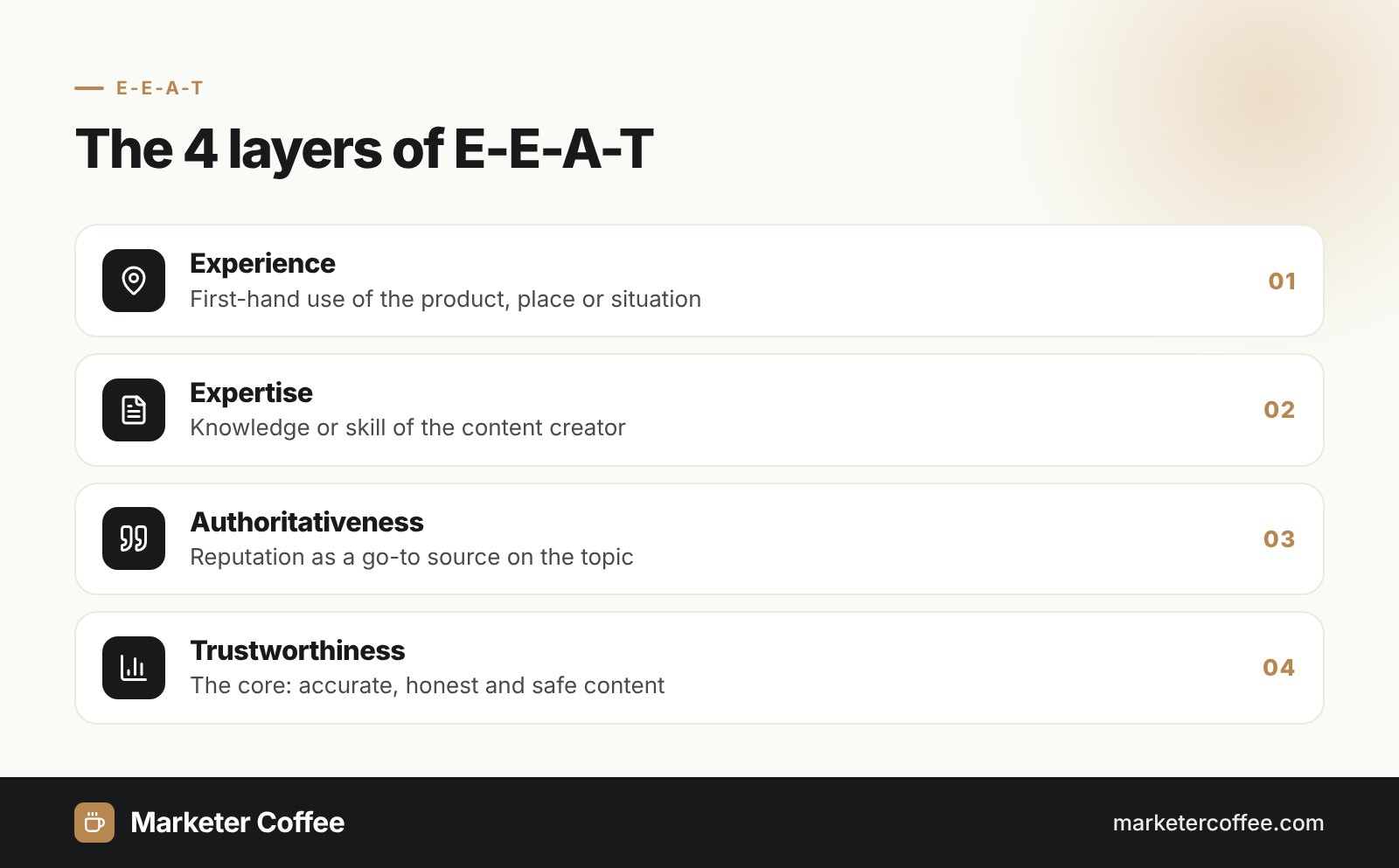
E-E-A-T stands for Experience, Expertise, Authoritativeness and Trustworthiness, the 4 qualities Google’s human raters look for in a page and its creator. The concept lives in the Search Quality Rater Guidelines, a document Google uses to train external raters. The H3s below explain each letter, from the outer layers to the core.
Experience
Experience means first-hand involvement with the topic: having used the product, visited the place or lived through the situation. Google’s own example contrasts a restaurant review by someone who ate there with one by someone who did not.
Expertise
Expertise is the knowledge or skill of the creator, often from training or professional practice. A tax guide needs an accountant’s expertise, while a review of tax software can rely on experienced users.
Authoritativeness
Authoritativeness is the reputation of the creator or website as a go-to source on the topic, visible in mentions, citations and links from respected sites.
Trustworthiness
Trust is the most important member of the family, according to Google Search Central. A page that is inaccurate, dishonest or unsafe has low E-E-A-T no matter how expert it looks; the other 3 qualities only feed into trust.
History of E-E-A-T
E-E-A-T evolved from E-A-T, which Google used in its rater guidelines for years before adding Experience. Key milestones:
| Date | Change |
|---|---|
| 15 December 2022 | Experience added, E-A-T becomes E-E-A-T, trust placed at the centre |
| 5 March 2024 | Factual inaccuracy listed as a sign of untrustworthy pages (170 pages) |
| 23 January 2025 | First definition of generative AI and spam abuse added (181 pages) |
| 11 September 2025 | AI Overview rating examples added (182 pages) |
Is E-E-A-T a ranking factor?
E-E-A-T is not a single ranking factor, but a description of what Google’s ranking systems try to reward. Google says its systems use a mix of signals that align with good E-E-A-T and give them more weight for YMYL (Your Money or Your Life) topics such as health, finance, safety and civic information. Raters do not change rankings directly: Google states that rater data is not used directly in its ranking algorithms. In 2023 Google ran 719,326 search quality tests and approved 4,781 launches, and rater feedback helps evaluate those changes. Google stated in 2023 that it works with about 16,000 raters worldwide.
How to show E-E-A-T on your website
Show E-E-A-T by answering Google’s “Who, How and Why” questions about every important page:
- Name the author with a byline and a bio page that proves real experience.
- Explain how the content was made, including testing methods and any use of AI.
- Publish first-hand evidence: your own photos, data, case studies and results.
- Cite primary sources and update facts when they change.
- Earn mentions and links from respected sites in your niche, the base of topical authority.
- Mark up authors and the organisation with structured data so search engines connect them to known entities.
Google also warns against fake author profiles, such as AI-generated headshots or invented credentials.
E-E-A-T in international SEO and AI search
E-E-A-T must be built separately in each market, because trust is local. A Polish brand known in Poland is often an unknown name in Germany, so its German pages need German reviews, a German address or contact, local press mentions and authors who know that market. In my expansions into Germany and the Czech Republic, translated author bios without local proof did little; local case studies did much more. The same signals feed AI search: systems like AI Overviews and ChatGPT prefer sources whose entity is clearly described in the Knowledge Graph and across the web, which is where entity SEO and E-E-A-T meet.
Want to know how your site scores? An SEO audit covers E-E-A-T signals, and my international SEO consultancy builds them market by market.
Frequently asked questions about E-E-A-T
What does E-E-A-T stand for?
E-E-A-T stands for Experience, Expertise, Authoritativeness and Trustworthiness. It is the framework Google's quality raters use to judge pages and their creators.
When did Google add Experience to E-A-T?
Google added Experience on 15 December 2022 in an update to its Search Quality Rater Guidelines. The change turned E-A-T into E-E-A-T and placed trust at the centre.
Is E-E-A-T a Google ranking factor?
No, Google says E-E-A-T is not a specific ranking factor. Its systems use a mix of signals that align with E-E-A-T, and they weigh them more heavily on YMYL topics.
Which part of E-E-A-T matters most?
Trust matters most, according to Google Search Central. Experience, expertise and authoritativeness support trust, but an untrustworthy page has low E-E-A-T regardless of the others.
Related terms
- Creating helpful, reliable, people-first content · Google Search Central
- Our latest update to the quality rater guidelines: E-A-T gets an extra E for Experience · Google Search Central Blog
- Rigorous testing: how Google improves Search · Google
- Search Quality Rater Guidelines updates · PPC Land
- Here comes E-E-A-T: Google adds Experience to its quality criteria · SEOZoom