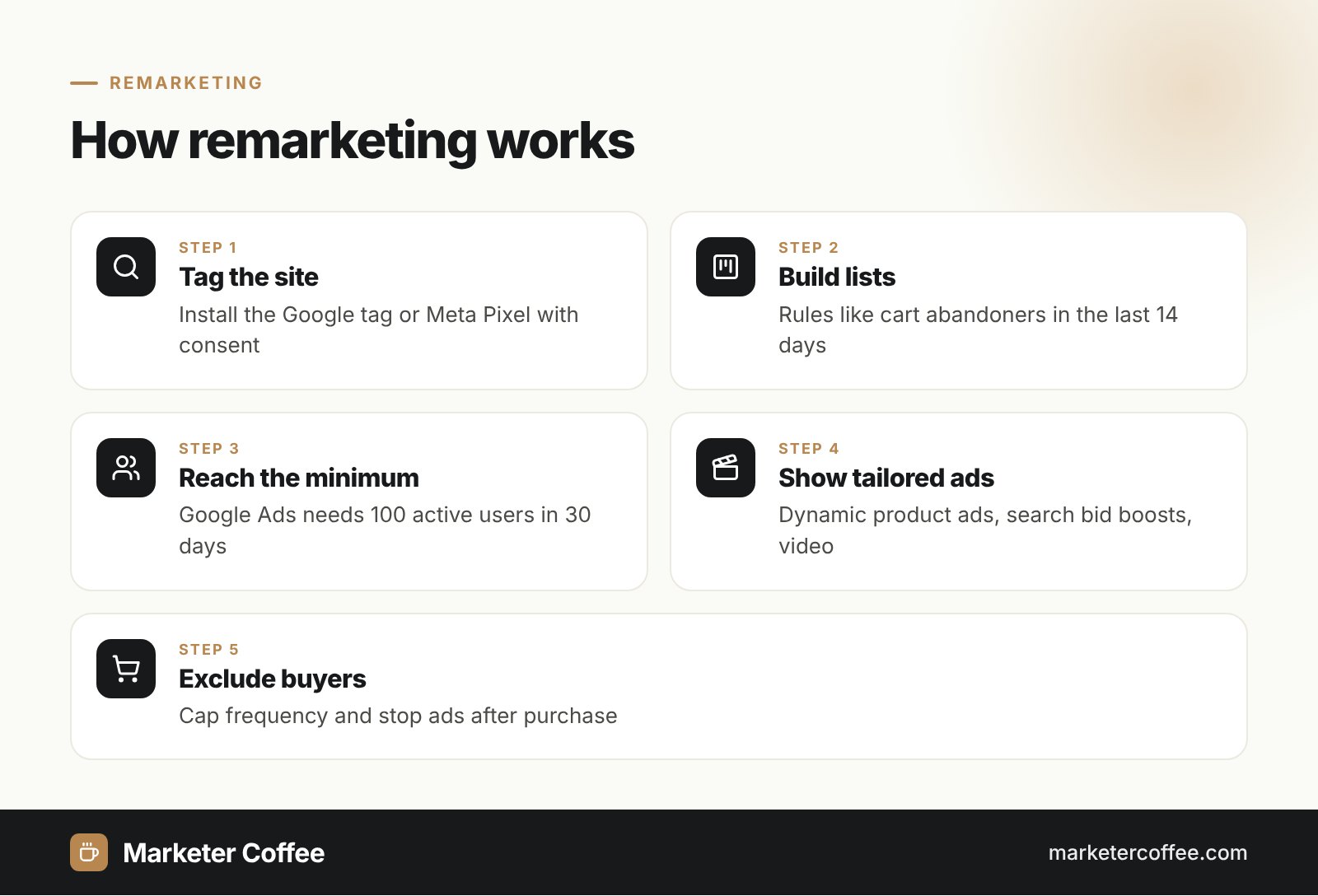
How does remarketing work?
Remarketing works by adding visitors to an audience list through a tag and then targeting that list with ads. You install the Google tag or the Meta Pixel on your site. When someone visits a page that matches a rule, for example a product page or an abandoned cart, the platform adds them to a list. Google says users join a list within seconds of a visit, and new lists take 48 to 72 hours to fill up.
The process has four steps:
- Tag the site or app with the Google tag, Meta Pixel or a server-side integration.
- Define lists with rules, such as “viewed product but did not buy in 14 days”.
- Wait until each list reaches the minimum size.
- Target the list with ads that match the stage the user reached.
Remarketing vs retargeting: the terms are used as synonyms in most ad platforms. Some marketers reserve “remarketing” for email follow-ups and “retargeting” for display ads, but Google itself has used “remarketing” for ads since 2010.
Types of remarketing
Remarketing comes in several types that differ by data source and ad placement. Google Ads Help lists the main ones:
Standard website remarketing
Display and YouTube ads shown to past site visitors as they browse Google partner sites and apps.
Dynamic remarketing
Ads that show the exact products or services a person viewed, built from a product feed. This is the standard for e-commerce and fits well with Performance Max campaigns.
Remarketing lists for search ads
Search ads adjusted for past visitors who search again on Google, for example higher bids or broader keywords for people who already saw your pricing page.
Video, app and Customer Match
Lists of people who watched your YouTube videos, used your app, or whose email addresses you uploaded from a CRM.
Remarketing list rules in Google Ads and Meta
Each platform sets minimum list sizes and maximum durations. The table lists the current values from official documentation.
| Setting | Google Ads | Meta (website custom audience) |
|---|---|---|
| Name in the platform | Your data segments | Website custom audience |
| Tracking code | Google tag | Meta Pixel or Conversions API |
| Minimum size | 100 active users in 30 days (Display, Search, YouTube) | Not stated in the API guide |
| Default duration | 30 days | Set per audience |
| Maximum duration | 540 days | 180 days (retention_days) |
Google closes segments that have not been used for targeting for 540 days. Google Ads also does not allow remarketing tags on pages tied to restricted offers under its personalised advertising policy.
Remarketing in marketing and SEO
Remarketing matters because most visitors do not buy on their first visit, and it brings them back at a lower cost than new traffic. It works with SEO too: blog readers from organic search can be added to lists and later shown product ads. In my projects this combination turns informational traffic into measurable revenue and lowers the blended CPA. I set this up in Google Ads campaigns and Meta Ads campaigns.
Privacy rules shape remarketing. Every remarketing tag needs user consent under GDPR in the EU. In April 2025, Google’s Anthony Chavez announced that Chrome will keep its current third-party cookie choice and will not roll out a new standalone prompt, so cookie-based remarketing continues, but first-party data and Customer Match grow in importance.
Pros and cons of remarketing
| Pros | Cons |
|---|---|
| Reaches warm users who know the brand | Needs consent and enough traffic to fill lists |
| Usually higher conversion rate than cold audiences | Frequent ads can annoy users |
| Supports funnel stages with tailored messages | Small lists are hard to scale |
Frequently asked questions about Remarketing
What is the difference between remarketing and retargeting?
In most ad platforms the two words mean the same thing: showing ads to people who already interacted with your brand. Some marketers use remarketing for email follow-ups and retargeting for display ads.
How long can someone stay on a remarketing list?
In Google Ads the default is 30 days and the maximum is 540 days. Meta's website custom audiences accept a retention of up to 180 days.
How many users do you need for remarketing in Google Ads?
A list needs at least 100 active users in the last 30 days to serve on the Display Network, Search Network or YouTube. Customer lists uploaded before February 2024 still need 1,000 matched users.
Is remarketing legal under GDPR?
Yes, provided you collect valid consent before setting remarketing cookies or tags. In the EU this is usually handled by a consent management platform and Google Consent Mode.
Related terms
- About your data segments · Google Ads Help
- How your data segments work · Google Ads Help
- Website Custom Audiences · Meta for Developers
- Google Ads Will Now Follow You Across The Web · TechCrunch
- Next steps for Privacy Sandbox and tracking protections in Chrome · Google Privacy Sandbox