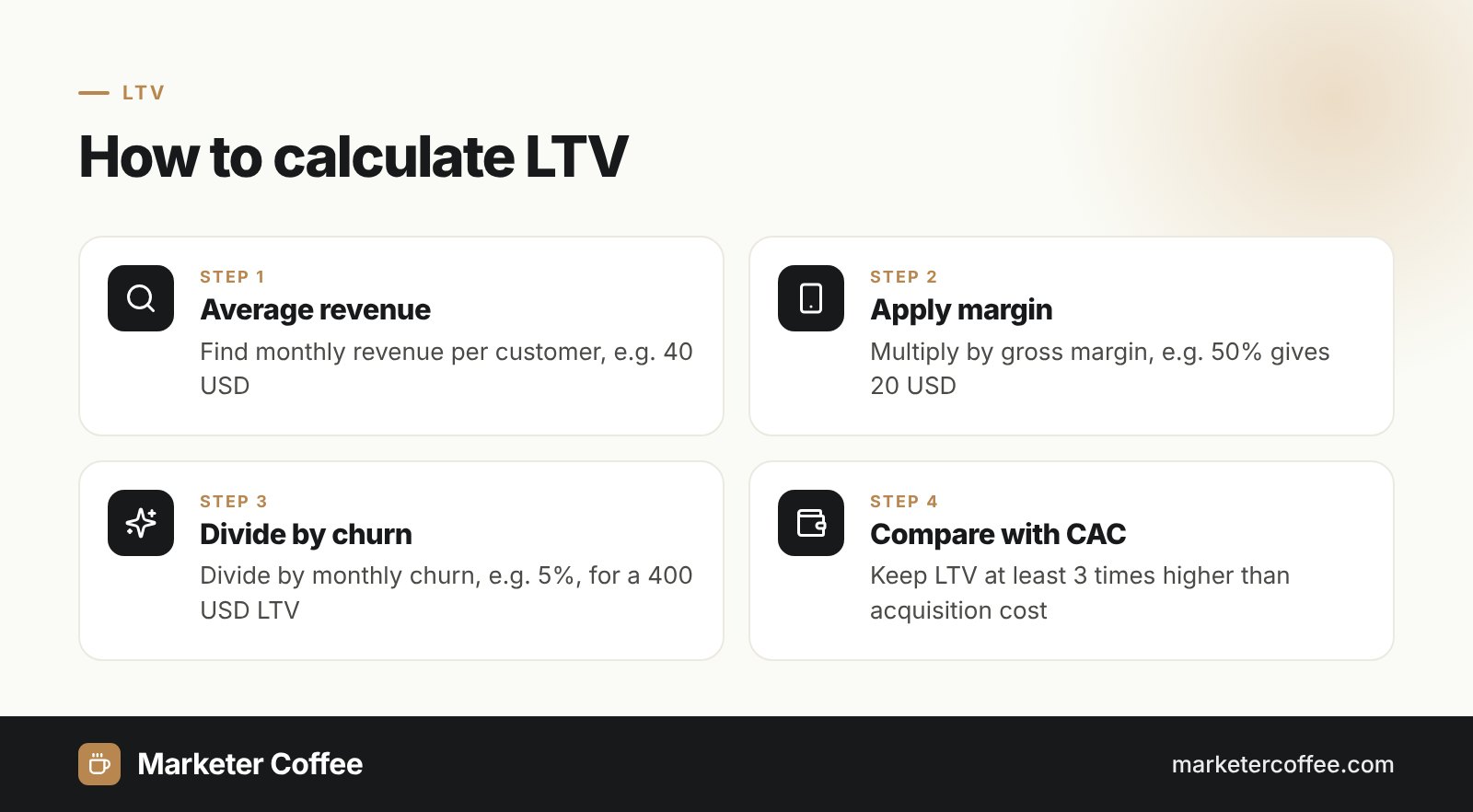
How do you calculate LTV?
You calculate LTV by multiplying what a customer spends per period by your margin and by how many periods they stay. The two most common formulas are:
- E-commerce: LTV = average order value × purchases per year × customer lifespan in years × gross margin.
- Subscriptions: LTV = ARPU per month × gross margin ÷ monthly churn rate.
Revenue-based LTV (without margin) is easier to compute, but it overstates what you can spend on acquisition. I always use the margin version when the number feeds bidding or budget decisions.
LTV example in USD
A worked example shows how LTV sets the ceiling for acquisition cost. Take a coffee subscription shop:
| Input | Value |
|---|---|
| Average monthly revenue per customer | 40 USD |
| Gross margin | 50% |
| Monthly churn | 5% |
| Average lifespan (1 ÷ churn) | 20 months |
LTV = 40 × 0.5 ÷ 0.05 = 400 USD of gross profit per customer. With a 3:1 target, the shop can spend up to about 133 USD to win one subscriber. If CAC is 150 USD, it loses money on growth until it raises margin, prices or retention.
What is a good LTV:CAC ratio?
A good LTV:CAC ratio is above 3:1, with the cost of acquisition recovered within 12 months. David Skok’s SaaS Metrics 2.0 guide gives these guidelines:
- Ratio above 3: healthy unit economics for most SaaS businesses.
- Ratio of 7 to 8: the level of the best SaaS companies.
- Payback in 5 to 7 months: typical for top performers.
- Payback over 12 months: profitability is weak.
Skok stresses these are guidelines and that many young, healthy companies do not meet them yet. A ratio far above 5 can also mean you are underinvesting in growth.
Why LTV matters in marketing
LTV matters because retention moves profit more than acquisition does. Harvard Business Review, citing Bain & Company’s Frederick Reichheld, reports that a 5% increase in retention can raise profits by 25% to 95%, and that winning a new customer costs 5 to 25 times more than keeping one. The H3s below show where LTV changes daily decisions.
LTV in Google Ads and Meta Ads
Ad platforms bid on the value you send them. Google Ads customer acquisition goals let you bid higher for new or high-value new customers, using your own data to define “high value”. Feeding predicted LTV instead of first-order revenue into value-based bidding pushes Google Ads and Meta Ads toward customers who come back.
LTV in SEO
In SEO I use LTV to rank keywords by business value, not by volume. A query that brings subscribers with a 400 USD LTV deserves more content investment than a high-volume query that brings one-off buyers. This logic sits at the core of my SaaS SEO work, where MRR and churn decide which pages matter.
LTV vs ROI and CAC
| Metric | Question it answers | Time frame |
|---|---|---|
| LTV | How much is one customer worth? | Whole customer lifespan |
| CAC | How much does winning one customer cost? | Acquisition period |
| ROI | Did an investment return more than it cost? | One campaign or period |
Keep customer data clean in your CRM, because LTV is only as accurate as the purchase history behind it.
Frequently asked questions about LTV
What is the formula for customer lifetime value?
For subscriptions, LTV equals average monthly revenue per customer times gross margin, divided by monthly churn. For example, 40 USD × 50% ÷ 5% gives an LTV of 400 USD.
What is the difference between LTV and CLV?
LTV and CLV are two names for the same metric: the total value a customer brings over the relationship. Some teams use CLV for predictive models and LTV for historical averages, but there is no formal difference.
What is a good LTV to CAC ratio?
A ratio of 3:1 or higher is the common benchmark, based on David Skok's SaaS guidelines. The best SaaS companies reach 7 or 8 to 1 and recover acquisition costs in 5 to 7 months.
How can I increase LTV?
You increase LTV by improving retention, raising average order value and improving margin. Onboarding, loyalty programmes, cross-selling and subscriptions are the most common levers.
Related terms
- SaaS Metrics 2.0: A Guide to Measuring and Improving What Matters · For Entrepreneurs (David Skok)
- The Value of Keeping the Right Customers · Harvard Business Review
- About customer lifecycle optimization goals · Google Ads Help