



How to calculate CPA
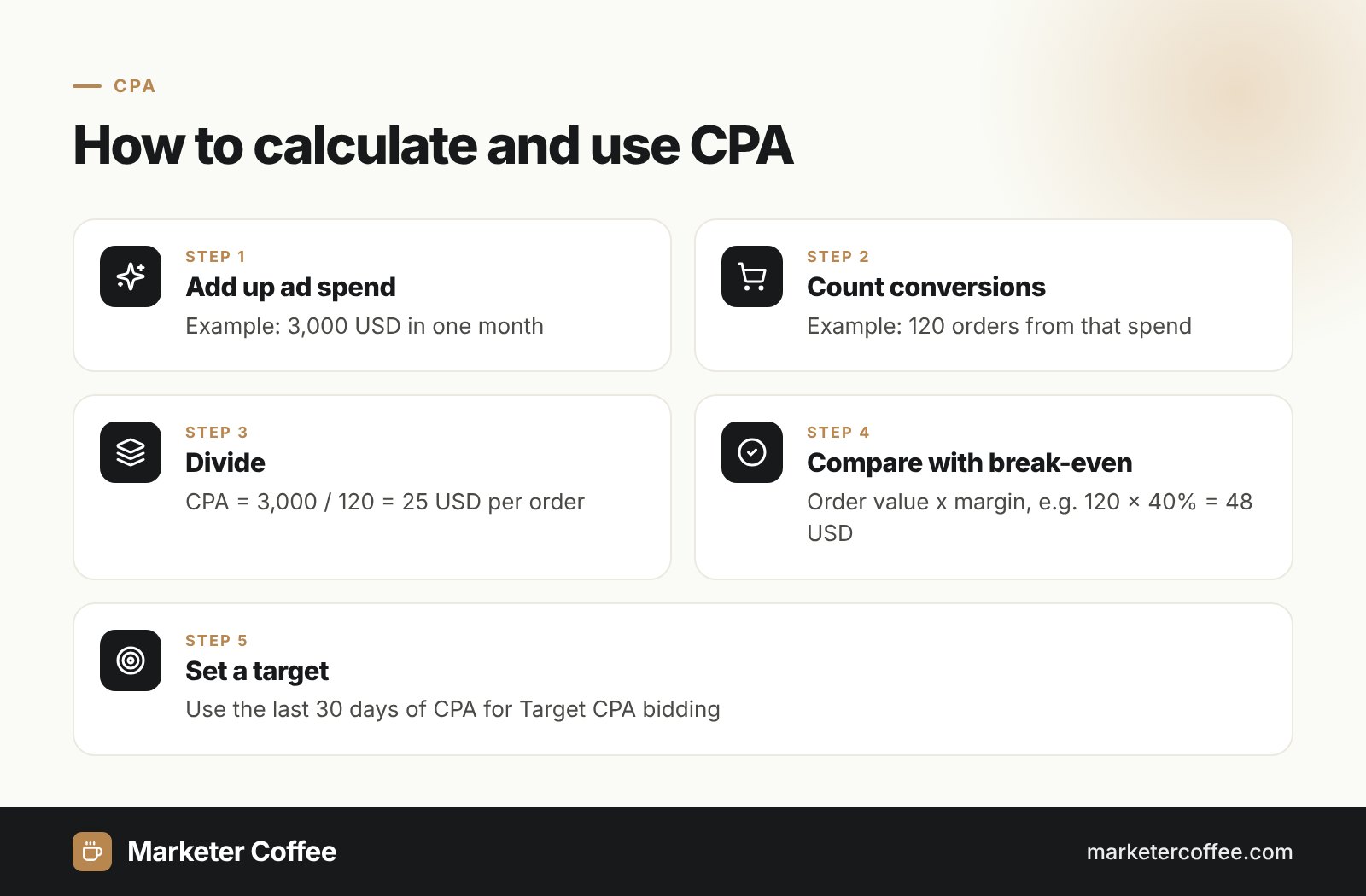
CPA is calculated as total ad spend divided by the number of conversions from that spend.
CPA = ad cost / conversions
Worked example: an online shop spends 3,000 USD on a Google Ads campaign in a month. The campaign gets 6,000 clicks at an average CPC of 0.50 USD, and 2% of those clicks end in a purchase, which gives 120 orders. CPA = 3,000 / 120 = 25 USD per order. The same result comes from CPC divided by conversion rate: 0.50 / 0.02 = 25 USD.
That second formula shows the two levers you control:
- Lower CPC: better Quality Score, tighter keywords, smarter bidding.
- Higher conversion rate: better landing pages, offers and checkout, which is the job of CRO.
What is a good CPA? Benchmarks
A good CPA is one that stays below the profit you make from a conversion, so benchmarks only give orientation. Public data from 2025 and 2026 shows wide ranges:
| Source and scope | Metric | Value |
|---|---|---|
| Triple Whale, Google Ads, e-commerce, Aug 2025 to Jul 2026 | Median CPA (purchase) | 28.14 USD |
| Triple Whale, Books and Music | Median CPA | 20.97 USD |
| Triple Whale, Electronics | Median CPA | 39.72 USD |
| WordStream by LocaliQ, Google Ads, 2025 | Average cost per lead | 70.11 USD |
| WordStream by LocaliQ, Facebook lead ads, 2025 | Average cost per lead | 27.66 USD |
Triple Whale reports that the median e-commerce CPA rose 9.96% year on year, and only the Pets and Animals category got cheaper. For lead generation, WordStream’s Facebook data ranges from 3.16 USD per lead for restaurants to 76.71 USD for dentists.
CPA vs CPL, CAC and ROAS
CPA measures the ad cost of one chosen action, while its neighbours measure other stages or include other costs.
| Metric | Formula | What it answers |
|---|---|---|
| CPA | ad cost / conversions | What does one conversion cost in ads? |
| CPL | ad cost / leads | What does one lead cost? (a CPA where the action is a lead) |
| CAC | all sales and marketing costs / new customers | What does one paying customer cost in total? |
| ROAS | revenue from ads / ad cost | How much revenue does 1 USD of ads return? |
CPA ignores order value. A 25 USD CPA is excellent for a 300 USD basket and a loss for a 20 USD basket, so e-commerce teams usually pair CPA with ROAS.
CPA in Google Ads and Meta Ads
Both platforms can bid automatically towards a CPA you choose. Google’s Target CPA strategy sets bids per auction so that the average cost per conversion matches your target; individual conversions can cost more or less. Google recommends starting from the average CPA of the last 30 days and judging results over at least 30 conversions. From June 2026 the setting appears in Google Ads simply as “Target CPA”. Meta offers a similar cost-per-result goal in Ads Manager. I set these targets with clients in Google Ads management and Meta Ads campaigns.
CPA from SEO is harder to measure but usually lower over time, because organic clicks have no CPC. I compare both in SEO results tracking.
Frequently asked questions about CPA
How do you calculate CPA?
Divide total ad spend by the number of conversions. For example, 3,000 USD of spend and 120 orders give a CPA of 25 USD.
What is a good CPA?
A good CPA is lower than the gross profit from one conversion. As a reference, Triple Whale measured a median Google Ads CPA of 28.14 USD for e-commerce brands between August 2025 and July 2026.
What is the difference between CPA and CAC?
CPA counts only ad spend per conversion. CAC includes all sales and marketing costs, such as salaries and tools, divided by new paying customers.
What is Target CPA in Google Ads?
Target CPA is an automated bid strategy that sets bids to get as many conversions as possible at the average cost you choose. Google recommends basing the target on your last 30 days of data.
Related terms
- About Target CPA bidding · Google Ads Help
- Google Ads Benchmarks by Industry · Triple Whale
- Google Ads CPCs rose to $5.42 in 2025 · Shopifreaks (WordStream by LocaliQ data)
- Facebook ad costs jump 21% in 2025, but still beat Google · Search Engine Land
