How do you calculate ROI?
You calculate ROI by dividing net profit from an investment by its cost and multiplying by 100. The standard formula is:
ROI = (gain from investment − cost of investment) ÷ cost of investment × 100%
In marketing, “gain” should be gross profit, not revenue, because the products you sell also cost money. “Cost” covers everything the campaign consumed: ad spend, agency fees, tools, creative production and staff time. A positive ROI means the campaign earned more than it cost; 0% means break-even; a negative ROI means a loss.
ROI example in USD
A worked example shows why ROI is always lower than ROAS for the same campaign. An online shop runs a Google Ads campaign for one month:
| Item | Value |
|---|---|
| Revenue from the campaign | 20,000 USD |
| Cost of goods sold | 9,000 USD |
| Gross profit | 11,000 USD |
| Ad spend | 4,000 USD |
| Agency fee and tools | 1,000 USD |
| Total investment | 5,000 USD |
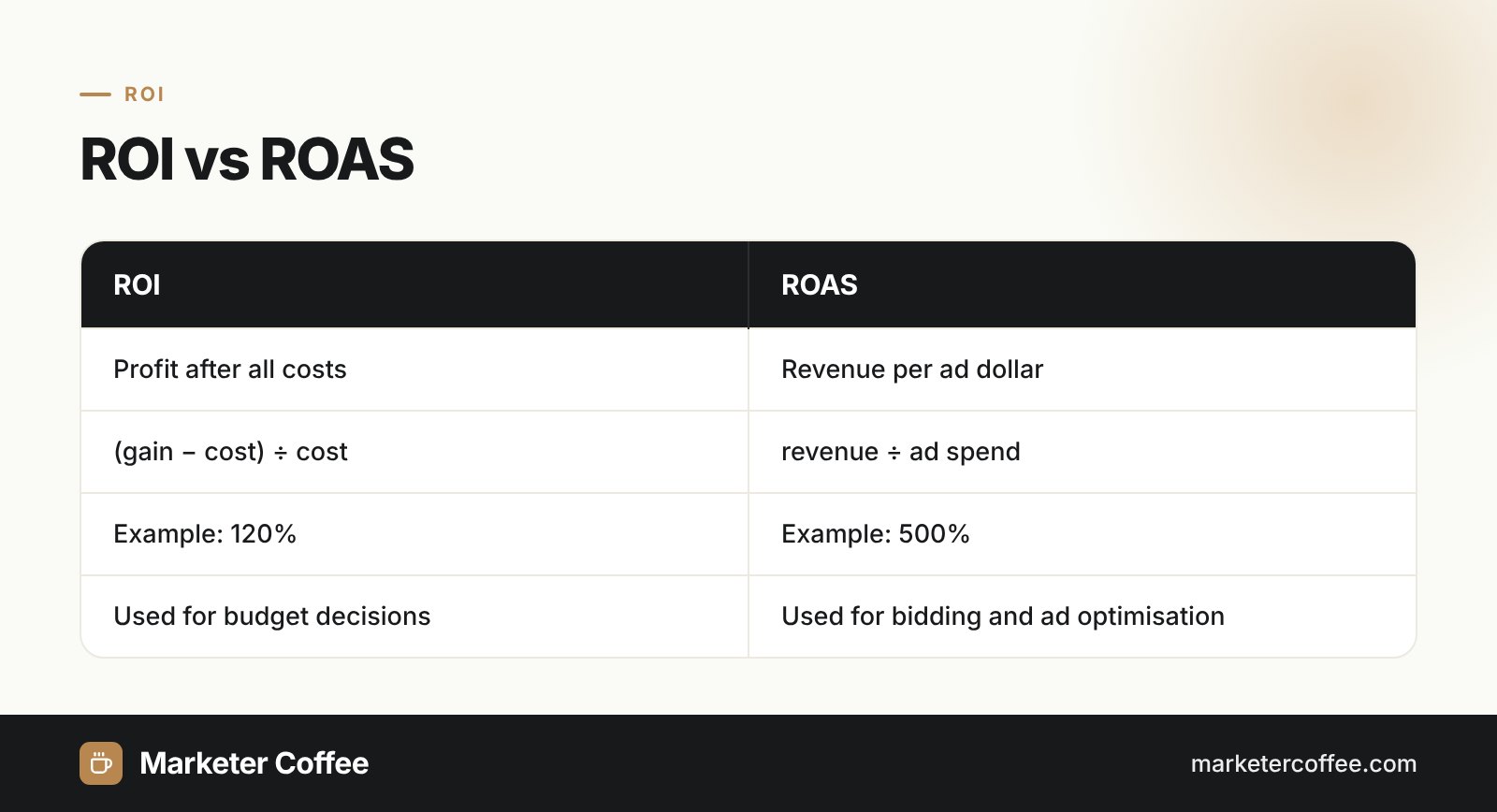
ROI = (11,000 − 5,000) ÷ 5,000 × 100% = 120%. Each dollar invested returned 1.20 USD of net profit. The same campaign has a ROAS of 20,000 ÷ 4,000 = 500%, which looks far better because it ignores product costs and fees.
What is a good marketing ROI?
A good marketing ROI is any value that beats your cost of capital and your other options, and it differs strongly by channel. Published benchmarks give a sense of scale:
- Google’s Economic Impact methodology assumes advertisers earn about 2 USD of profit per 1 USD spent on Google Ads, based on Hal Varian’s 2009 research.
- Google’s estimate rises to about 8 USD of profit per 1 USD when it adds the value of organic clicks that come with paid visibility.
- Litmus’s 2025 State of Email report found that 35% of marketing leaders get 10 to 36 USD back for every 1 USD spent on email, and another 30% get 36 to 50 USD.
Treat these as ranges reported by the platforms themselves, not as targets. In my projects I set the ROI target from the client’s margin: a shop with a 20% margin needs far more revenue per dollar than a SaaS company with 80% margins.
ROI vs ROAS, CPA and LTV
ROI differs from its neighbours because it is the only one of them that measures profit after all costs. The table compares them.
| Metric | What it measures | Formula |
|---|---|---|
| ROI | Net profit vs total investment | (gain − cost) ÷ cost |
| ROAS | Revenue vs ad spend only | revenue ÷ ad spend |
| CPA | Cost of one conversion | spend ÷ conversions |
| LTV | Value of a customer over time | avg order value × purchases × margin |
ROAS is better for daily bid decisions in ad platforms, while ROI is the number a CFO uses to decide whether marketing gets more budget.
ROI in SEO and paid campaigns
ROI in SEO is harder to calculate than in ads, because costs come first and returns build up over months. I measure SEO ROI over 12 to 24 months, counting organic conversions valued at margin, against content, technical work and link costs. The same model works for Meta Ads and other PPC channels, as long as attribution windows are the same.
Frequently asked questions about ROI
What is the ROI formula?
ROI equals gain from the investment minus its cost, divided by the cost, multiplied by 100%. For example, 11,000 USD of gross profit on a 5,000 USD investment gives an ROI of 120%.
What is the difference between ROI and ROAS?
ROI measures net profit after all costs, while ROAS only divides revenue by ad spend. A campaign can have a 500% ROAS and still a much lower ROI once product costs and fees are counted.
What is a good ROI in marketing?
A good marketing ROI is positive and higher than the return from your other options. Google's own methodology assumes about 2 USD of profit per 1 USD spent on Google Ads, while email often reports higher ratios.
Can ROI be negative?
ROI is negative when the investment costs more than it earns. A result of minus 20% means the campaign lost 20 cents for every dollar invested.
Related terms
- Economic Impact Report: Methodology · Google
- The ROI of Email Marketing · Litmus
- Nielsen unveils Marketing ROI Blueprint · Nielsen