



What is a data center?
A data center is the physical home of digital services: the place where code is executed and data is stored. When a user opens a website, a server in a data center answers the request. When ChatGPT or Google Gemini writes an answer, thousands of accelerators in a data center compute it.
How does a data center work?
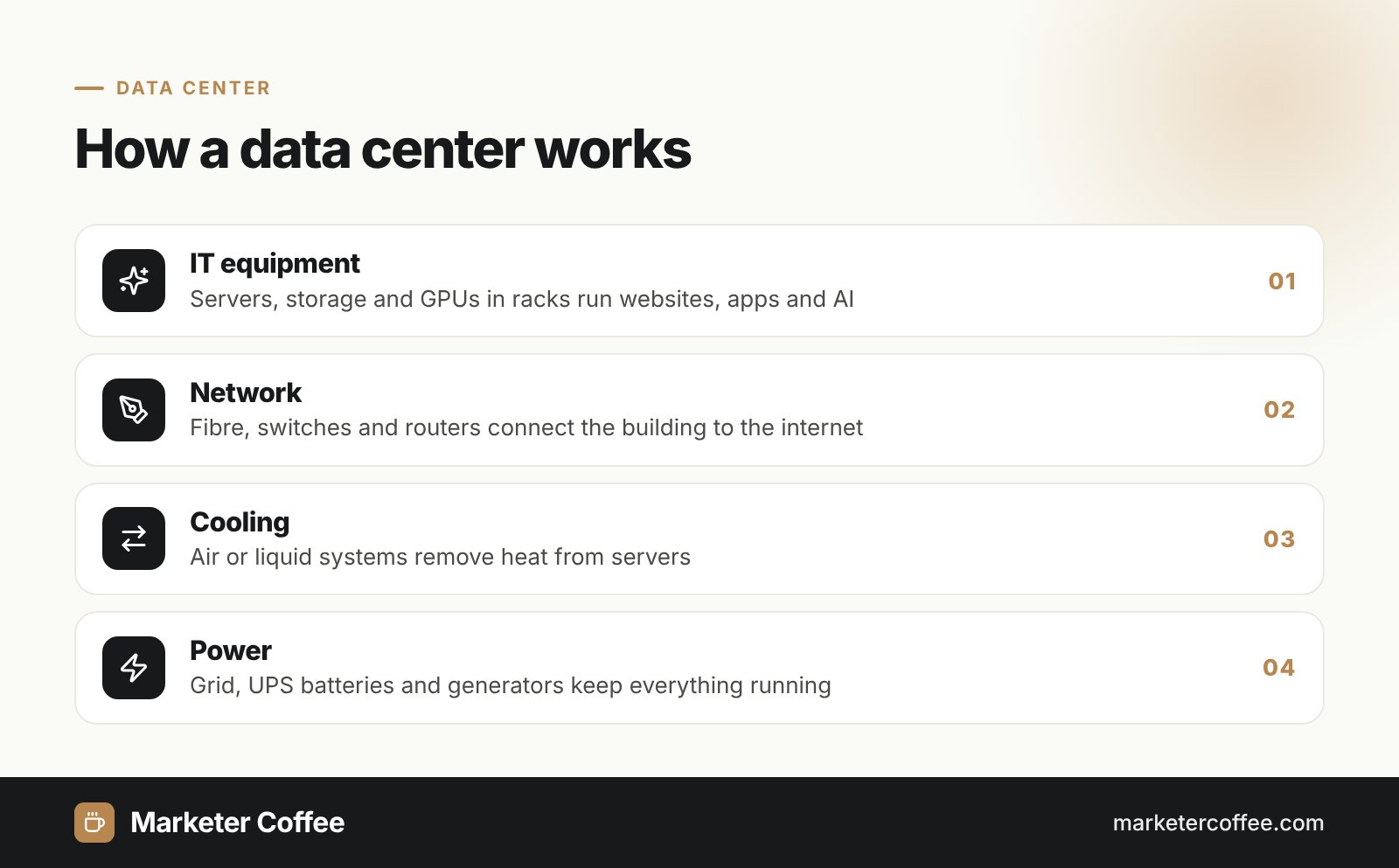
A data center works as a stack of layers, where each layer keeps the one above it running. The four main layers are:
- Power: grid connections, UPS batteries and diesel generators that take over during an outage.
- Cooling: air or liquid systems that remove the heat produced by servers.
- Network: fibre links, switches and routers that connect the facility to the internet.
- IT equipment: servers, storage arrays and GPUs placed in racks.
Efficiency is measured with PUE (power usage effectiveness), the ratio of total facility energy to IT energy. The Uptime Institute Global Data Center Survey 2025 reports a weighted average PUE of 1.54, a figure that has barely moved for six years.
Data center tiers (Uptime Institute)
The Uptime Institute Tier standard sorts data centers into 4 levels of resilience, from basic capacity to fault tolerance.
| Tier | Name | What it means |
|---|---|---|
| I | Basic capacity | UPS, cooling and generators, but maintenance usually requires a shutdown |
| II | Redundant capacity | extra power and cooling components |
| III | Concurrently maintainable | any component can be serviced without stopping IT |
| IV | Fault tolerant | independent, isolated systems survive any single failure |
Types of data centers
Data centers differ mainly by who owns the building and who uses the servers.
Enterprise data center
An enterprise data center is owned and used by one organisation, for example a bank that keeps customer data on its own premises.
Colocation
A colocation facility rents space, power and cooling to many companies that bring their own servers.
Cloud and hyperscale
Cloud data centers run by Google, Microsoft or Amazon serve thousands of customers. The IEA notes that a typical AI-focused data center uses as much electricity as 100,000 households.
Edge data center
An edge data center is a small facility placed close to users or IoT devices to cut latency.
Data centers and the AI boom: key numbers
The IEA “Energy and AI” report shows that AI is the main driver of data center growth. Its key figures:
- Consumption in 2024: about 415 TWh, 1.5% of global electricity.
- Growth: about 12% per year since 2017.
- Projection for 2030: about 945 TWh, more than double.
- Geography: the United States 45% and China 25% of global data center consumption in 2024.
Why do data centers matter for SEO and marketing?
Data centers matter for SEO because hosting location and quality affect speed, uptime and crawl efficiency. A server close to your users lowers latency, which helps Core Web Vitals and mobile SEO. Frequent 5xx errors slow Googlebot down, which wastes crawl budget. For international sites, a CDN with points of presence in each market usually beats moving the whole site between countries.
Data centers are also behind AI search. Every answer in AI Overviews or ChatGPT is computed in a data center, which is why Google, Microsoft and OpenAI keep announcing new capacity.
Frequently asked questions about Data center
What is a data center used for?
A data center is used to run and store digital services: websites, apps, databases, email, cloud storage and AI models. It provides servers together with stable power, cooling, security and network connections.
How much electricity do data centers use?
According to the International Energy Agency, data centers used about 415 TWh of electricity in 2024, roughly 1.5% of global consumption. The IEA expects this to grow to about 945 TWh by 2030.
What is a Tier III data center?
A Tier III data center is concurrently maintainable under the Uptime Institute standard. Any power or cooling component can be serviced without shutting down IT equipment, thanks to redundant components and distribution paths.
Does server location affect SEO?
Server location affects SEO indirectly through speed. A server or CDN close to your users lowers response time, which helps user experience and Core Web Vitals, while country targeting itself comes from hreflang, domains and content.
Related terms
- Energy and AI: Executive summary · International Energy Agency (IEA)
- Uptime Institute Global Data Center Survey 2025 · Uptime Institute
- Uptime data center tier standards · TechTarget
- Google Cloud opens Warsaw region · Techzine
- Microsoft launches its first datacenter region in Poland · Microsoft News Centre Europe
