What is a conversion?
A conversion is a user action that you define as valuable and that moves a visitor closer to becoming a customer. Buying a product is the obvious example, but a conversion can also be a form submission, a phone call, a trial sign-up, a newsletter subscription or a download. What counts as a conversion depends on the business goal, so the same click on “contact” can be a key conversion for a B2B agency and a minor step for a shop.
How does conversion tracking work?
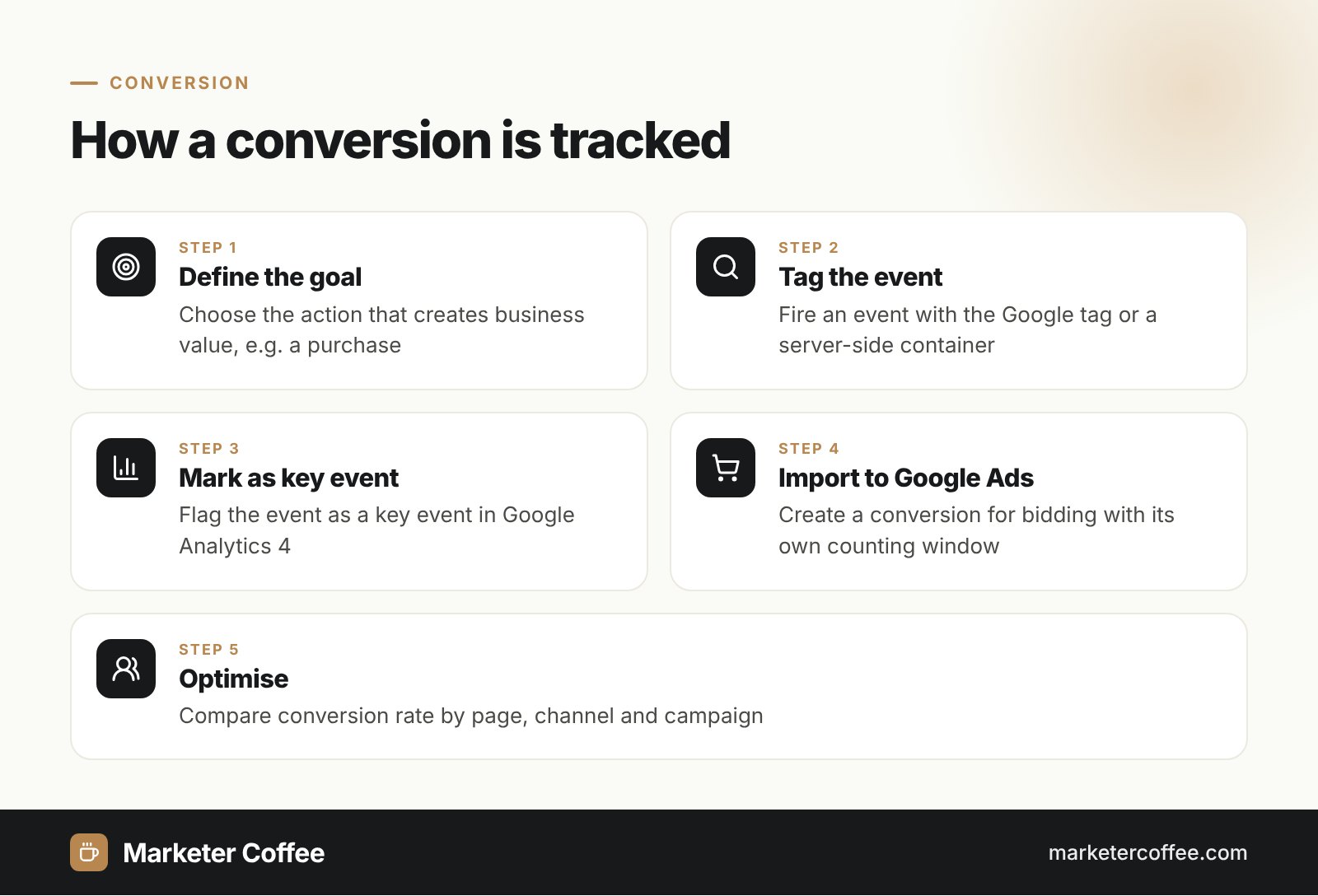
Conversion tracking works by firing an event when the action happens and attributing it to the session, channel and campaign that led to it. A tag (Google tag, Meta Pixel or a server-side container) records the event, sends it to analytics or an ad platform, and the platform links it to the click or visit. Without correct tracking, Smart Bidding in Google Ads and SEO reporting work on incomplete data.
Conversions in GA4 and Google Ads
Since March 2024, Google uses two separate terms: “key event” in Google Analytics 4 and “conversion” in Google Ads. A key event is any GA4 event you mark as particularly important to the business. A Google Ads conversion is created from a key event or another source and is used for campaign measurement and bidding, with its own counting window and primary or secondary status.
Types of conversions
Marketers usually split conversions into two levels, and both are worth tracking.
- Macro conversions: purchases, qualified leads, booked demos and paid subscriptions.
- Micro conversions: add-to-cart, newsletter sign-ups, pricing page views and video plays.
- Offline conversions: phone sales or signed contracts imported back into Google Ads from a CRM.
How to calculate the conversion rate
The conversion rate is the number of conversions divided by the number of sessions or clicks, multiplied by 100. A page with 2,000 sessions and 50 purchases has a 2.5% conversion rate. For paid search, LocaliQ’s 2025 Google Ads benchmarks report an average conversion rate of 7.52% across all industries, with an average cost per lead of $70.11. Compare yourself with your own history and your industry rather than with the global average, because B2B and high-ticket offers convert far less often than local services.
| Metric | Formula |
|---|---|
| Conversion rate | conversions / sessions (or clicks) x 100 |
| Cost per conversion | ad spend / conversions |
| Conversion value / cost (ROAS) | conversion value / ad spend |
Conversions in SEO and AI search
In SEO, conversions turn organic traffic into a measurable business result, which is why I report conversions per landing page, not only rankings and clicks. Pages with high CTR but weak conversion rates are candidates for conversion rate optimisation. AI search adds a new pattern: in my projects, visitors who arrive from ChatGPT or Google AI Mode view fewer pages, because the assistant has already done part of the comparison for them. Track these sources separately, as I describe in my guide to measuring SEO results.
Frequently asked questions about Conversion
What is a good conversion rate?
A good conversion rate depends on industry, traffic source and offer. LocaliQ's 2025 Google Ads benchmarks put the cross-industry search average at 7.52%, but e-commerce sites often convert at a lower rate.
What is the difference between a conversion and a key event?
A key event is an important event marked in Google Analytics 4. A conversion is the Google Ads object used for bidding, often created from a key event. Google split the terms in March 2024.
How do you calculate the conversion rate?
Divide conversions by sessions or clicks and multiply by 100. For example, 50 purchases from 2,000 sessions give a 2.5% conversion rate.
What is a micro conversion?
A micro conversion is a small step towards the main goal, such as adding to cart or signing up for a newsletter. It helps diagnose where users drop out of the funnel.
Related terms
- [GA4] About key events · Google Analytics Help
- Key event: definition and history · PPC Land
- Google Ads costs rise 12.88% (LocaliQ 2025 benchmarks) · PPC Land