




The best marketing analytics tools in 2026 are Google Analytics 4 for website and campaign traffic, Data Studio for reporting, Microsoft Clarity for free behaviour analytics, and Supermetrics for pulling ad data into one place, with Piwik PRO and Matomo as the privacy-first alternatives for European companies. I am Adrian Dąbrowiecki, an SEO consultant who works with SaaS and ecommerce teams in the US, UK and Europe, and this guide covers ten marketing analytics tools with current prices, what each one measures well, where each one falls short, and three stacks for three kinds of team.
The category moved in two directions this year. Google renamed Looker Studio back to Data Studio in April 2026 and added a default AI Assistant channel to GA4 in May, so traffic from ChatGPT, Gemini and Claude finally has its own line in reports. At the same time, nearly every tool here, from Mixpanel and Amplitude to Clarity and Supermetrics, now has an MCP server, which means you can ask an AI assistant questions about your data instead of building another dashboard.
What Is a Marketing Analytics Tool?
A marketing analytics tool is software that collects data on how people find and use your website or product, and connects it to marketing activity, so you can see which channels, campaigns and pages produce results.
The tools fall into four groups, and most teams need one from at least two of them. Web analytics tools such as GA4, Matomo and Piwik PRO count visits, sources and conversions. Behaviour analytics tools such as Clarity and Hotjar show what people do on a page, through heatmaps and session recordings. Product analytics tools such as Mixpanel, Amplitude and PostHog follow individual users through sign-up, activation and retention. Reporting and data tools such as Data Studio and Supermetrics combine everything into reports people actually read.
The mistake I see most often is buying a fourth tool before the first one is set up properly. A GA4 property with clean key events, linked to Search Console and Google Ads, answers most marketing questions on its own.
How I Chose These Tools
I judged each tool on data quality and how easy it is to trust, on what it costs at a realistic traffic level, on privacy and where data is stored, and on how well it connects to the rest of a marketing stack, including AI assistants. I also gave weight to tools that work for marketers without an analyst on the team.
Every price below was checked on the vendor’s own pricing page on 14 October 2026. Where a vendor does not show a price, I say so and give the source I used. Ratings come from G2. None of the links here are affiliate links.
The AI channel is the reason to revisit your setup this year. In May 2026 Google added an AI Assistant default channel to GA4 that groups traffic from chatbots such as ChatGPT, Gemini and Claude, and Microsoft Clarity now reports which AI crawlers visit a site and whether that turns into real visits. For the first time, the two most widely installed free tools both show the AI channel without custom setup.
10 Best Marketing Analytics Tools in 2026
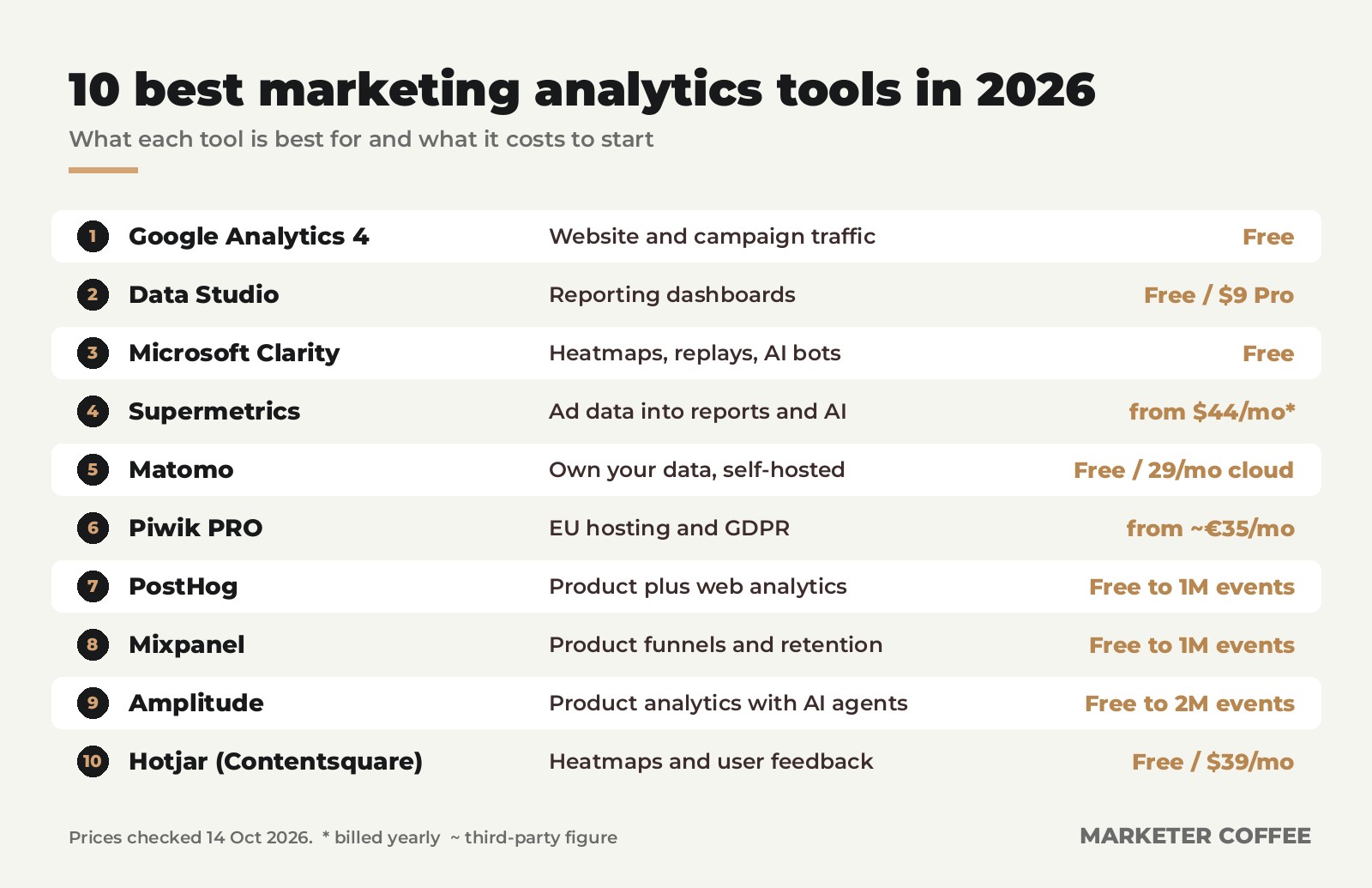
The ten tools are ranked by how much of a typical marketing team’s measurement each one covers, with free and widely used tools first and specialists after them.
| Tool | Best for | Starting price | Free option |
|---|---|---|---|
| Google Analytics 4 | Website and campaign traffic | Free | Yes |
| Data Studio | Reporting dashboards | Free; Pro $9 per user per project/mo | Yes |
| Microsoft Clarity | Heatmaps, recordings and AI bot traffic | Free | Yes |
| Supermetrics | Moving ad data into reports and AI | $44/mo, billed yearly | 14-day trial |
| Matomo | Owning your data, self-hosted | Free on-premise; Cloud from 29/mo | Yes (self-hosted) |
| Piwik PRO | EU hosting and GDPR | About €35/mo (Business) | 30-day trial |
| PostHog | Product and web analytics in one | Free to 1M events, then usage-based | Yes |
| Mixpanel | Product funnels and retention | Free to 1M events | Yes |
| Amplitude | Product analytics with AI agents | Free to 2M events | Yes |
| Hotjar (Contentsquare) | Heatmaps and user feedback | $39/mo (Growth) | Free plan |
1. Google Analytics 4
GA4 is the default for a reason. It is free, it connects natively to Google Ads, Search Console, BigQuery and Data Studio, and almost every marketer and agency knows how to read it. For most companies it should be the first tool configured and the last one replaced.
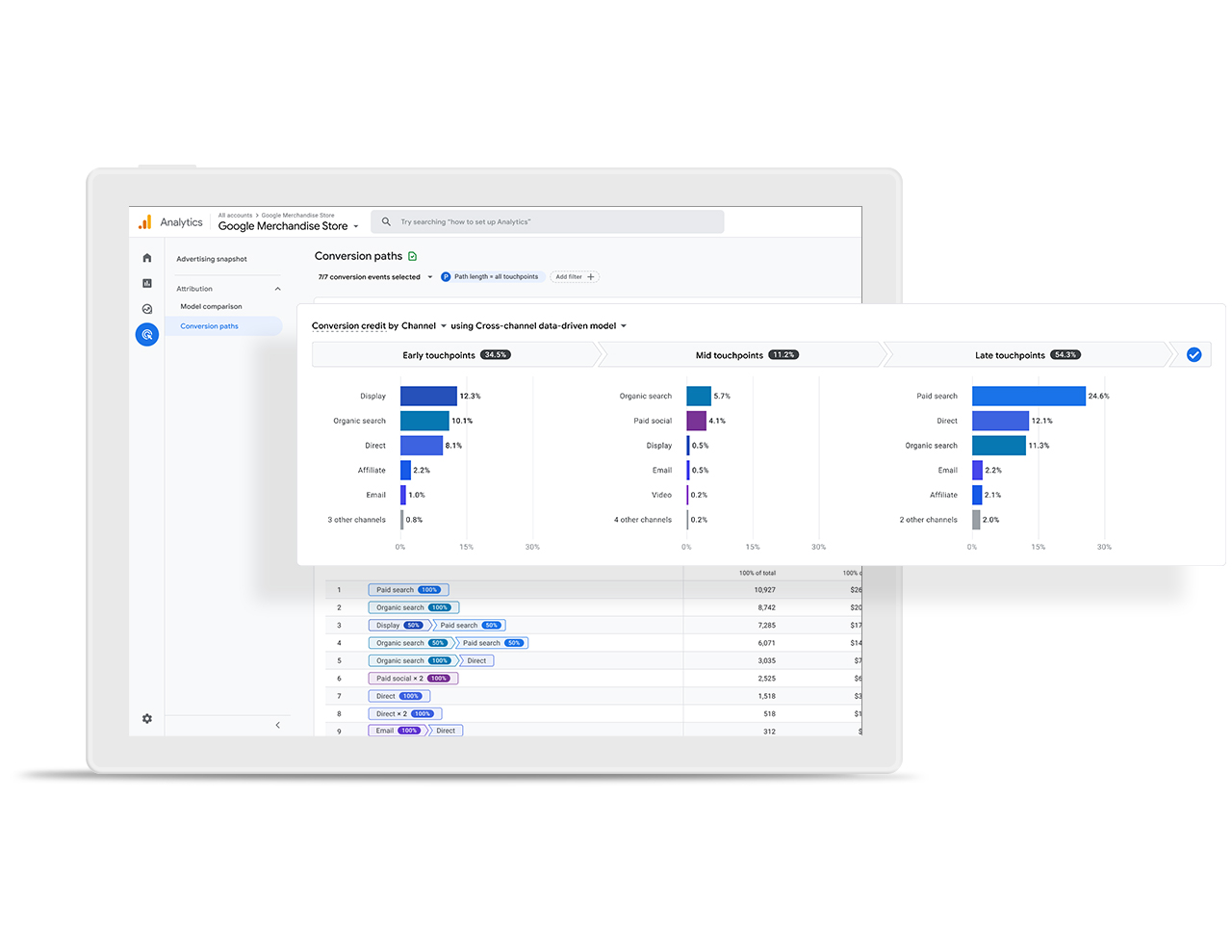
This year’s updates are worth knowing. Generated insights on the Home page summarize the three biggest changes since your last visit. The AI Assistant default channel, added on 13 May 2026, separates chatbot referrals from ordinary referral traffic, and in June Google added built-in source grouping for ChatGPT and Perplexity. Dashboards arrived in September. Google also publishes an experimental, read-only MCP server that lets an AI assistant run GA4 reports for you.
The weak spots have not changed much. The interface is harder to navigate than Universal Analytics was, thresholding and consent mode hide part of the data, and standard properties keep detailed data for a maximum of 14 months. In the EU, GA4 needs a proper consent setup, which some legal teams still treat with caution. Release notes are on Google’s What’s new in Google Analytics page.
2. Google Data Studio
You probably know it as Looker Studio. Google rebranded it back to Data Studio on 16 April 2026, and the old address redirects. It connects GA4, Search Console, Google Ads, Sheets and BigQuery into dashboards that update themselves, which removes the most boring hour of every month.
The AI layer is now real. Gemini in Data Studio helps build charts and calculated fields, and Conversational Analytics, generally available since 30 July 2026, lets you ask questions of your data in plain language. Data agents built in BigQuery can be published into Data Studio too.
Native connectors only cover Google’s own products, so Meta Ads, LinkedIn or a CRM need a paid connector such as Supermetrics. Large reports with many sources get slow. The release notes list every change. For the way I structure SEO dashboards in it, see Measuring SEO: How to track SEO results?
3. Microsoft Clarity
Clarity gives you heatmaps and session recordings for free with no traffic cap, which alone makes it the easiest recommendation on this list. Copilot summarizes recordings and answers questions about behaviour in plain language, so you do not have to watch hundreds of sessions to spot a broken form.
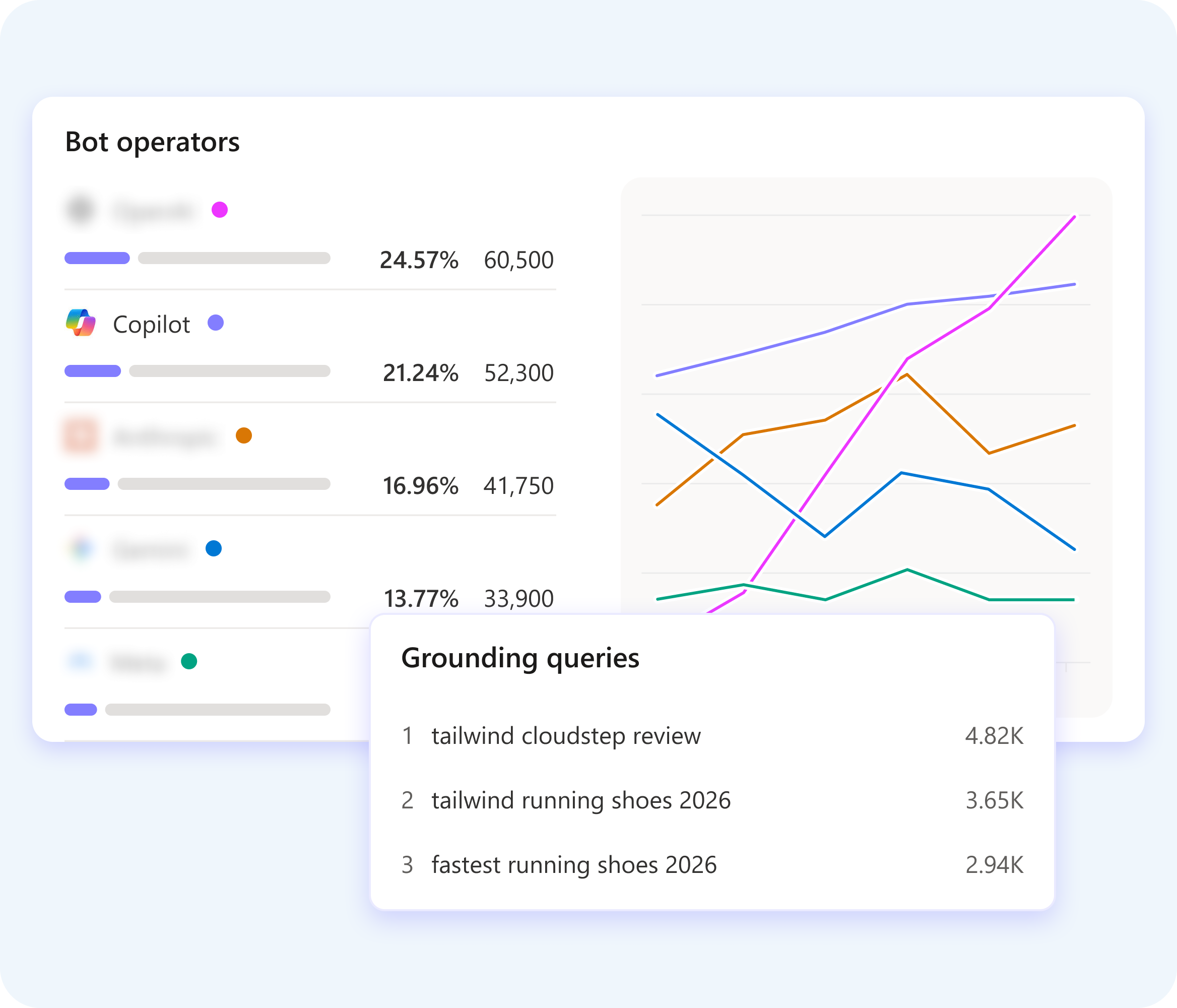
What makes Clarity more interesting in 2026 is its AI visibility work. Bot Activity shows which AI crawlers visit your site, which pages they request and which ones ignore robots.txt. Since August, it connects crawler activity to real referral visits, and its Citations dashboard groups the AI queries where your content appears by topic, split into branded and non-branded. There is an MCP server as well.
Clarity is a behaviour tool, not a full analytics platform, so it complements GA4 rather than replacing it. Recordings need consent in most EU setups, and the G2 sample is small for a tool this widely installed. Pick it for any site that does not already have heatmaps.
4. Supermetrics
Supermetrics pulls data from more than 150 sources, including Meta Ads, LinkedIn Ads, TikTok, HubSpot and Shopify, into Data Studio, Sheets, Excel, Power BI or a data warehouse. For an agency or a team running paid campaigns on several platforms, it is the shortest path from “five ad accounts” to “one report”.
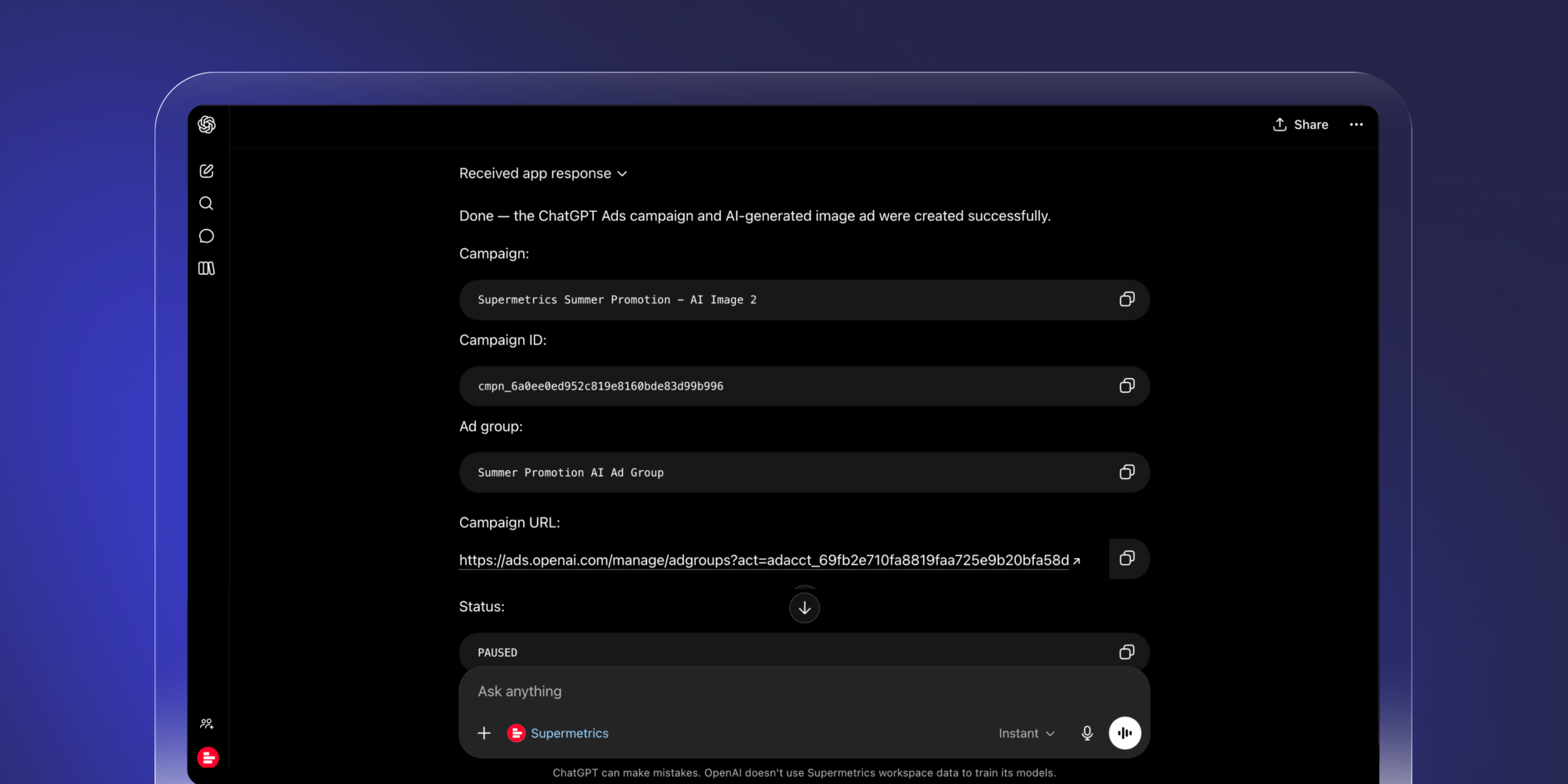
The newer part is AI. Claude, ChatGPT and Copilot are now listed as destinations alongside Data Studio and Sheets, so you can ask an assistant how campaigns performed last month and get an answer from live data. Supermetrics Studio builds dashboards with AI and includes monthly AI credits.
Pricing grows with sources, accounts and users. Starter covers three data sources and one user; Growth covers six sources and two users. Data warehouse destinations like BigQuery and Snowflake are Enterprise only. The pricing page lists extras for more seats and sources, and that is where bills climb.
5. Matomo
Matomo is the open-source alternative to Google Analytics. You can host it on your own server for free with unlimited traffic and users, which means no data leaves your infrastructure and no sampling ever applies. That makes it a common choice for public sector bodies, universities and companies with strict data policies.

The reports will feel familiar to anyone who used Universal Analytics. It can run without cookies, and with the right configuration it can be used without a consent banner in some EU countries; check your own legal position before relying on that.
Self-hosting is free in licence terms, not in time. Someone has to maintain the server, update Matomo and keep the database fast as traffic grows, and several premium features, such as heatmaps and A/B testing, are paid plugins. The Cloud version removes the hosting work, starting at 29 a month on the pricing page, which does not state the currency for Cloud.
6. Piwik PRO
Piwik PRO is the tool I would look at first for a European company whose legal team is uncomfortable with Google Analytics. It combines analytics, a tag manager and a consent manager in one platform, and its Business plan runs on a cloud operated in the EU, in Sweden, according to a third-party pricing review. Reports are close to the Universal Analytics model, which reviewers on G2 often mention as a plus.
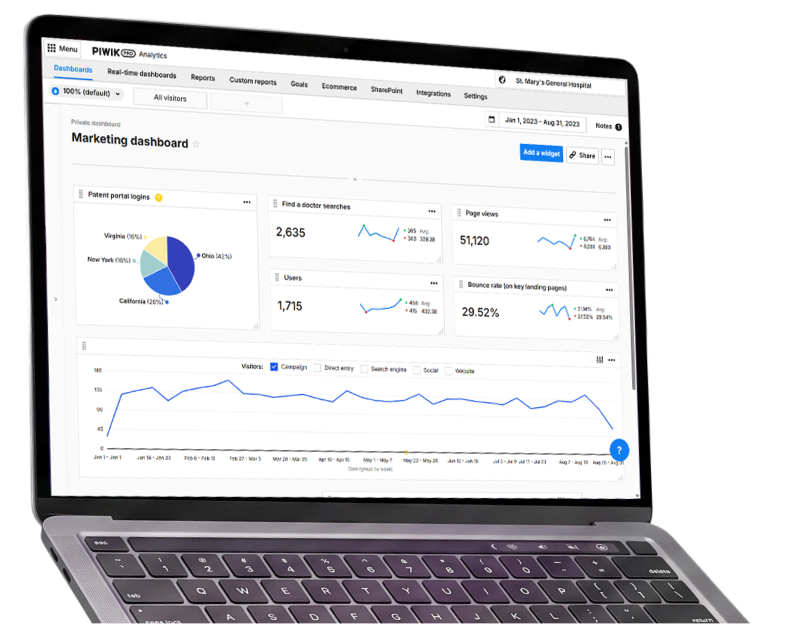
The big change this year is that the free Core plan is gone. Piwik PRO confirmed on its community forum that Core would be discontinued in February 2026, and the entry point is now a paid Business plan, quoted at about €35 to €36 a month for up to 2 million monthly actions. Fees rise 4% a year by default, and the official pricing page did not show plan prices when I checked.
Integrations are thinner than GA4’s, and the interface feels dated to some users. Pick Piwik PRO if data residency and consent are deal-breakers. If they are not, GA4 with a good consent setup is cheaper and better connected.
7. PostHog
PostHog bundles product analytics, web analytics, session replay, feature flags, experiments and surveys in one platform, with a free allowance on each that resets every month. Its web analytics dashboard covers visitors, sources, UTMs and Core Web Vitals, and has a cookieless mode that avoids a cookie banner for analytics.
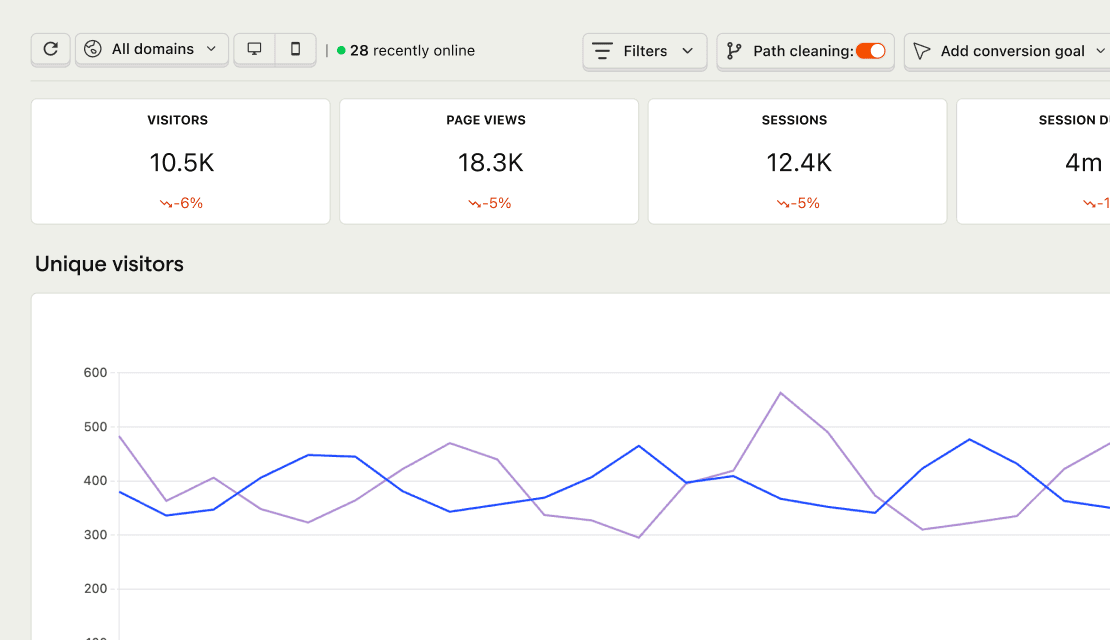
For a SaaS marketing team, the value is seeing a visitor’s whole path in one place: the blog post that brought them in, the pricing page they read, the sign-up, and whether they activated. PostHog AI and an MCP integration let you query that in plain language.
It is built for product and engineering teams first, and it shows. Setting up events properly takes a developer, and marketers used to GA4’s acquisition reports will find fewer ready-made views. The pricing page lets you cap spend per product, which I would set on day one.
8. Mixpanel
Mixpanel is the product analytics tool I see most often in SaaS companies that grew past GA4’s limits for in-app behaviour. Funnels, retention curves and cohort analysis are fast and flexible, and non-analysts can build them without SQL.

The 2026 version leans heavily on AI. Mixpanel Agent monitors your product and flags changes before you ask, you can tag it in Slack, and the MCP server connects Mixpanel to Claude, ChatGPT or Cursor. Session replay, experiments and feature flags are included with free allowances.
It is not a marketing attribution tool. Ad spend, campaign cost and SEO data still live in GA4 or your ad platforms. The pricing page uses an events slider; the example shown was $120 a month billed yearly for 18 million events a year.
9. Amplitude
Amplitude covers the same ground as Mixpanel, with a larger free allowance and a bigger enterprise footprint. Its Global Agent answers questions across your data, such as why new users drop off before setup, and AI agents and the MCP server are available on every plan, including Free.
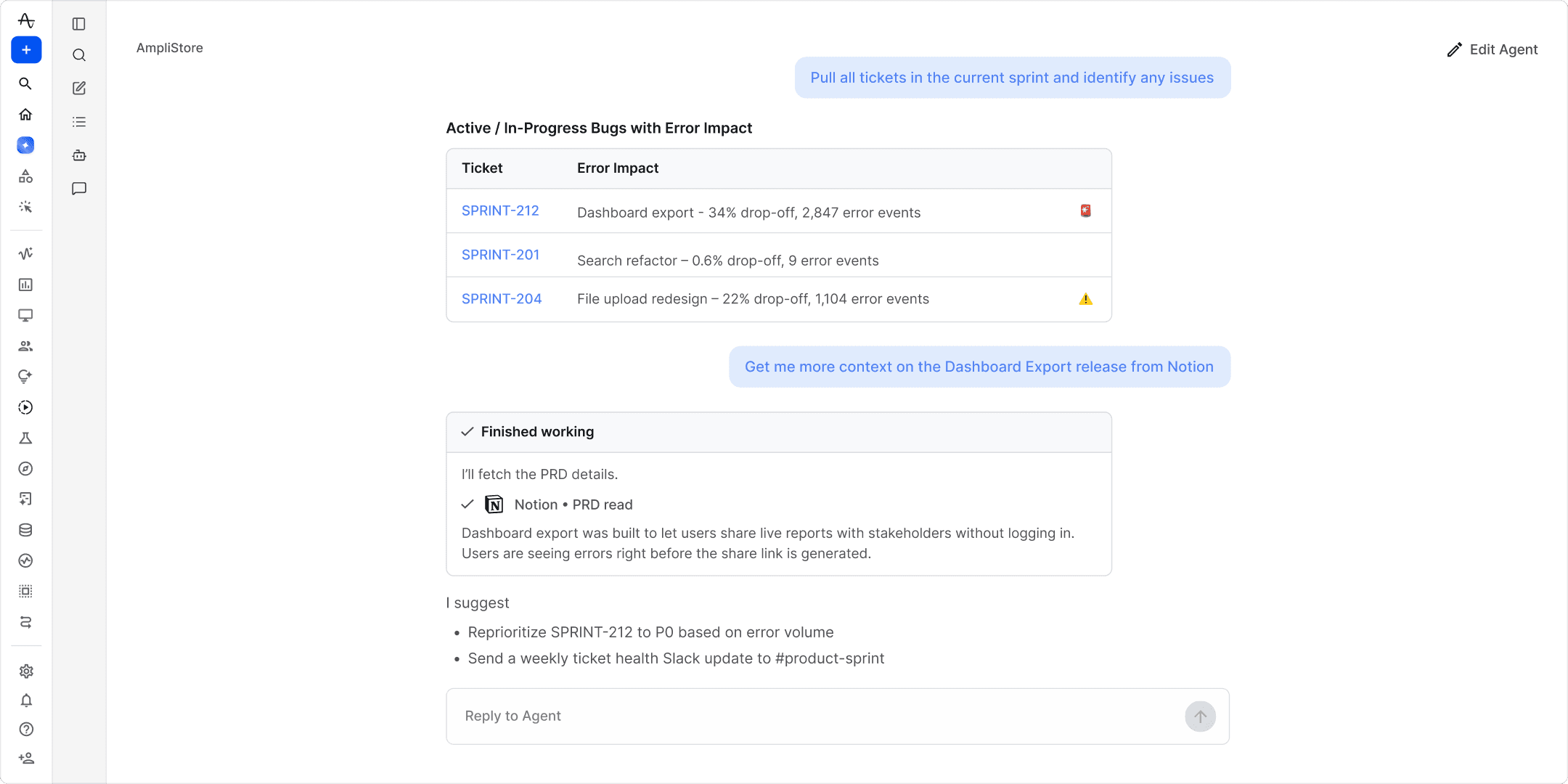
Amplitude also has Agent Analytics, which measures how users interact with AI features inside your own product. For SaaS companies shipping AI assistants, that is a measurement problem few other tools address.
The free plan caps saved charts at ten per organization and data access at one year, which a growing team hits quickly. Growth and Enterprise are sales-only, so the jump in cost is hard to predict. The pricing page lists limits per plan.
10. Hotjar (Contentsquare)
Hotjar is now part of Contentsquare, and new Hotjar accounts can no longer be created; new users are sent to Contentsquare’s free plan, while existing Hotjar users can still log in. The product that replaced it combines heatmaps, session replay, funnels, surveys and feedback widgets.
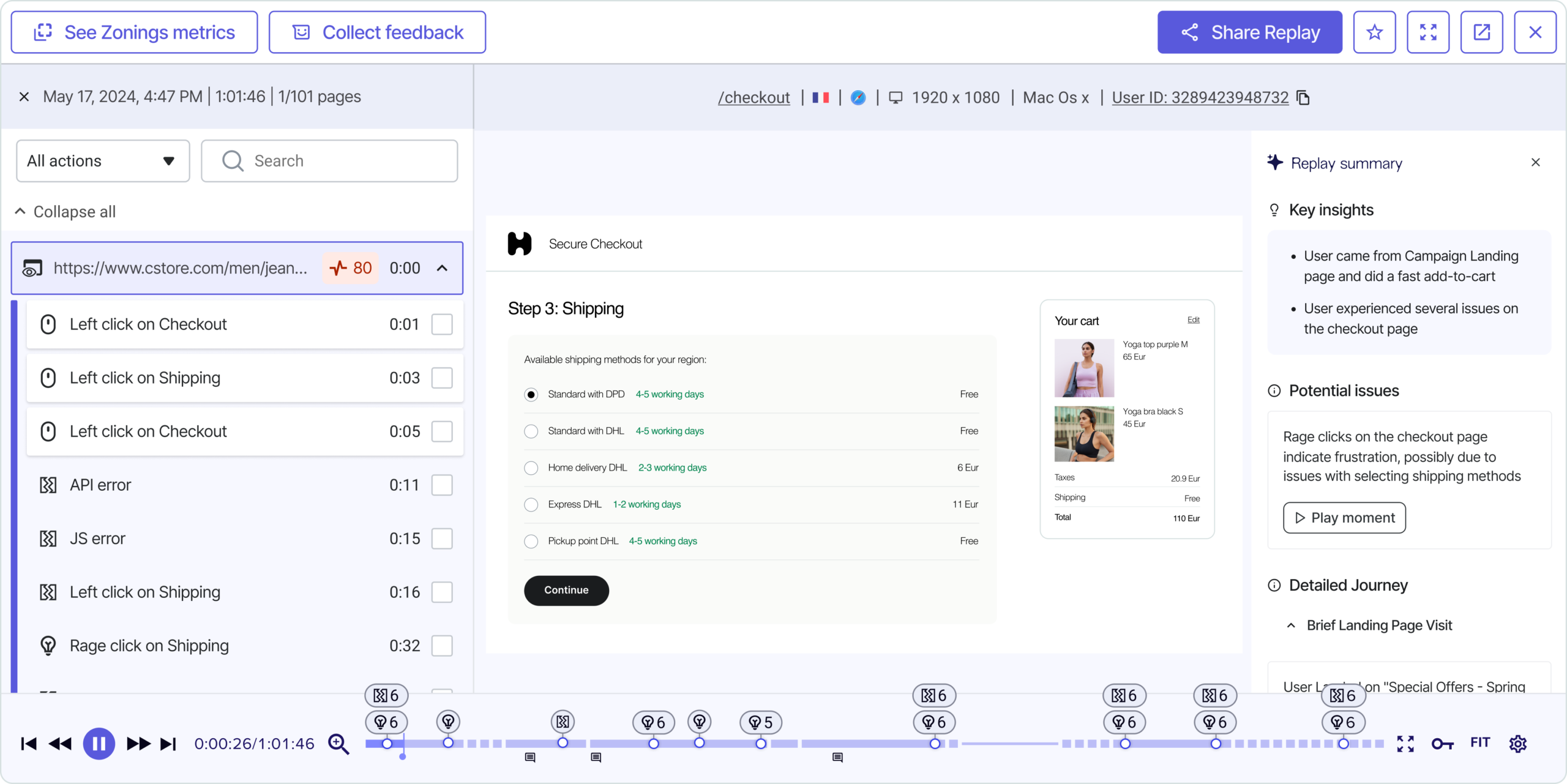
The reason to pick it over Clarity is feedback. Surveys and on-page feedback tell you why people behave the way the heatmap shows, which Clarity does not do. The free plan is generous at 200,000 monthly sessions but keeps only one month of data.
Growth starts at $39 a month on the Contentsquare pricing page, with 13 months of data. If you only need heatmaps and recordings, Clarity does it for free.
Which Marketing Analytics Stack Should You Use?
Most teams need one traffic tool, one behaviour tool and one reporting layer; product analytics only earns its place once you have a product people log into.
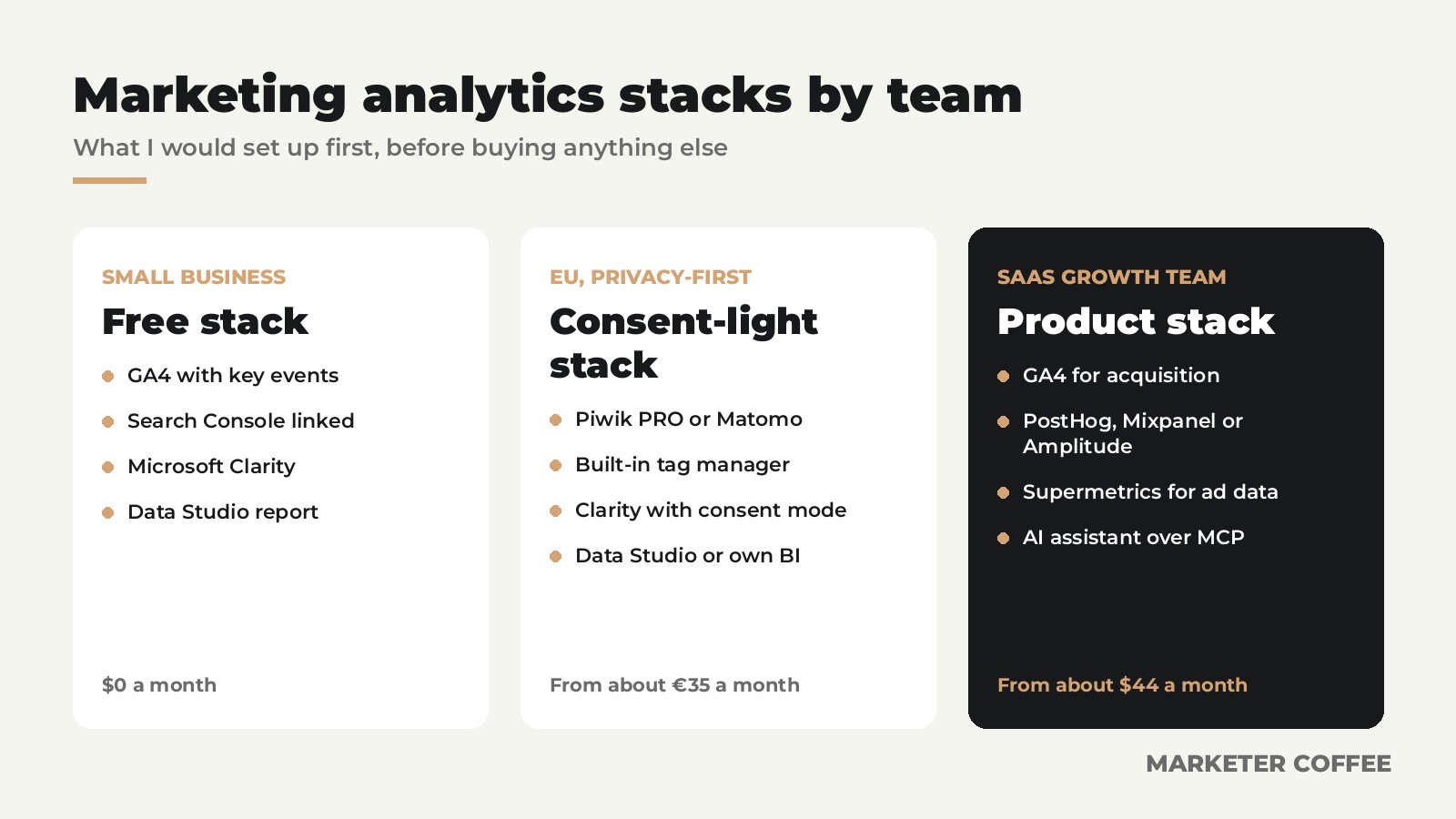
A small business can measure almost everything for free with GA4, Search Console, Clarity and a Data Studio report. A European company with strict privacy requirements should replace GA4 with Piwik PRO or self-hosted Matomo and keep Clarity behind consent. A SaaS growth team should keep GA4 for acquisition, add PostHog, Mixpanel or Amplitude for what happens after sign-up, and use Supermetrics if paid channels span several platforms.
For SEO specifically, none of these tools replaces Search Console and a rank or visibility tracker. The SEO side of the stack is in the best SEO tools in 2026, and the AI visibility trackers are compared in the best AI visibility tools.
Is Google Analytics 4 GDPR Compliant?
GA4 can be used in a GDPR-compliant way, but only with a proper consent mechanism, IP and data-sharing settings reviewed, and a legal basis your company is comfortable with; it is not compliant out of the box.
Several EU data protection authorities raised concerns about Google Analytics in 2022, and while the EU-US Data Privacy Framework has eased most of those since 2023, some organizations still prefer EU-hosted alternatives. That is the main market for Piwik PRO and Matomo. If your legal team signs off on GA4 with consent mode, its free price and integrations are hard to beat.
What Is the Best Free Marketing Analytics Tool?
The best free marketing analytics tool is Google Analytics 4, paired with Microsoft Clarity for behaviour data and Data Studio for reporting, all three free with no traffic limits that matter for most sites.
For product analytics, PostHog, Mixpanel and Amplitude all have free plans large enough for an early-stage SaaS. Matomo is free if you host it yourself. Piwik PRO no longer has a free plan.
FAQ: Marketing Analytics Tools
Short answers to the questions teams ask most when choosing marketing analytics software.
What is the best marketing analytics tool overall?
Google Analytics 4 is the best marketing analytics tool overall because it is free, widely understood and connected to Google Ads, Search Console and Data Studio. Most teams should add Microsoft Clarity for behaviour data before buying anything else.
Did Looker Studio change its name?
Yes. Google rebranded Looker Studio back to Data Studio on 16 April 2026. Existing reports and links still work, and Gemini in Looker became Gemini in Data Studio at the same time.
How do I track traffic from ChatGPT and other AI assistants?
In GA4, use the AI Assistant default channel added in May 2026, which groups traffic from chatbots such as ChatGPT, Gemini and Claude. Microsoft Clarity adds data on which AI crawlers visit your site and how often that turns into real visits.
What is the best GDPR-friendly alternative to Google Analytics?
Piwik PRO is the best GDPR-focused alternative for companies that want a hosted EU platform with built-in consent management. Matomo is the best choice if you want to host analytics on your own servers.
Do I need product analytics as well as GA4?
Only if you have a product people sign into. GA4 is built for acquisition and website behaviour, while Mixpanel, Amplitude and PostHog follow individual users through activation, retention and feature use.
Measure What Your SEO Actually Earns
Analytics tools tell you what happened. Turning that into a plan for which pages to build, fix or drop is where most teams get stuck, and it is the part of SEO we handle at Marketer Coffee. We are a Poland-based SEO agency for SaaS and ecommerce brands across the US, UK and Europe, working at rates 40% to 60% below comparable US and UK agencies, and every engagement starts with a free preliminary audit and a 90-day plan.
See scope and pricing in SaaS SEO Services, Ecommerce SEO Services or International SEO Services. The Galeria Zapachu case study shows how fast clean measurement pays off: technical quick wins lifted traffic by 84% in 28 days.
Written by Adrian Dąbrowiecki, founder of Marketer Coffee and SEO consultant with 7+ years in SaaS and ecommerce. Prices checked on each vendor’s pricing page on 14 October 2026; Piwik PRO figures come from Piwik PRO’s community forum and Hardal’s pricing review (August 2026) because the official pricing page did not display them. Ratings: G2. Sources: Data Studio release notes; What’s new in Google Analytics; Microsoft Clarity blog; Contentsquare on Hotjar. Screenshots belong to their respective vendors. No affiliate links.
Pingback: 10 Best Landing Page Builders in 2026 (Prices Checked)