



How does anchor text work?
Anchor text works by attaching a short description of the target page to the link itself, so Google can understand a page partly through the words other pages use to point at it. In HTML it is the text between the opening and closing a tags:
- <a href=”https://example.com/espresso-grinders/”>espresso grinders</a>
Brin and Page explained the idea in their 1998 Stanford paper: anchors often describe a page more accurately than the page itself, and they let a search engine index files it cannot read, such as images. For a linked image, Google uses the alt attribute as the anchor text.
Types of anchor text
SEO practitioners group anchors into 6 types, based on how closely the text matches the target keyword:
| Type | Example for a page about espresso grinders |
|---|---|
| Exact match | espresso grinders |
| Partial match | best grinders for espresso at home |
| Branded | Marketer Coffee |
| Naked URL | example.com/espresso-grinders |
| Generic | click here, read more |
| Image | alt text of a linked image |
Anchor text best practices from Google
Google’s link guidelines ask for anchor text that is descriptive, reasonably concise and relevant to the target page. The rules I apply in every audit come straight from that document:
- Describe the destination: “espresso grinder guide” instead of “click here”.
- Keep it short: a full promotional sentence as a link is too long.
- Write naturally: stuffing every related keyword into anchors breaks Google’s spam policies.
- Give context: the words around a link matter, so avoid chaining several links next to each other.
- Use crawlable links: an a element with an href, not a span or onclick handler.
Anchor text in internal and external links
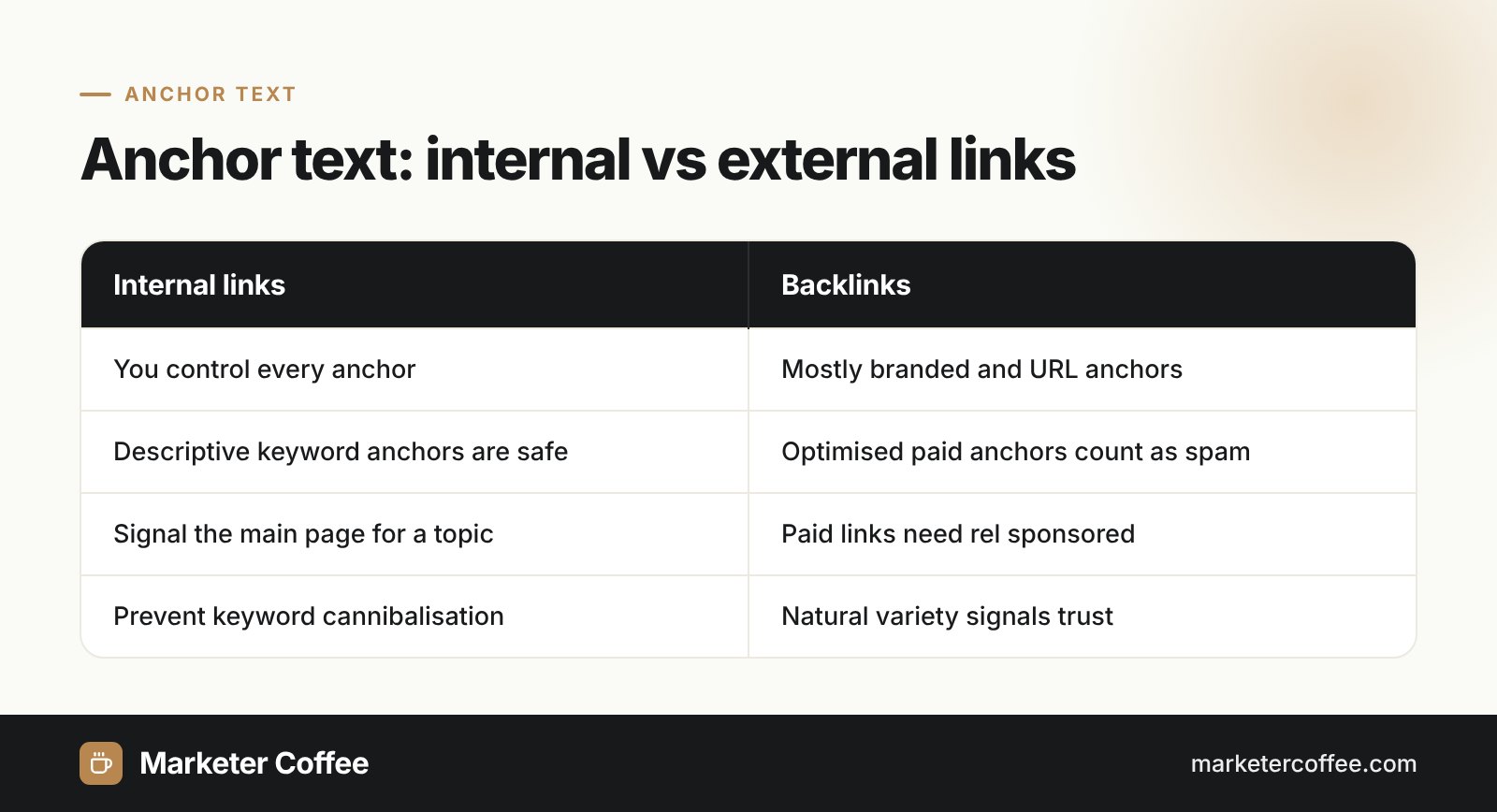
The same text plays a different role in internal linking and in backlinks, so I treat the 2 differently.
Internal links
On your own site you control every anchor, and descriptive, keyword-rich anchors are safe and useful. They tell Google which page is the main one for a topic and help prevent keyword cannibalisation. This glossary is an example: each entry links related terms with their names as anchors.
External links
For backlinks, Google’s spam policies list optimised anchor text in paid articles, guest posts, press releases and advertorials as link spam when those links pass ranking credit. Google’s Penguin update, launched in April 2012, targeted exactly this kind of manipulation. A natural link profile is dominated by branded, URL and partial-match anchors, because that is how people link on their own. Paid or sponsored links must carry rel=”sponsored” or rel=”nofollow”.
Anchor text on multilingual sites
On international sites, anchors must be written in the language of the page that contains the link, not copied from the source language. A German category page should link with German phrases that Germans actually search, which often differ from a literal translation of the Polish or English keyword. I also check 3 recurring problems:
- Untranslated navigation and footer anchors left in English on the /de/ or /cz/ version.
- Internal links pointing to another language version instead of the matching hreflang alternate.
- Local backlinks with anchors in the wrong language, which weakens the topical signal for that market.
Getting this right is part of every international SEO project I run, and it matters for AI search too, because language models also read the link text when they connect pages and entities.
Need help with a natural anchor profile? See my link building service.
Frequently asked questions about Anchor text
What is a good anchor text?
A good anchor text describes the target page in a few words and fits naturally into the sentence. Google recommends descriptive, concise anchors and advises against generic text such as click here.
Is exact-match anchor text bad for SEO?
Exact-match anchors are fine in internal links on your own site. In backlinks they become risky when they are paid or placed at scale, because Google's spam policies treat optimised anchors in paid links as link spam.
How does Google treat image links?
Google uses the alt attribute of a linked image as its anchor text. A linked image with an empty alt attribute gives Google no description of the target page.
Should anchor text be translated on multilingual sites?
Yes, anchor text should be written in the language of the page and match local search phrases. Literal translations often miss the words people in that country actually use.
Related terms
- SEO link best practices for Google · Google Search Central
- Spam policies for Google web search · Google Search Central
- The Anatomy of a Large-Scale Hypertextual Web Search Engine · Stanford University (Sergey Brin, Lawrence Page)
- Google Penguin update · Search Engine Land
