



What does topical authority mean in SEO?
In SEO, topical authority means that a search engine sees your site as a reliable source for a whole subject, not just for one page. A site with topical authority on running shoes ranks faster for a new article on pronation, because its existing pages already cover cushioning, sizing, terrain and brands. The opposite is a site that publishes on many unrelated topics. Google’s helpful content guidance lists mass publishing on many unrelated topics, in the hope that some pages perform, as a warning sign.
How does Google assess topic authority?
Google has described its topic authority system for news with 3 groups of signals, which it says are not the only ones:
- Notability: how closely a source is tied to a topic or a location.
- Influence and originality: how often other publishers cite and link to its original reporting.
- Reputation: a history of high-quality work and recommendations from expert sources such as professional societies.
Google’s example is a local flood: publications that regularly cover that town rise in Search and Google News above national outlets. The system is documented for news, but the same logic matches Google’s wider guidance on first-hand expertise and E-E-A-T, which Google says is not a single ranking factor but describes what its systems try to reward.
Topical maps and semantic content networks
A topical map is a plan of every entity, attribute and question a site must cover to own a subject, and the order in which pages link to each other. In his Search Engine Land articles from 2026, Koray Tuğberk Gübür splits a topical map into 2 parts:
Core section
The core section holds the commercial pages and the most important entities, for example product categories and service pages.
Outer section
The outer section holds informational content that connects the central entity with related entities, and passes relevance inward through internal links towards the core.
Together these pages form a semantic content network: a group of documents connected so that they cover the full set of queries around a topic. Query templates, such as “best X for Y” or “X vs Y”, help find the many ways people search for the same entity.
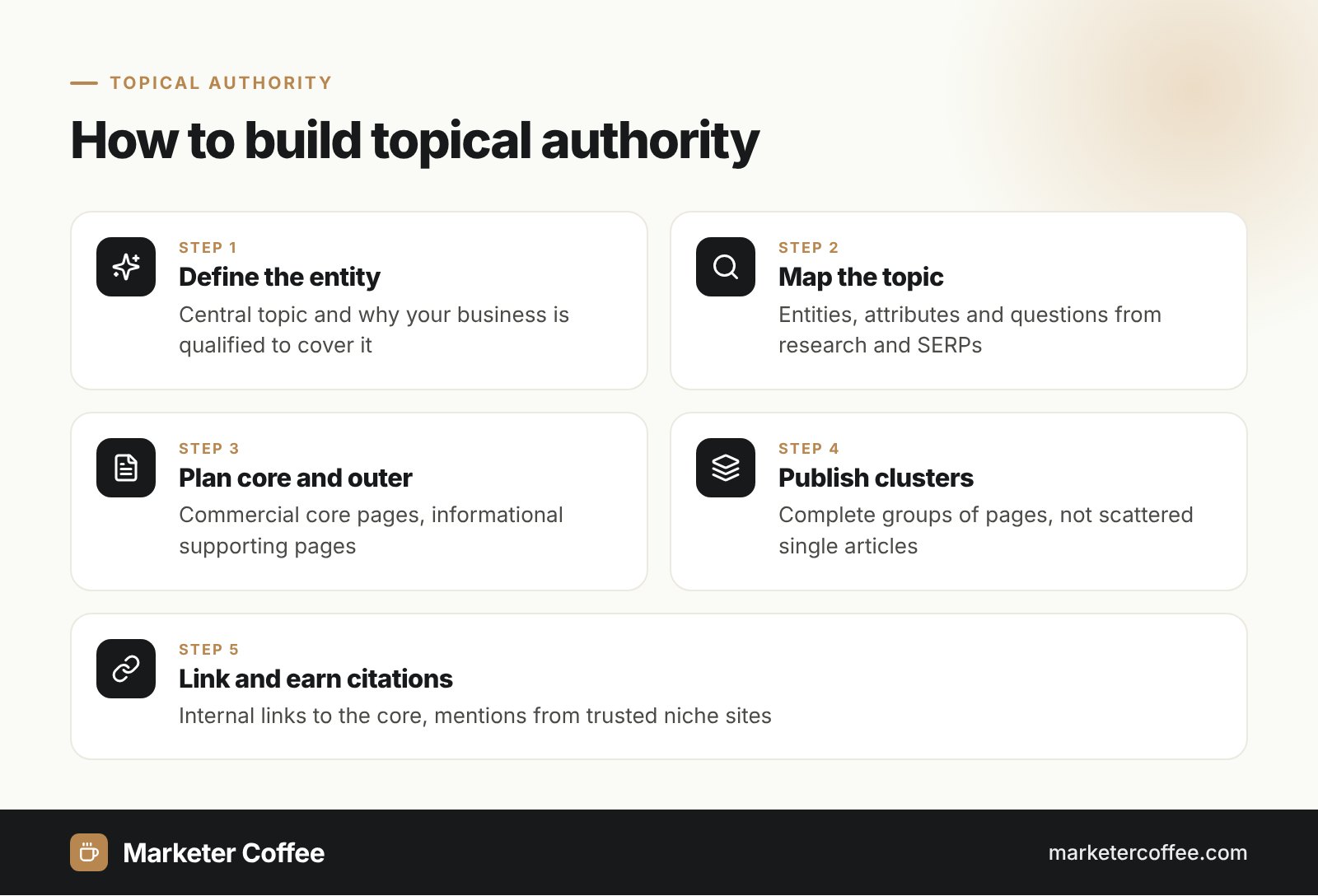
How to build topical authority in 5 steps
Building topical authority is a sequence that moves from defining the topic to publishing and linking a complete cluster:
- Define the central entity and its source context, meaning why your business is qualified to cover it.
- Map entities, attributes and questions with keyword research, SERP analysis and “People also ask”.
- Plan the topical map: core commercial pages first, then supporting informational pages.
- Publish in complete clusters, not single scattered articles, so Google sees coverage quickly.
- Link every supporting page to its core page with descriptive anchor text, and earn citations from trusted sites in your niche.
Topical authority in international SEO and AI search
Topical authority is built per language and per market, because each language version competes in a different SERP with different sources. A Polish shop with deep coverage in Polish does not automatically win in German: translating only a few pages of the cluster leaves the German version thin and isolated. In my expansions into Germany and the Czech Republic I translate and localise full clusters, not just the money pages, and I add local entities such as regional brands, certifications and regulations. The same depth helps in AI search: tools like ChatGPT, Perplexity and Google’s AI Overviews pull answers from sources that cover the follow-up questions, which is the basis of GEO. Mark up authors and the organisation with Schema.org properties such as knowsAbout and sameAs to connect your brand with the topic as an entity.
Read my guide to entity SEO or see how I build topical maps for several markets in my international SEO consultancy.
Frequently asked questions about Topical authority
Is topical authority a Google ranking factor?
Google confirmed a topic authority system for news in May 2023, with signals such as notability, original reporting and reputation. For other content, Google does not name a single topical authority factor, but its helpful content guidance rewards depth and first-hand expertise.
Who created the concept of topical authority?
The idea of topic authority appears in a 2013 Google patent, and SEO specialist Koray Tuğberk Gübür popularised topical authority with topical maps and semantic content networks. Google itself described its news topic authority system in May 2023.
How long does it take to build topical authority?
It usually takes several months, because Google needs to crawl, index and evaluate a full cluster of connected pages. Publishing complete clusters with strong internal linking shortens that time.
What is a topical map?
A topical map is a plan of all entities, attributes and questions a site must cover to own a subject. It divides content into a commercial core section and an informational outer section linked together.
Related terms
- Google launches new topic authority system to better surface news content · Search Engine Land
- Understanding news topic authority · Google Search Central Blog
- Creating helpful, reliable, people-first content · Google Search Central
- Query templates: Expanding the scope of topical authority · Search Engine Land (Koray Tuğberk Gübür)
- How topic authority impacts SEO · Practical Ecommerce
