



How does the Knowledge Graph work?
The Knowledge Graph works by storing entities as nodes and the relationships between them as connections, so Google understands “things, not strings”, in the words of Amit Singhal’s 2012 launch post. When you search for Marie Curie, Google does not match letters: it recognises a person, knows her dates, discoveries and family, and shows them together. The same mechanism disambiguates queries with several meanings, such as Taj Mahal the monument versus Taj Mahal the musician.
History of the Google Knowledge Graph
The Knowledge Graph grew from Google’s 2010 purchase of Metaweb, the company behind the open Freebase database. The table shows the main milestones.
| Year | Milestone |
|---|---|
| 2010 | Google acquires Metaweb and its Freebase entity database |
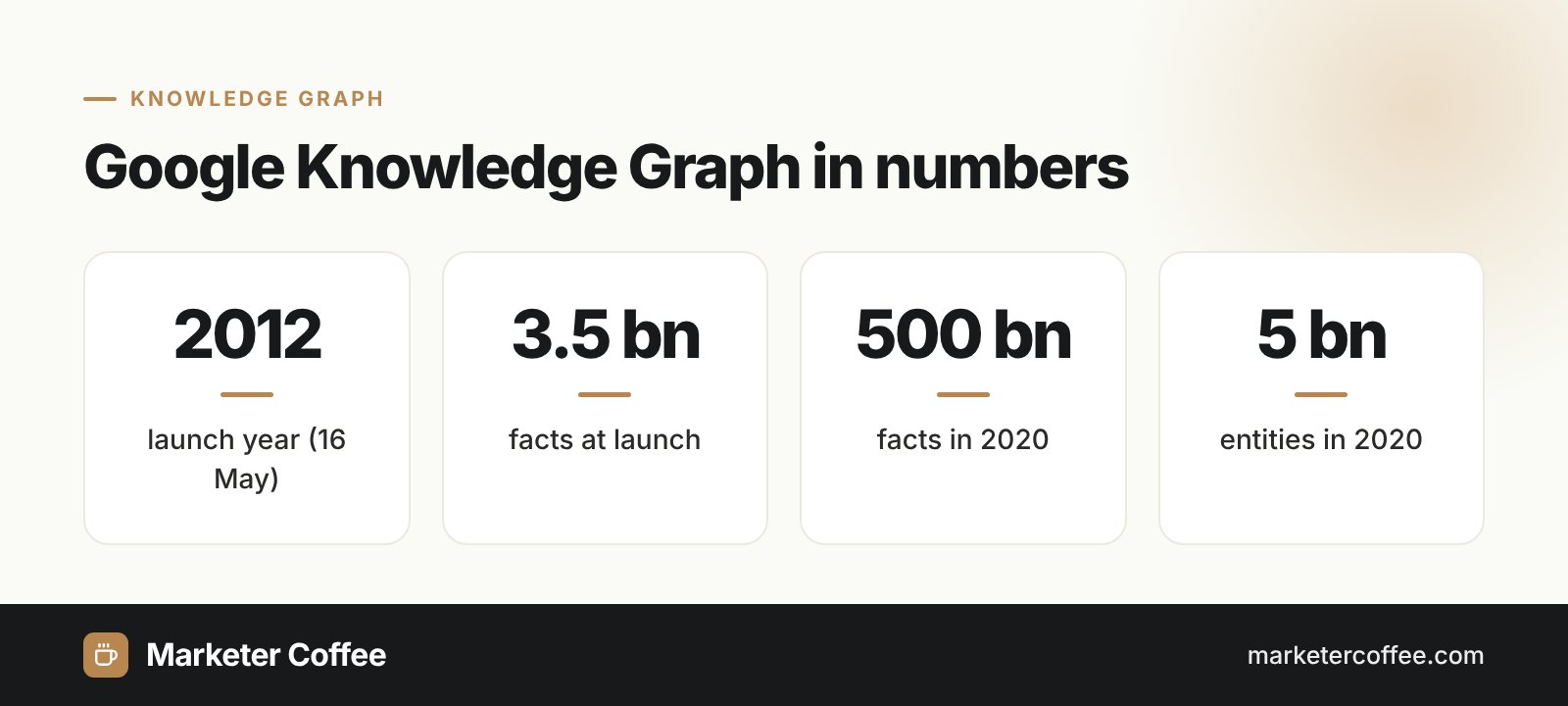
| 2012 | Knowledge Graph launches in US English: 500 million objects, 3.5 billion facts |
| 2020 | Google reports 500 billion facts about 5 billion entities |
| 2025 | AI Mode launches and draws on the Knowledge Graph as a real-time source |
Where does the Knowledge Graph get its data?
The Knowledge Graph gets data from public web sources, licensed databases and structured data that site owners publish. Danny Sullivan’s 2020 explainer names Wikipedia as only one of hundreds of sources, alongside licensed data for sports, music and TV, medical providers for health panels and markup such as event listings.
Knowledge panels
A knowledge panel is the box on the right of desktop results (or near the top on mobile) that summarises one entity. Many panels can be claimed: you sign in to an official profile such as YouTube, Search Console or Facebook, and then suggest changes like a preferred photo.
Google Business Profile
Local businesses with an address or service area manage their facts through Google Business Profile, not through the knowledge panel claim process.
Knowledge Graph Search API
Developers can query entities through the Knowledge Graph Search API, which returns schema.org types in JSON-LD. Google says it is not meant for production-critical use and is moving it to Cloud Enterprise Knowledge Graph.
Knowledge Graph in SEO and AI search
For SEO, the Knowledge Graph is the layer that decides whether Google treats your brand as a known entity or as a string of words. A recognised entity gets a knowledge panel, richer brand SERP features and a stable identity that AI systems reuse. Google’s March 2025 announcement of AI Mode names the Knowledge Graph among its real-time sources, so entity clarity now affects AI Overviews and AI Mode answers, not only classic results.
- Publish Organization markup with name, logo and sameAs links on the home page or about page.
- Keep the brand name, address and description identical across your site, social profiles and directories.
- Earn mentions on authoritative sites that Google already trusts, which also supports E-E-A-T.
- Claim the knowledge panel as soon as the claim option appears.
The international angle
The Knowledge Graph is one graph shared across languages, but panel labels and descriptions are shown per language. In expansions into Germany and the Czech Republic I check that the brand panel shows the local description, that sameAs points to local profiles (for example a German Xing page or a Czech company register entry) and that each market version uses the same Organization entity, not a new one per country.
Read more in my entity SEO guide or see how I work on brand visibility in AI answers in AI SEO (GEO) services.
Frequently asked questions about Knowledge Graph
When was the Google Knowledge Graph launched?
Google launched the Knowledge Graph on 16 May 2012, starting with US English users. At launch it contained more than 500 million objects and 3.5 billion facts.
How big is the Knowledge Graph?
Google reported in May 2020 that the Knowledge Graph holds over 500 billion facts about 5 billion entities. Google has not published a newer official figure.
How do I get a knowledge panel for my brand?
A knowledge panel appears when Google recognises your brand as an entity. Publish Organization structured data with sameAs links, keep your details consistent across the web and earn coverage on trusted sites, then claim the panel when the option appears.
Is the Knowledge Graph the same as Wikipedia?
No. Wikipedia is only one of hundreds of sources the Knowledge Graph uses, next to licensed databases, public web pages and structured data from site owners.
Related terms
- Introducing the Knowledge Graph: things, not strings · Google
- A reintroduction to our Knowledge Graph and knowledge panels · Google
- Knowledge Graph Search API · Google for Developers
- Organization structured data · Google Search Central
- Get verified on Google · Google Search Help
- Google Acquires Metaweb To Make Search Smarter · TechCrunch
