



What does search intent mean in SEO?
In SEO, search intent means the type of answer a page must give to satisfy the query, regardless of how well it uses the keyword. A page optimized for “running shoes” that is a blog essay will not rank when Google shows product listings for that phrase, because the dominant intent is to buy. Matching intent comes before every other on-page factor.
4 types of search intent
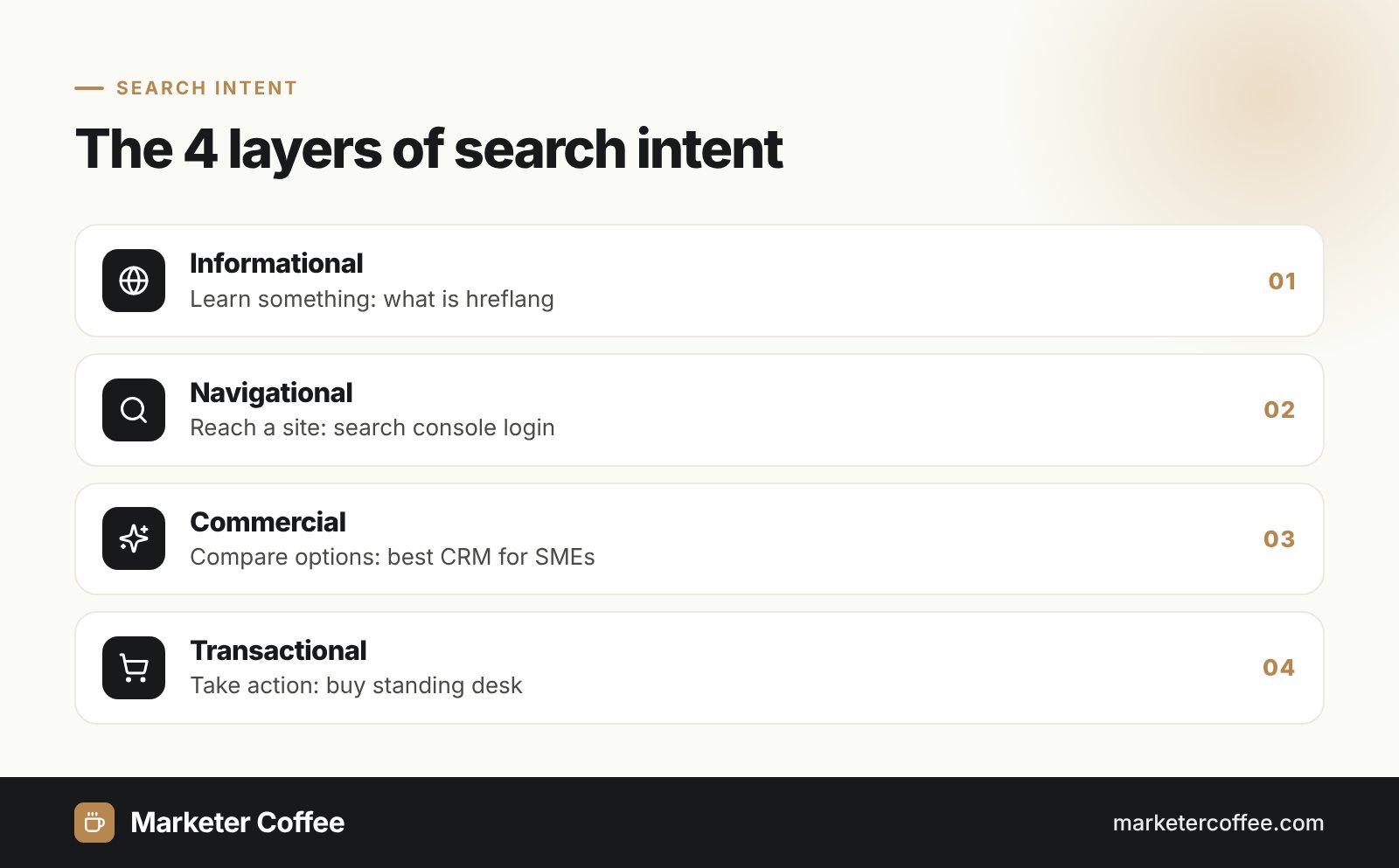
Most SEO tools, including Semrush, sort queries into 4 intent types: informational, navigational, commercial and transactional. Broder’s original 2002 taxonomy had 3 types; commercial investigation was added later by the industry. The layers below run from early research to purchase.
Informational intent
The user wants knowledge: “what is hreflang”, “how to set up GA4”. Pages that win are guides, definitions and how-tos, often with a featured snippet or an AI Overview on the results page.
Navigational intent
The user wants a specific site or page: “allegro”, “search console login”. Only the brand’s own pages realistically rank here.
Commercial intent
The user compares options before a purchase: “best CRM for small business”, “Shopify vs WooCommerce”. Comparisons, rankings and reviews win.
Transactional intent
The user is ready to act: “buy iPhone 17”, “SEO audit price”. Product, category, pricing and contact pages win.
| Intent | Example query | Best page type |
|---|---|---|
| Informational | what is crawl budget | Guide, glossary entry |
| Navigational | semrush login | Brand page |
| Commercial | best SEO tools 2026 | Comparison, ranking |
| Transactional | buy standing desk | Product or category page |
How Google describes search intent
Google’s rater guidelines use their own intent labels: Know (and Know Simple), Do, Website and Visit-in-Person. They also separate queries with several meanings into dominant, common and minor interpretations, and they rate each result on a Needs Met scale from Fully Meets to Fails to Meet. Raters must judge results from the point of view of users in their own locale, which is why the same keyword can carry a different intent in Poland and in Germany.
How to identify search intent
The fastest way to identify intent is to search the keyword and study what already ranks. Google has already tested which pages satisfy users, so the SERP is the best evidence:
- Search the keyword in the target country and language.
- Note the page types in the top 10: guides, categories, products or comparisons.
- Check SERP features: shopping ads, local pack, video, People Also Ask, AI Overview.
- Compare titles and formats for repeated patterns.
- Choose the page type that matches the majority, then make it better.
Group keywords with the same intent onto one URL during keyword research. Two pages targeting the same intent compete with each other, which leads to keyword cannibalization.
Search intent in international SEO and AI search
Intent changes between markets even when the keyword is translated correctly. In my projects for Polish companies entering Germany, a phrase that shows blog posts in Poland often shows comparison portals or marketplaces in Germany, so the translated article simply does not fit. Check the local SERP for each language version before you localize content, as part of your multilingual SEO process.
AI search makes intent even more central. Google counts a follow-up question in AI Mode as a new query in Search Console, so one conversation can cover informational, commercial and transactional steps in a row. Pages that answer each step clearly are the ones that get cited.
See how intent shapes my SEO strategy work, or how I adapt it per market in international SEO projects.
Frequently asked questions about Search intent
What are the 4 types of search intent?
The 4 types are informational, navigational, commercial and transactional. They describe whether a user wants to learn, reach a specific site, compare options or take an action such as buying.
Who created the search intent classification?
Andrei Broder published the first classification in 2002 in the paper A taxonomy of web search. He described 3 types: navigational, informational and transactional.
Can a keyword have more than one intent?
Yes. Many queries are mixed, and Google's rater guidelines describe dominant, common and minor interpretations. In that case Google shows several page types on one results page.
How do I check the search intent of a keyword?
Search the keyword in the target market and look at the top 10 results and SERP features. The page types that dominate show which intent Google has identified.
Related terms
- A taxonomy of web search (SIGIR Forum) · Andrei Broder, IBM Research
- Search Quality Rater Guidelines (General Guidelines, September 11, 2025) · Google
- What Is Search Intent? How to Identify It and Optimize for It · Semrush
- Managing multi-regional and multilingual sites · Google Search Central
- AI features and your website: impressions and clicks in Search Console · Google Search Console Help
