



How does structured data work?
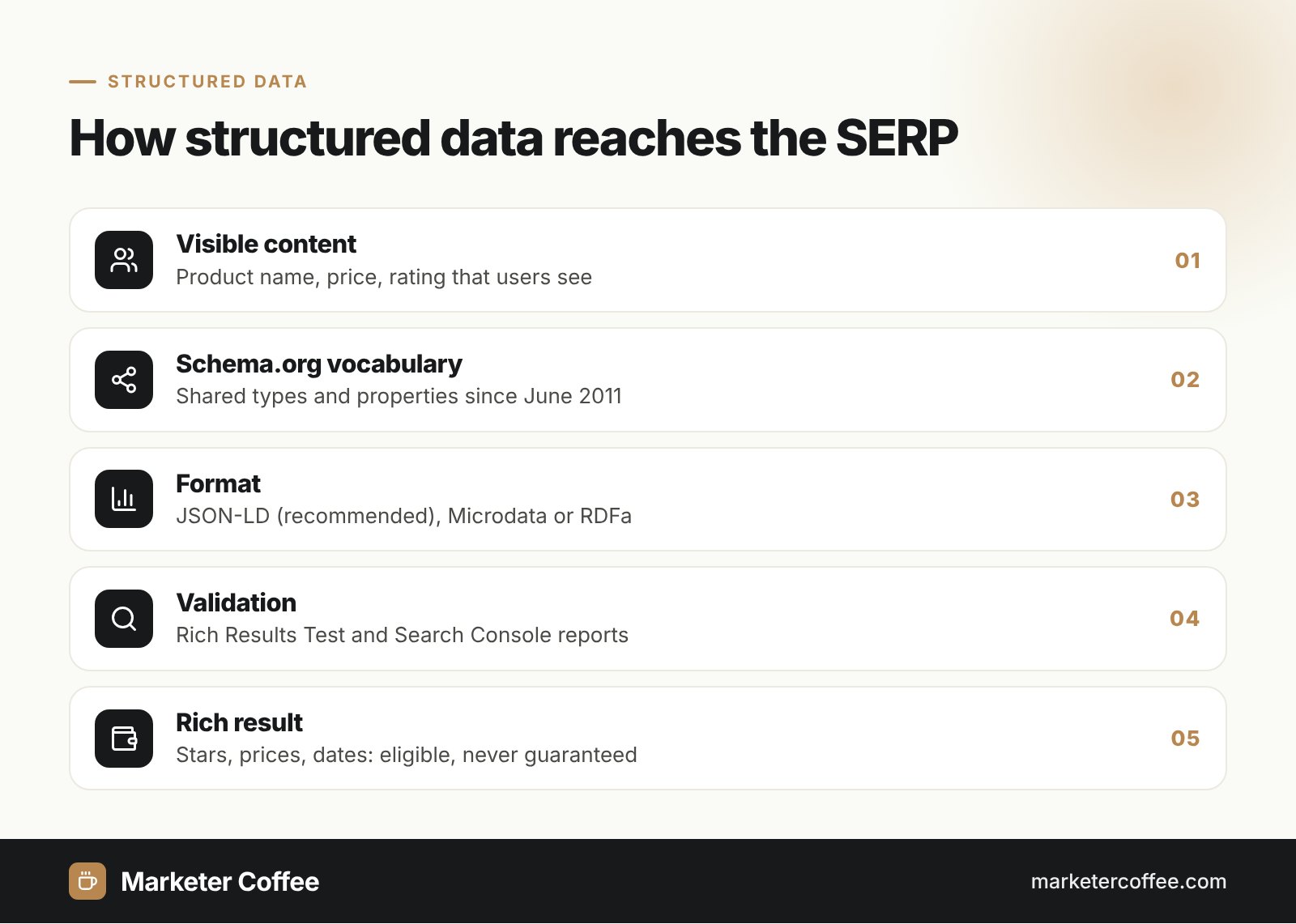
Structured data works by adding labelled facts about the page, built from schema.org types and properties, next to the content people see. A product page can declare its name, price, currency, availability and rating as named fields, so Google does not have to guess them from the layout. Google reads the markup during crawling and indexing, uses it to understand the entities on the page and can turn it into rich results such as review stars, prices or event dates.
A minimal JSON-LD block for a product looks like this and can sit anywhere in the HTML:
- <script type=”application/ld+json”>
- {“@context”: “https://schema.org”, “@type”: “Product”, “name”: “Espresso grinder”, “offers”: {“@type”: “Offer”, “price”: “199.00”, “priceCurrency”: “EUR”}}
- </script>
Structured data formats: JSON-LD, Microdata and RDFa
Google supports 3 formats, and all of them work equally well when the markup is valid. The difference lies in where the data lives and how hard it is to maintain.
| Format | Where it lives | Maintenance |
|---|---|---|
| JSON-LD | Separate script block in head or body | Easiest, recommended by Google |
| Microdata | Attributes on visible HTML tags | Breaks easily when templates change |
| RDFa | Attributes in head and body | Common in older CMS themes |
Google recommends JSON-LD because it is the easiest to implement and maintain at scale, and on new sites it is the only format I deploy.
Schema.org: the vocabulary behind structured data
Schema.org is the shared vocabulary that Google, Bing and Yahoo launched on 2 June 2011, so publishers could describe content once for every search engine. The project site lists Google, Microsoft, Yahoo and Yandex as founders. According to schema.org, more than 45 million web domains used the vocabulary in 2024, and the release current in September 2026 is version 30.1.
Types of structured data that trigger rich results
Google’s search gallery lists 25 supported features, which fall into 3 practical groups for marketers: e-commerce, content and brand, and local or event markup.
E-commerce markup
Product, Review snippet and Breadcrumb show prices, availability, ratings and the category path directly in the result. These are the first types I implement in every online store.
Content and brand markup
Article, Organization, Profile page, Video and Discussion forum describe publishers, authors and media. Organization markup also carries the logo and the official profiles of the brand.
Local and event markup
Local business, Event, Job posting and Recipe serve local services, venues, employers and food publishers.
Google adds and retires features over time, so check the current gallery before you build a project around one rich result type.
Structured data in SEO and AI search
Google presents structured data as a way to earn rich results and help understanding, not as a ranking boost. Its own case studies show the business effect: Rotten Tomatoes measured a 25% higher click-through rate on 100,000 marked-up pages, Food Network saw 35% more visits after enabling search features on 80% of its pages, and Nestlé recorded an 82% higher CTR on pages shown as rich results.
For AI Overviews and AI Mode, Google says no special schema.org markup is required, but it lists structured data that matches the visible text among its best practices. I treat markup as the entity layer of a site: Organization with sameAs links to official profiles helps Google connect the brand to its Knowledge Graph entry, which is the core of entity SEO.
Structured data on multilingual sites
On international sites every language version needs its own markup that mirrors its own visible content:
- Translate names and descriptions in the markup, because Google requires markup to describe what users see.
- Set priceCurrency per market: PLN in Poland, EUR in Germany, CZK in the Czech Republic.
- Keep one Organization @id across all versions, so every market points to the same brand entity.
- Match the url property to the self-referencing canonical of that version and to its hreflang set.
In international SEO audits I often find German or Czech pages still carrying English markup copied from the main store, which sends mixed signals about price and language.
Structured data guidelines and validation
Valid markup makes a page eligible for rich results, but Google does not guarantee them. Markup must describe visible content only, and a structured data manual action removes rich result eligibility without changing web rankings. Test markup with the Rich Results Test, monitor it in the rich result reports of Search Console and confirm detection with the URL Inspection tool.
Need markup that works across several markets? My technical SEO services cover schema design, deployment and monitoring.
Frequently asked questions about Structured data
Is structured data a ranking factor?
Google does not present structured data as a ranking boost. It makes pages eligible for rich results and helps Google understand entities, which can raise click-through rate.
Which structured data format is best?
JSON-LD is the best choice for most sites. Google supports JSON-LD, Microdata and RDFa equally, but recommends JSON-LD because it is easiest to implement and maintain.
Do I need structured data for AI Overviews?
No special markup is required for AI Overviews or AI Mode. Google still lists structured data that matches the visible text among its best practices for these features.
How do I test structured data?
Use Google's Rich Results Test before launch and the rich result reports in Search Console after launch. The URL Inspection tool confirms that Google found the markup on a page.
Related terms
- Introduction to structured data markup in Google Search · Google Search Central
- General structured data guidelines · Google Search Central
- Structured data markup that Google Search supports · Google Search Central
- Introducing schema.org: Search engines come together for a richer web · Google Search Blog
- Schema.org · Schema.org
- AI features and your website · Google Search Central
