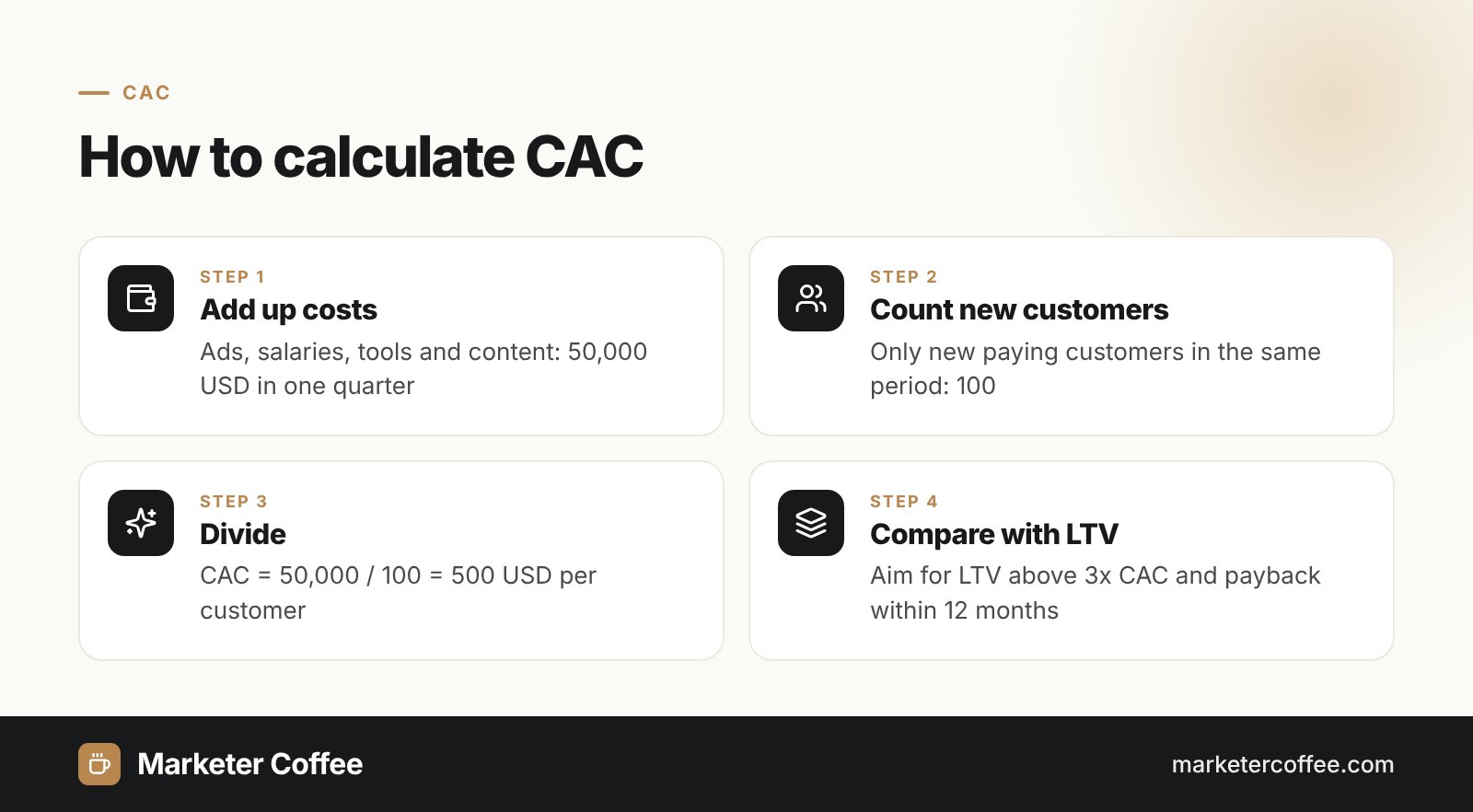
How to calculate CAC: the formula
CAC is calculated as all sales and marketing costs in a period divided by the new customers won in that period.
CAC = (marketing costs + sales costs) / number of new customers
Costs include ad spend, agency and freelancer fees, salaries of the marketing and sales team, software such as CRM and analytics tools, content production and events. HubSpot’s Brad Coffey, quoted by David Skok, sums it up as adding up all marketing and sales expense and dividing by the new customers, with no costs left out. Many teams also track paid CAC (ad spend only), but that figure always looks better than the real one.
CAC example with numbers
CAC is easiest to see on one quarter of a small SaaS business:
- Ad spend (Google Ads, LinkedIn): 15,000 USD
- Marketing and sales salaries: 30,000 USD
- Tools and content: 5,000 USD
- Total cost: 50,000 USD
- New paying customers: 100
CAC = 50,000 / 100 = 500 USD per customer. If each customer pays 100 USD per month at an 80% gross margin, the company needs 500 / 80 = 6.25 months to recover CAC. That sits inside the 5 to 7 months that Skok observes in the best SaaS companies.
CAC benchmarks by industry
Average CAC ranges from under 100 USD in e-commerce to over 1,000 USD in education. The table shows First Page Sage’s B2B figures, based on client data from January 2022 to August 2025.
| Industry | Organic CAC | Paid CAC | Blended CAC |
|---|---|---|---|
| eCommerce | 87 USD | 81 USD | 86 USD |
| B2B SaaS | 205 USD | 341 USD | 239 USD |
| Cybersecurity | 345 USD | 512 USD | 387 USD |
| Financial services | 644 USD | 1,202 USD | 784 USD |
| Education | 862 USD | 1,985 USD | 1,143 USD |
In most industries in this dataset, organic CAC (mainly SEO) is lower than paid CAC (mainly PPC and paid social). For B2B SaaS the paid figure is 66% higher than the organic one.
CAC and LTV: the key ratio
CAC tells you whether growth is profitable only when you compare it with customer value. Two rules from David Skok’s SaaS Metrics 2.0 are standard in board decks:
- Keep the ratio of customer lifetime value to CAC above 3, with the best companies reaching 7 or 8.
- Recover CAC within 12 months, because longer payback makes profitability weak.
Skok himself calls these guidelines, not hard rules, and notes that many healthy start-ups miss them in the early stage. For subscription businesses, MRR per customer and churn drive the LTV side of the equation.
CAC vs CPA, CPL and ROAS
CAC differs from its neighbours because it counts all costs and only paying customers.
| Metric | What it divides | Scope |
|---|---|---|
| CAC | All sales and marketing costs / new customers | Whole company or channel |
| CPA | Ad cost / conversions (purchase, sign-up) | Campaign |
| CPL | Ad cost / leads | Campaign, top of funnel |
| ROAS | Ad revenue / ad cost | Campaign |
Triple Whale’s August 2025 to July 2026 data shows a median CPA of 38.99 USD on Meta ads and 28.14 USD on Google Ads. Real CAC for the same brands is higher, because it adds team, tools and returning-customer conversions do not count.
How SEO and AI search lower CAC
SEO lowers CAC because organic traffic keeps arriving without a cost per click. Paid campaigns stop delivering the day the budget stops, while ranking content and mentions in AI answers keep bringing customers. In my SaaS SEO projects I report blended CAC by channel, so the company sees how organic growth changes what it can afford to pay in PPC.
Frequently asked questions about CAC
How do you calculate customer acquisition cost?
Divide all sales and marketing costs in a period by the number of new customers won in that period. For example, 50,000 USD of costs and 100 new customers give a CAC of 500 USD.
What is a good CAC?
A good CAC is one that customer lifetime value exceeds at least 3 times and that you recover within 12 months. First Page Sage reports an average blended CAC of 239 USD for B2B SaaS and 86 USD for e-commerce.
What is the difference between CAC and CPA?
CPA divides ad cost by any conversion, such as a purchase or sign-up, in one campaign. CAC divides all sales and marketing costs by new paying customers only, so it is almost always higher.
What is the LTV to CAC ratio?
The LTV to CAC ratio compares the value a customer brings over their lifetime with the cost of acquiring them. David Skok recommends a ratio above 3 for healthy SaaS businesses.
Related terms
- SaaS Metrics 2.0: A Guide to Measuring and Improving What Matters · For Entrepreneurs (David Skok)
- Average Customer Acquisition Cost (CAC) By Industry: B2B Edition · First Page Sage
- Facebook Ads Benchmarks · Triple Whale
- Google Ads Benchmarks · Triple Whale