



What is generative engine optimization?
Generative engine optimization is optimization for being included in an AI-written answer, not for a position in a list of ten blue links. A generative engine retrieves several documents, summarises them with a large language model and shows a single response with a few cited sources. GEO aims to make your page one of those sources and to make the model describe your brand accurately.
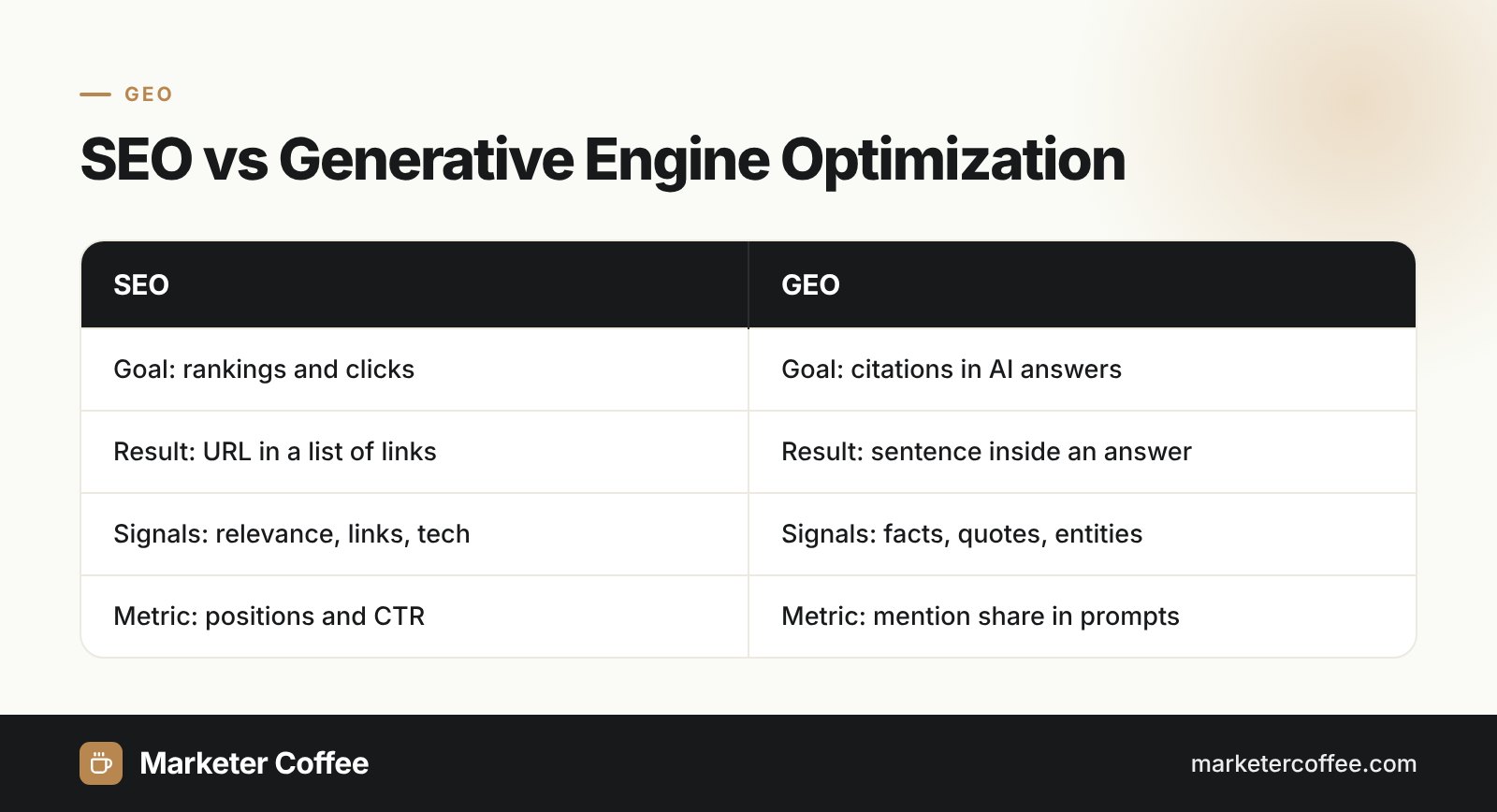
Classic SEO measures rankings and clicks. GEO measures citations, brand mentions and the share of the answer that comes from your content. Both disciplines share the same base, because AI systems still retrieve pages from a search index first.
Where does the term GEO come from?
The term GEO comes from the paper “GEO: Generative Engine Optimization”, published on arXiv in November 2023 by Pranjal Aggarwal (IIT Delhi), Vishvak Murahari, Karthik Narasimhan and Ameet Deshpande (Princeton University), with Tanmay Rajpurohit and Ashwin Kalyan. The paper appeared in the proceedings of ACM SIGKDD 2024.
| Fact | Value |
|---|---|
| First publication | 16 November 2023, arXiv |
| Conference | KDD 2024, Barcelona, 25 to 29 August 2024 |
| Benchmark (GEO-bench) | 10,000 queries from many domains |
| Maximum visibility gain | up to 40% in generative answers |
| Gain on Perplexity.ai | up to 37% |
Which GEO methods work best?
The Princeton and IIT Delhi team tested 9 content changes, and three of them clearly beat the baseline. The authors report that the best methods improve visibility by 41% on their position-adjusted word count metric and by 28% on subjective impression.
Quotation addition
Adding quotations from relevant, credible people gave the largest gain in the study. Language models like to reuse attributed statements because they read as evidence.
Statistics addition
Replacing vague claims with concrete numbers made sources noticeably more visible. A sentence with a figure and a named source is easy for a model to lift into an answer.
Citing sources
Linking to credible references raised visibility as well, especially for factual queries. Keyword stuffing, the old SEO habit, performed below the baseline in the same test.
How does GEO relate to SEO and Google AI features?
GEO builds on SEO, because a page that is not crawled and indexed cannot be retrieved by an AI system. Google Search Central states that a page must be indexed and eligible for a snippet to appear as a supporting link in AI Overviews or Google AI Mode, and that no extra technical requirements exist. Google also explains that both features use query fan-out: they run several related searches across subtopics, so one answer can cite pages that rank for different sub-questions.
Other engines work in a similar way. ChatGPT search and Perplexity retrieve live web results and attach citations, so the same well-structured, factual page can earn mentions in all of them.
| SEO | GEO | |
|---|---|---|
| Goal | ranking and clicks | citations and brand mentions |
| Unit of result | URL in a results list | sentence or source inside an answer |
| Key signals | relevance, links, technical health | facts, quotes, clear entities, retrievable passages |
| Measurement | Search Console, rank trackers | prompt tracking, AI referral traffic, mention share |
How to do GEO in practice
Effective GEO combines a technically sound site with content that a model can quote without rewriting. In my AI SEO projects I focus on these steps:
- Answer each heading in its first sentence, so a single passage stands on its own.
- Add numbers with named sources and dates.
- Describe your brand as an entity consistently across your site, profiles and directories, which is the core of entity SEO.
- Track a fixed set of prompts in ChatGPT, Perplexity and Google every month.
- Publish the content in every market language, because AI engines answer in the user’s language.
If you want this done systematically, my AI SEO and GEO services cover audits, content rewrites and prompt monitoring.
Frequently asked questions about GEO
What does GEO stand for in marketing?
GEO stands for Generative Engine Optimization. It means optimizing content and brand signals so that AI answer engines like ChatGPT, Perplexity and Google AI Overviews cite or mention you. In local marketing, GEO can also mean geographic targeting, so check the context.
Who invented generative engine optimization?
The term was introduced by researchers from Princeton University and IIT Delhi, led by Pranjal Aggarwal, in a paper published on arXiv in November 2023. The paper was presented at the KDD 2024 conference.
Is GEO replacing SEO?
No, GEO extends SEO rather than replacing it. AI engines still retrieve indexed web pages, and Google confirms that pages need to be indexed and snippet-eligible to appear in AI Overviews. Strong SEO is the foundation for GEO.
How do you measure GEO results?
You measure GEO by tracking a fixed list of prompts and recording how often your brand is mentioned or cited. Add AI referral traffic from tools like Google Analytics and compare your mention share with competitors over time.
Related terms
- GEO: Generative Engine Optimization (arXiv 2311.09735) · arXiv / Princeton University, IIT Delhi
- GEO: Generative Engine Optimization (full text, KDD '24) · arXiv
- AI features and your website · Google Search Central
